






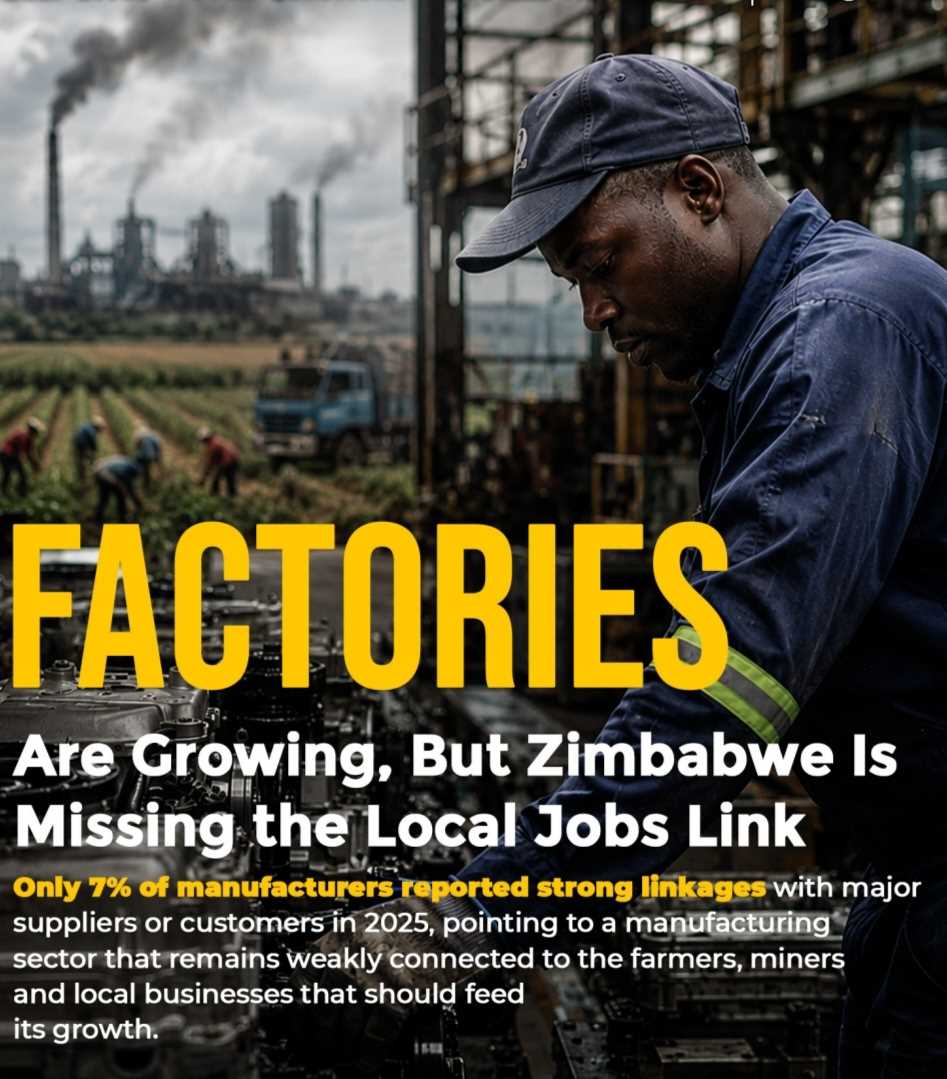
Zimbabwe’s factories may be getting busier, but the benefits are not travelling far enough through the economy.
Only 7% of manufacturers reported strong linkages with major suppliers or customers in 2025, pointing to a manufacturing sector that remains weakly connected to the farmers, miners and local businesses that should feed its growth.
The finding is contained in the 2025 Confederation of Zimbabwe Industries (CZI) Manufacturing Sector Survey, which shows that many manufacturers continue to depend on imported raw materials instead of building stronger local supply chains.
For ordinary households, this is more than an industrial policy problem. Weak local supply chains can mean fewer opportunities for small businesses, fewer jobs along local value chains and less money circulating within communities.
Economist Lazarus Muchabaiwa said Zimbabwe risks having factories that are producing without creating enough value across the wider economy.
“Factories are busier, but they are manufacturing with imported components instead of locally produced components,” Muchabaiwa told Zim Now.
He said more than half of the inputs used by manufacturers are imported, meaning money generated locally is used to pay foreign suppliers.
“We are assembling, not truly making,” he said, arguing that local farms, mines and suppliers often cannot provide raw materials in the quantity or form required by manufacturers.
The CZI survey shows the problem varies across industries. Food products had the strongest local integration at 34%, followed by textiles at 14%. Chemicals and non-metallic mineral products recorded 9%, while furniture and beverages stood at 7%. Wearing apparel, rubber and plastics and fabricated metal products were at 5%.
At the other end, wood products recorded 3%, while repairs and installation of machinery, other manufacturing and paper products each stood at just 1%.
Related Stories
The weak links also affect rural communities. Only 7% of manufacturing output is sold to the rural economy, with low incomes, poor roads, high transport costs, weak distribution networks and informal markets limiting access to manufactured goods.
Food manufacturers sell 34% of their output to rural markets, while textiles account for 14%, showing how some industries are already more connected to rural consumers.
Economist Lucian Kasu described the problem as a “self-reinforcing loop” of import dependence.
Manufacturers sourced 54% of their raw materials from foreign markets in 2025, up from 52% in 2023, while 59% said local alternatives were unavailable or insufficient.
Kasu said this creates continued demand for foreign currency while limiting opportunities for local value addition.
Muchabaiwa also warned that less than 5% of manufactured output is exported, meaning Zimbabwe is using scarce foreign currency to bring in inputs while earning little foreign currency from manufactured exports.
He warned that weak industrial linkages could undermine Zimbabwe’s ambition of reaching upper-middle-income status by 2030.
The CZI report identifies opportunities in horticulture, traditional foods, herbal teas, energy and the informal economy, while the government’s Local Content Strategy seeks to increase local input use from about 30% to 75% by 2035.
Kasu said stronger local suppliers, affordable finance, consistent policies, agro-industrial linkages and mineral beneficiation are needed to close the gap.
He said manufacturers face lending rates of between 40% and 47%, making investment in local production and supplier development difficult.
The CZI findings therefore point to a bigger question: Can Zimbabwe build a stronger economy if its factories remain disconnected from the local businesses and communities that should grow alongside them?








Leave Comments