






Against a backdrop of slowing global growth, persistent inflationary pressures and weakening consumer confidence across major economies, Zimbabwe's consumer sector is showing unexpected resilience, driven by robust household spending, rising disposable incomes in the informal economy, record corporate earnings and improving demand for consumer goods.
While international markets continue to grapple with high interest rates, subdued retail spending and geopolitical uncertainty, Zimbabwe's consumer-facing businesses are benefiting from a unique combination of informal sector liquidity, diaspora remittances and changing consumption patterns that continue to support demand despite domestic economic headwinds.
A new IH Securities 2026 Consumer Report paints a cautiously optimistic picture of Zimbabwe's consumer economy, describing it as one of the few sectors demonstrating sustained growth amid broader macroeconomic challenges.
The report highlights that formal retailers remain under pressure from competition with tuckshops and informal traders, yet consumer spending itself has not weakened.
Instead, it has shifted.
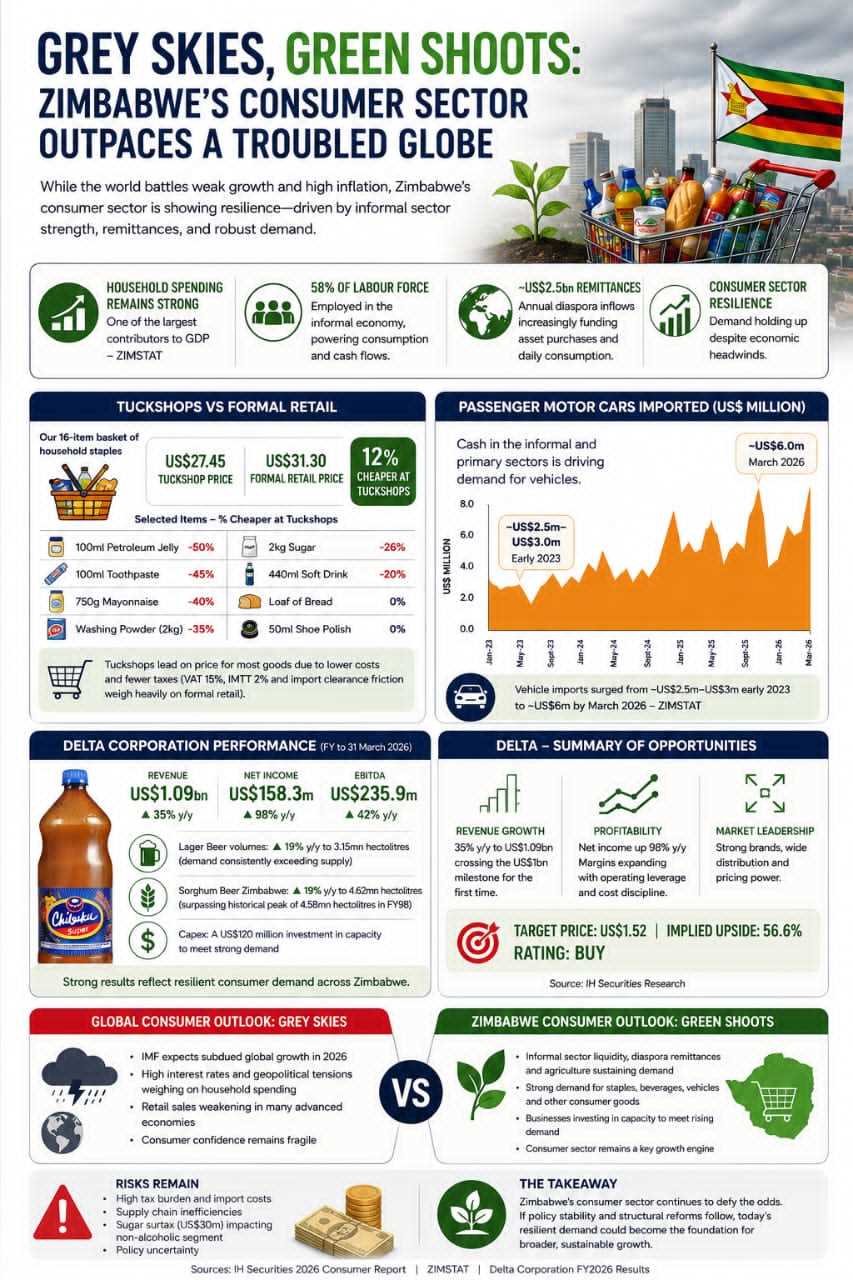
According to the report, a basket of 16 household staple products costs US$31.30 in formal retail outlets compared to US$27.45 in tuckshops, representing a 12 percent price discount in favour of informal retailers.
The price gap is even wider for imported and processed products.
The report states: "The discount is not evenly distributed as tuckshops are materially cheaper on processed and import-heavy items such as 100ml petroleum jelly at -50%, 100ml toothpaste -45%, 750g mayonnaise -40%, washing powder -35%, 2kg sugar -26% and 440ml soft drink -20%."
However, formal retailers retain advantages in certain locally sourced products.
"There is broad parity on loaf of bread and 50ml shoe polish at US$1.00 in both channels. The variance widens on items where VAT of 15%, IMTT of 2% and import-clearance friction weigh most heavily on the formal trader."
Rather than signalling consumer weakness, analysts argue this reflects Zimbabwe's rapidly evolving retail landscape, where purchasing power increasingly flows through informal distribution networks.
The report estimates that 58 percent of Zimbabwe's labour force is employed in the informal economy, allowing tuckshops to remain highly competitive due to lower operating costs.
It concludes: "With informal employment at 58% of the labour force and US dollar cash dominant in everyday transactions, the tuckshop channel will continue to anchor price discovery in basic foods, beverages and household chemicals."
Yet perhaps the strongest indicator of consumer resilience lies beyond groceries.
Vehicle imports have surged dramatically over the past three years.
According to ZIMSTAT trade data cited by IH Securities, monthly passenger motor vehicle imports have increased from roughly US$2.5 million to US$3 million during early 2023 to around US$6 million by March 2026.
IH Securities argues this reflects far more than increased vehicle demand.
"The trajectory is, in our view, a direct read-out of a booming cash economy in the informal and primary sectors, where tuckshop traders, cross-border merchants, artisanal miners and smallholder agriculture have generated sustained US dollar cash surpluses that bypass the formal banking system and surface visibly in vehicle purchases."
The report further notes that this liquidity is reinforced by Zimbabwe's diaspora.
"This cash pool sits alongside the formal 36% of the labour force and the diaspora corridor, where remittance inflows of close to US$2.5bn p.a. are increasingly directed at asset purchases."
Related Stories
The findings appear consistent with broader macroeconomic trends.
According to ZIMSTAT, household final consumption expenditure has remained one of the largest contributors to Zimbabwe's Gross Domestic Product in recent years despite periodic inflationary shocks and currency volatility.
Private consumption has continued supporting economic growth even as manufacturing and mining experience cyclical pressures.
Corporate earnings equally suggest that consumer demand remains robust.
Delta Corporation, Zimbabwe's largest beverages manufacturer, delivered a landmark financial performance during the year ended March 31, 2026.
The company crossed the US$1 billion revenue mark for the first time in its history, with revenues growing 35 percent to US$1.09 billion from US$807.5 million.
Net income almost doubled to US$158.3 million, while EBITDA increased 42 percent to US$235.9 million.
Demand remained exceptionally strong across beverages.
IH Securities notes:
"Lager Beer volumes rose 19% y/y to 3.15mn hectolitres, with demand consistently exceeding supply. Sorghum Beer Zimbabwe surged 19% y/y to 4.62mn hectolitres."
The brokerage believes Delta's decision to commit US$120 million towards expanding production capacity reflects confidence that consumer demand will remain strong.
"The FY27 capex programme of US$120m is a direct and necessary response to Lager demand that has consistently outstripped available supply."
IH Securities has consequently placed a BUY recommendation on Delta shares, assigning a target price of US$1.52, implying an estimated 56.6 percent upside from current market levels.
Despite these positive indicators, the report warns that structural challenges remain.
Formal retailers continue losing market share to informal operators, while tax burdens, import costs and supply chain inefficiencies constrain competitiveness.
Manufacturers also remain heavily dependent on imported raw materials, increasing production costs and exposing businesses to exchange-rate fluctuations.
The report further highlights policy risks, particularly the US$30 million sugar surtax, which continues weighing on Delta's non-alcoholic beverage operations.
Although discussions with tax authorities are ongoing, analysts identify the levy as one of the largest regulatory risks facing the company.
Globally, consumer markets present a markedly different picture.
The International Monetary Fund expects global economic growth to remain subdued in 2026 as tighter financial conditions and geopolitical tensions continue to dampen household spending across advanced economies.
Retail sales in several developed markets have weakened, while consumer confidence remains fragile.








Leave Comments