








Zimbabwe has entered a new phase in its long and complex relationship with the European Union after the bloc removed the last remaining legal framework that allowed it to impose travel bans and asset freezes on Zimbabwean individuals and entities.
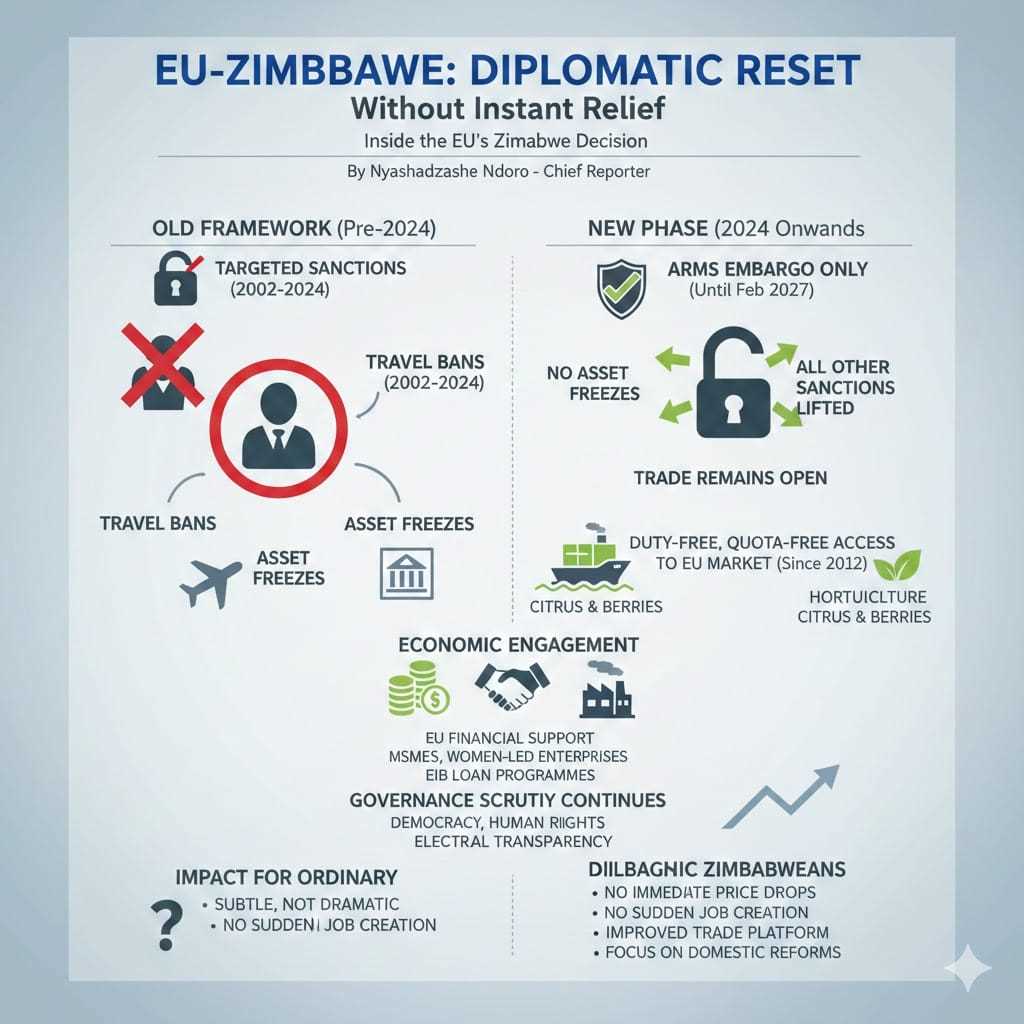
Following its annual review of restrictive measures, the EU decided to maintain only the arms embargo until 20 February 2027, while lifting all provisions related to the possibility of imposing new sanctions. The move effectively ends more than two decades of targeted EU sanctions first introduced in 2002 and later revised in 2011.
The decision means that there are now no EU asset freezes or travel bans in place against Zimbabwean officials or entities. The only remaining measure is the arms embargo, which restricts the supply of military equipment but does not affect trade, banking or civilian economic activity.
For ordinary Zimbabweans, the immediate impact is likely to be subtle rather than dramatic. There were already no EU trade sanctions in place. Since 2012, Zimbabwe has enjoyed duty-free and quota-free access to European markets under the EU–Eastern and Southern Africa interim Economic Partnership Agreement. That arrangement remains intact.
Related Stories
The continued access to a market of 27 EU member states provides stability for Zimbabwe’s export sectors, particularly horticulture. More than 40 percent of Zimbabwe’s horticultural exports, including citrus and berries, are destined for Europe. For farmers and workers in agriculture and agro-processing, the removal of the sanctions framework may improve long-term confidence and contract security, even if it does not immediately translate into higher wages or lower prices.
Beyond trade, the EU has reaffirmed its economic engagement with Zimbabwe through financial support targeting micro, small and medium-sized enterprises. Funding commitments include grant support and lending facilities, as well as loan programmes channelled through the European Investment Bank. If effectively implemented, these facilities could improve access to credit for small businesses, including women-led enterprises, and support expansion in manufacturing and value addition.
While sanctions have been lifted, EU scrutiny of governance issues has not disappeared. In 2023, the EU suspended its contribution to an electoral support project managed by the United Nations Development Programme following concerns raised by election observers about transparency and independence. The bloc has indicated it will continue monitoring developments relating to democracy, human rights and the rule of law.
The removal of the sanctions framework also shifts the political narrative. For years, Zimbabwe’s economic difficulties were frequently linked to EU sanctions. With asset freezes and travel bans now removed, and trade already open, attention may increasingly turn to domestic economic management, investor confidence and structural reforms.
In practical terms, ordinary Zimbabweans should not expect immediate price reductions, currency stability or sudden job creation as a direct result of the EU decision. What the move does provide is diplomatic normalisation, improved international optics and a clearer platform for trade and investment.






Leave Comments