






Delta Corporation Limited says the government’s sugar tax is increasingly distorting Zimbabwe’s soft drinks market, squeezing margins for formal manufacturers while allowing cheaper, unregulated imports to gain ground.
Presenting its half-year results for the period ended September 30, 2025, the beverages manufacturer said volumes in its sparkling beverages unit grew 11 percent, but profitability was constrained by the company’s decision to absorb the sugar tax in order to protect consumers from price shocks.
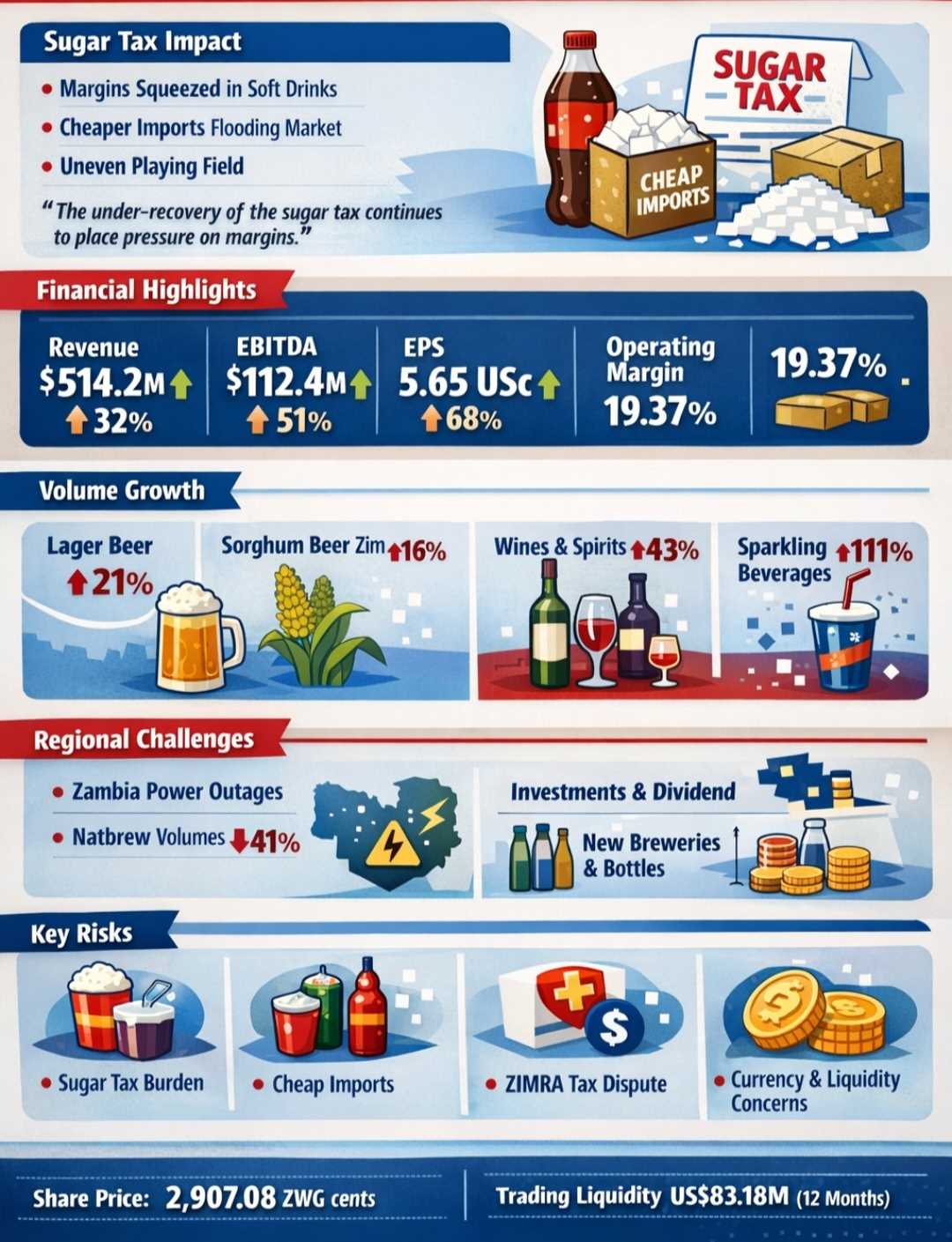
“The under-recovery of the sugar tax continues to place pressure on margins and has created an uneven competitive environment as cheaper imports enter the market,” Delta said, adding that the policy has destabilised the formal soft drinks sector.
Despite the margin pressure, Delta delivered a strong overall performance for the half year, buoyed by rising consumer demand and a more stable operating environment in Zimbabwe.
Group revenue increased 32 percent to US$514.2 million, while EBITDA surged 51 percent to US$112.4 million, lifting the operating margin to 19.37 percent, up from 16.66 percent in the prior period.
Attributable earnings per share climbed 68 percent to 5.65 US cents, reflecting improved operational efficiency and disciplined cost management.
Excluding the consolidation of Schweppes Holdings Africa Limited, which became a subsidiary during the period, revenue still rose a solid 21 percent, underscoring strength in the core business.
Management said the stabilisation of the macroeconomic environment, anchored by a more predictable exchange rate and improved disposable incomes, supported volume recovery across most categories.
“Improved economic stability and better product availability allowed us to recover volumes and strengthen margins across the business,” the company said.
Total beverage volumes grew 11 percent, with particularly strong growth recorded in lager beer, sorghum beer and wines and spirits. Lager beer volumes rose 21 percent, driven by stable pricing and improved supply, while sorghum beer volumes in Zimbabwe recovered 16 percent, supported by increased activity in the agricultural and mining sectors.
African Distillers delivered standout performance, with wines and spirits volumes rising 43 percent, aided by improved market execution and intensified anti-smuggling campaigns.
Related Stories
“Our brands continue to resonate with consumers, and tighter market controls are helping to protect formal trade, particularly in wines and spirits,” Delta said.
However, the group warned that the sugar tax continues to weigh heavily on the sparkling beverages segment, creating competitive distortions and encouraging the inflow of cheaper imports.
“Absorbing the sugar tax has helped maintain affordability, but it is not sustainable in the long term without addressing the growing presence of unregulated imports,” management said.
Beyond Zimbabwe, Delta’s regional operations faced challenges, particularly in Zambia, where prolonged power outages disrupted production. Sorghum beer volumes at Natbrew declined 41 percent during the period.
“Power supply disruptions in Zambia had a material impact on operations, and restoring stability in that market remains a key priority,” the company said.
To meet firm consumer demand and close supply gaps, Delta is pressing ahead with major capital investments, including the replacement of the brewhouse at Belmont Brewery, upgrades at Southerton Brewery, and the injection of new glass bottles for both lager and sparkling beverages.
“We are investing deliberately in capacity to defend market share, improve efficiency and ensure long-term sustainability,” management said.
Despite the strong performance, Delta flagged several headwinds, including an unresolved dispute with the Zimbabwe Revenue Authority over foreign currency tax assessments, persistent liquidity constraints in the economy, and exposure to global commodity price volatility.
Even so, the board struck a confident tone, declaring an interim dividend of 2.00 US cents per share, a 100 percent increase on the prior year, reflecting improved cash generation and balance sheet strength.
“This dividend declaration underscores our confidence in the business and our commitment to delivering value to shareholders,” the company said.
Delta said its focus for the remainder of FY26 will be on prudent capital allocation, generating positive cash flows to fund ongoing investments, and continued engagement with authorities to minimise the impact of tax and policy changes on the formal manufacturing sector.
As of 3 February 2026, Delta Corporation shares were trading at 2,907.08 ZWG cents, with the counter remaining one of the most actively traded on the Zimbabwe Stock Exchange.








Leave Comments