






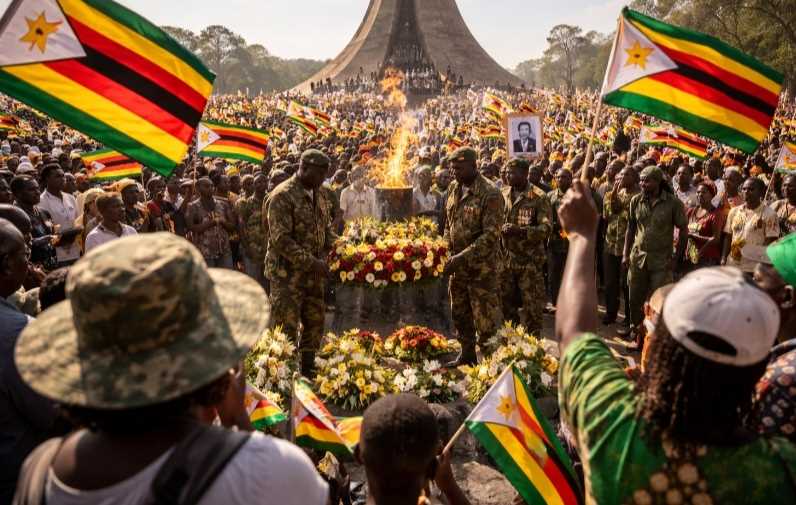
In Zimbabwean politics, the liberation struggle occupies a sacred place. It is the moral foundation of the state, the origin story of independence, and a history written in sacrifice. Its legitimacy is not in question.
Yet, more than four decades after independence, a quiet transformation has taken place: the liberation struggle has shifted from historical memory into a renewable political resource, repeatedly drawn upon to sustain authority in the present.
Liberation credentials are routinely invoked as proof of political legitimacy. They validate leadership, frame dissent as disrespect, and recast contemporary political competition as an attack on history itself. In this framing, criticism is no longer just disagreement; it becomes ingratitude, betrayal, or alignment with hostile external forces.
The emotional power of the liberation narrative explains its political utility. It carries pain, pride, and identity. When economic pressures mount or public frustration rises, the language of the struggle reliably resurfaces—in speeches, commemorations, and moments of national address.
The past is summoned to explain the present. Structural failures are reframed as unfinished battles. Accountability is deferred in the name of historical loyalty.
What emerges is a subtle substitution. Liberation memory begins to stand in for governance performance. Roads, hospitals, schools, and employment outcomes recede as measures of leadership effectiveness. Instead, legitimacy is inherited from history and reaffirmed through ritual invocation. Authority becomes something preserved rather than earned.
This is why the liberation struggle functions as a renewable resource. Unlike economic capital, it does not deplete through use. But its moral force weakens through overuse. The more it is deployed to shield power from scrutiny, the less it unites. What once mobilized a nation increasingly divides it along generational lines.
Related Stories
For younger Zimbabweans—many born long after independence—the struggle is not lived memory but inherited narrative. When it is repeatedly used to dismiss their economic realities or political aspirations, it begins to feel less like shared heritage and more like a political constraint. The risk is not historical amnesia, but quiet alienation.
The danger lies in weaponizing remembrance. When liberation history is treated as exclusive political capital rather than collective inheritance, democratic space narrows. Those without struggle credentials are portrayed as less authentic, less patriotic, and less entitled to lead. Politics hardens. Debate thins.
There is a deeper contradiction at work. Liberation movements fought against unaccountable power, silencing, and imposed authority. Yet, when liberation history is used to justify intolerance of criticism or the permanent occupation of power by a political elite, it undermines the very values the struggle claimed to advance.
A mature post-liberation state must eventually make a transition—from foundational legitimacy to performance legitimacy. History explains how authority was first acquired; it does not permanently justify how it is exercised. Independence was not an endpoint. It was the beginning of responsibility.
Honoring the liberation struggle does not require freezing politics in the past. It requires translating sacrifice into institutions that function, services that work, and leadership that is accountable. True respect for history lies not in repeated invocation, but in outcomes that reflect its ideals.
As long as liberation memory is treated as an endlessly refillable political well, Zimbabwe risks exhausting not the history itself, but public faith in it. And when a founding story loses its unifying power, it does not disappear—it returns as resentment.
The challenge, then, is not to abandon the liberation narrative, but to release it from political overuse. Let it remain history that teaches, not rhetoric that substitutes. Legitimacy, like independence itself, must ultimately live in the present.
Simbarashe Namusi is a peace, leadership, and governance scholar, as well as a media expert, writing in his personal capacity.





Leave Comments