





0pnion by OMALLI JANI
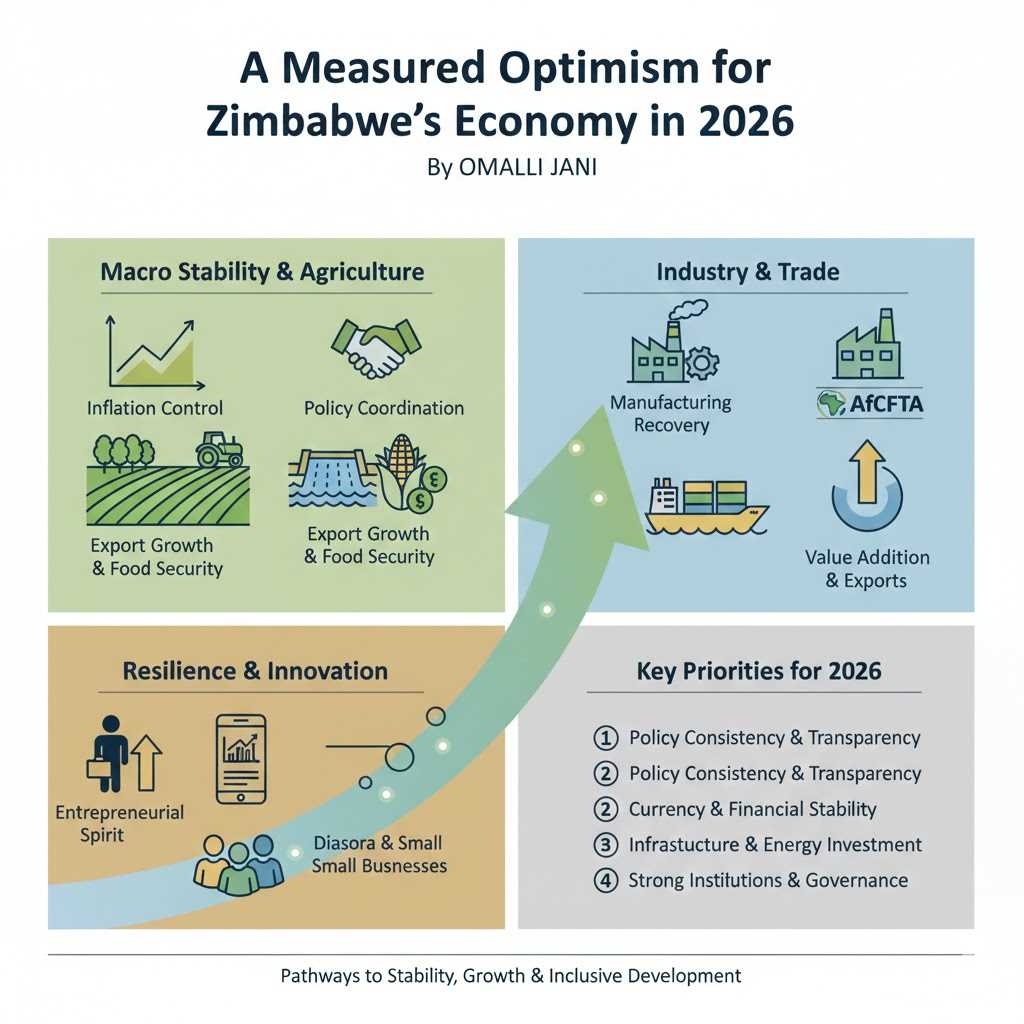
As Zimbabwe enters 2026, the country stands at a defining moment in its economic journey. After years marked by instability, inflationary pressures and constrained growth, there are now visible signs that the economy can stabilise and progress. While challenges remain, emerging policy discipline and sectoral resilience provide a basis for cautious optimism. With consistency and strategic execution, 2026 can become a year of consolidation and renewed confidence.
One of the most positive developments has been improved macroeconomic coordination. Greater alignment between fiscal and monetary authorities has helped curb extreme volatility and restore predictability. Although inflation risks persist, improved control of money supply and public expenditure has supported relative price stability. This predictability is vital for business planning, investment decisions and the rebuilding of confidence.
The productive sectors continue to anchor recovery prospects. Agriculture remains the backbone of the economy, supported by contract farming, irrigation expansion and climate-smart practices. Improved food security and export-oriented agriculture contribute directly to foreign currency inflows and rural livelihoods. Mining also remains a key growth driver, particularly in gold, lithium and platinum group metals. As global demand for critical minerals increases, Zimbabwe’s resource endowment presents a strategic advantage that must be managed responsibly.
Manufacturing, though still operating below optimal capacity, is gradually recovering. Import substitution, local procurement initiatives and regional trade opportunities have stimulated renewed industrial activity. A stronger manufacturing base has the potential to create employment, support value chains and reduce reliance on imports, provided that energy supply and infrastructure constraints are addressed.
Regional integration presents further opportunity. Zimbabwe’s participation in SADC and the African Continental Free Trade Area offers access to wider markets and economies of scale. By improving standards, logistics and competitiveness, local firms can expand beyond national borders and strengthen export performance. Regional trade should be viewed as a catalyst for industrial growth.
Equally important is the resilience of Zimbabweans themselves. The private sector, small businesses and the diaspora have demonstrated remarkable adaptability. Digital platforms, fintech solutions and informal enterprise activity have sustained livelihoods under difficult conditions. Harnessing this entrepreneurial energy through supportive policies and access to finance can significantly broaden economic participation.
Related Stories
To secure a positive 2026, several priorities must be pursued. Policy consistency is essential. Abrupt regulatory changes undermine confidence and deter investment. Clear, predictable and transparent policies will encourage long-term capital formation.
Currency and financial market stability must remain a central focus. Disciplined money supply management and transparent exchange rate mechanisms are critical to sustaining confidence and controlling inflation.
Support for the private sector and small businesses should be strengthened through simplified licensing, reduced compliance costs and affordable financing. This will unlock job creation and innovation.
Investment in infrastructure and energy is non-negotiable. Reliable electricity, transport networks and digital connectivity underpin productivity and competitiveness. Public-private partnerships should be leveraged to close infrastructure gaps.
Value addition must be prioritised across agriculture and mining. Exporting processed goods rather than raw materials will enhance foreign currency earnings and industrial depth.
Finally, strong institutions and good governance remain fundamental. Efficient public service delivery, accountability and a firm stance against corruption will improve the ease of doing business and national credibility.
Zimbabwe’s outlook in 2026 does not have to be defined by past difficulties. With discipline, collaboration and steady implementation of reforms, the economy can transition towards stability, growth and inclusive development for all.
Omalli Jani is a Executive and Board level Professional with over twenty five years of experience in strategic management , corporate governance and information technology enabled transformation across Zimbabwe and SADAC region. His Academic background includes a Master of Management in Digital Business from Wits Business School, Global MBA from University of Milan and ongoing Doctoral Studies in Management ,Technology and Innovation from Davinci Business School.







Leave Comments