





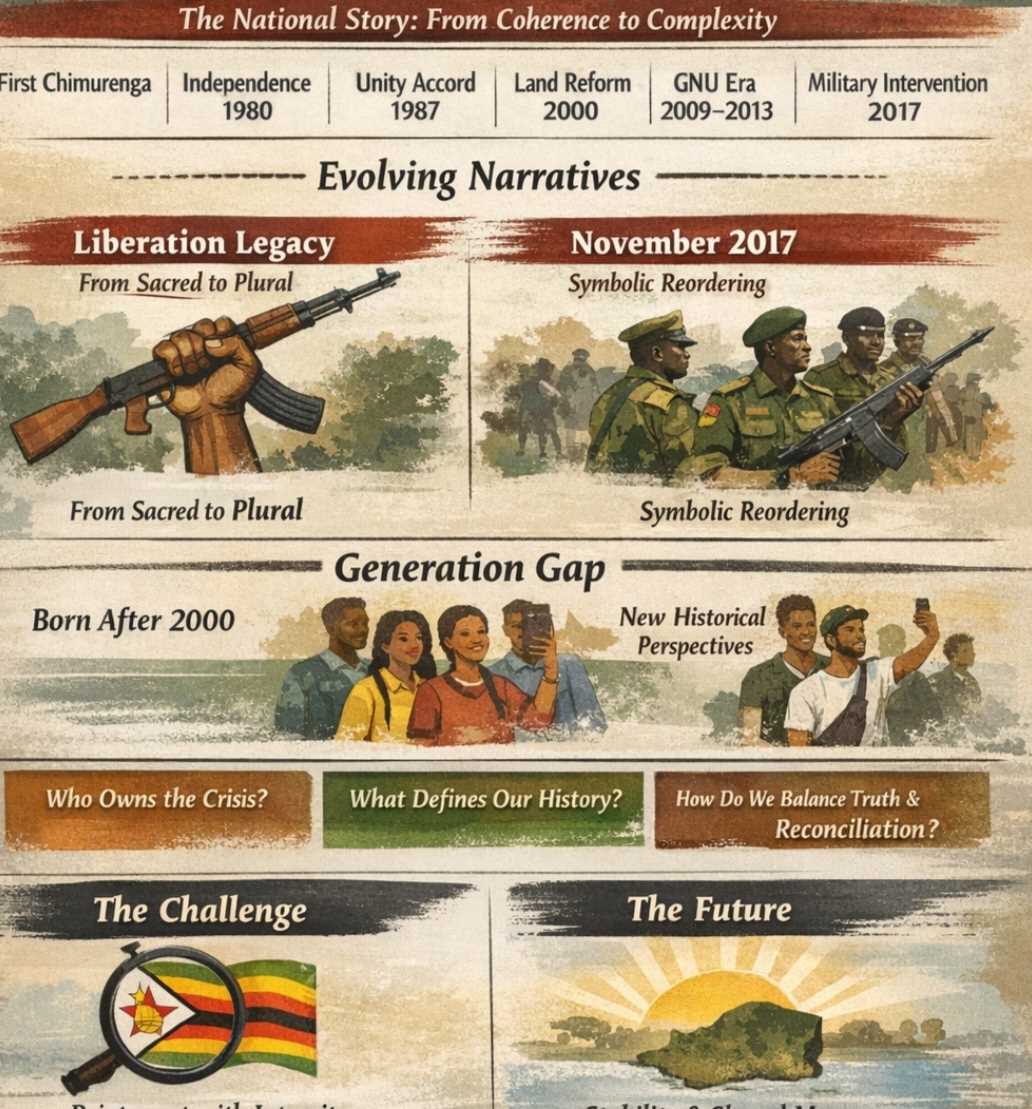
For decades, Zimbabwe’s national story followed a clear arc.
It began with the First Chimurenga, moved through the liberation struggle of the 1960s and 1970s, culminated in Independence on 18 April 1980, and found political consolidation in the Unity Accord of 22 December 1987.
The Fast Track Land Reform Programme, launched in 2000, was framed as the unfinished business of decolonisation—a correction of colonial land dispossession.
One could debate the interpretations embedded in that storyline. But the narrative itself was coherent. Linear. Anchored.
As Zimbabwe approaches fifty years of Independence in 2030, that coherence feels less settled.
Over roughly the past fifteen years, the country has experienced subtle but consequential shifts in how its recent history is framed. Nations naturally reinterpret their past as political contexts evolve. What makes Zimbabwe’s case distinctive is the speed of recalibration and the proximity of many key actors to the events now being reinterpreted.
The Government of National Unity (2009–2013) marked an inflection point. For the first time since 1980, competing political explanations coexisted within government itself. The economic crisis of the 2000s—including hyperinflation that peaked in 2008—was interpreted differently by coalition partners.
Land reform, sanctions, governance failures, and global financial pressures were weighted according to political vantage point.
The liberation narrative was not dismantled. But it ceased to be singular inside the state. Pluralism entered official discourse.
The events of November 2017—the Zimbabwe military intervention—marked a deeper structural shift. The military-assisted transition that ended the 37-year tenure of Robert Mugabe did more than change leadership; it subtly reordered the symbolic hierarchy of the post-Independence era.
Figures once presented as permanent pillars of the liberation-to-state continuum were reassessed. Some retained prominence, while others receded from central celebration. Public commemorations and official rhetoric adjusted tone and emphasis.
The liberation struggle remained the primary source of political legitimacy, but its internal distribution of symbolic weight shifted.
Related Stories
This was not abandonment. It was editing. But editing changes meaning.
Zimbabwe has revised its national story before. The Unity Accord reframed the violence of 1983–1987 as a chapter resolved through reconciliation. Land reform reframed colonial property relations and re-centred sovereignty in economic terms. Yet those revisions occurred within a relatively stable ideological framework. The liberation struggle remained the uncontested anchor.
In the past fifteen years, reinterpretation has coincided with rapid political realignments. Alliances have shifted. Roles have been reassigned. Individuals who once spoke with one historical voice now speak with another. For a demographically young country, this carries implications.
A significant portion of Zimbabwe’s population was born after 2000. Many have no lived memory of the liberation war, the early 1980s, or even the political transitions of the 1990s. Their understanding of national history is mediated through school curricula, family memory, digital platforms, and contemporary political messaging.
When interpretations shift within a compressed time span, generational transmission becomes complicated. Was the crisis of the 2000s externally driven, internally generated, or structurally inherited? Who bears responsibility for key turning points? Which events define national character?
These are not abstract debates. They shape civic identity and institutional trust.
No nation requires uniform agreement about its past. Debate is healthy. Democratic societies thrive on contestation. But a baseline of shared chronology and acknowledged fact is essential for legitimacy. If historical roles become entirely fluid, public confidence in institutions can weaken. If responsibility is endlessly redistributed without clarity, accountability becomes abstract.
Consistency does not mean rigidity. It means preserving enough continuity in the national story for citizens to orient themselves within it.
Zimbabwe’s challenge is not whether to reinterpret history. Reinterpretation is inevitable. The challenge is whether it is done deliberately, transparently, and with intellectual integrity.
As 2030 approaches, Zimbabwe faces an opportunity for reflective recalibration rather than reactive reframing. What elements of the national narrative are foundational and non-negotiable? Which aspects require fuller acknowledgement? How can complexity be integrated without destabilising collective memory?
Narratives rarely unravel dramatically. They shift gradually through tone changes, selective emphasis, and the repositioning of actors within the national script. Over time, those adjustments accumulate.
History is not merely about preserving the past. It underwrites legitimacy in the present and confidence in the future.
The question is not who owns Zimbabwe’s past. It is whether the nation can sustain a version of it stable enough to carry it forward at fifty and beyond.
Simbarashe Namusi is a peace, leadership, and governance scholar as well as a media expert writing in his personal capacity.




Leave Comments