




The shock was not in the request itself. Schools have long gone without computers. Alumni have always stepped in where government fails. But when ICT Minister Tatenda Mavetera urged Zimbabweans to donate laptops to their former schools, with government only supplementing, she opened a window into a bigger national question: Who is really funding Zimbabwe’s development,, the taxpayer, or the taxpayer again?
Her message, wrapped in the slogan “The country is built by its owners, the school is built by its owners,” lands differently in a nation where citizens who are expected to rally to this call are the ones who already pay taxes, levies, tolls, ZIMRA duties, and still crowd-fund ambulances, surgeries, boreholes and classroom blocks. It came across not as partnership, but as state abdication.
The Outrage: Laptops vs Land Cruisers
Fadzai Mahere’s critique touched the exposed nerve: “How many laptops could you buy with the money used to import ministerial cars? Why is there never a shortage of funds for luxury, only for hospitals, wheelchairs and school computers?”
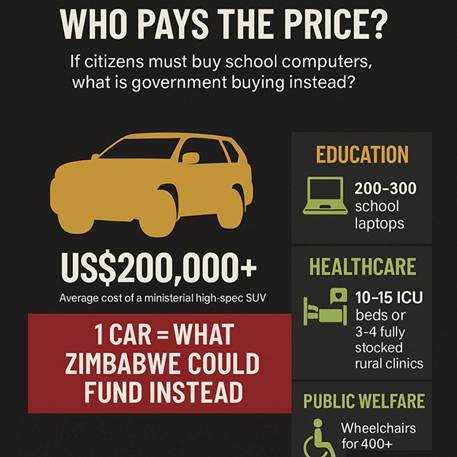
It is a question Zimbabweans know too well. A nation whose ministers cruise in US$200 000+ SUVs while clinics reuse gloves and children learn on dust floors inevitably raises suspicion. It isn’t that the state lacks money, the public increasingly believes it chooses how not to spend it on them.
The Elite Bubble: Privilege as Policy
From duty-free vehicle rebates under SI 124 of 2022, to inflated allowances that dwarf official salaries, Zimbabwe has engineered a political class financially insulated from the misery of the majority. Luxury is not an exception, it is line-item policy.
Sbusiso Mokoena framed it bluntly: “The government has normalised citizens making their own plans while treating tax revenue as private wealth as though they are a dynasty, and we are tribute payers.”
Related Stories
Moses Chebundo sharpened the contrast further: “to the average Zimbabwean, a top-range car is a 25-year mortgage. To a minister, it is a toy. Even worse, these toys are often driven to foreign summits where leaders arrive in modest sedans while Zimbabwe pleads for aid.”
There is symbolism there and Zimbabweans are reading it loudly.
When Luxury Becomes More Urgent Than Livelihood
Budget choices tell the story better than any speech:
One luxury vehicle vs 100–200 laptops +10 ICU beds + months of rural medicine +accessible ICT for thousands of learners.
Brine Chipfukuto’s frustration echoed across timelines:“When asked to help hospitals or the disabled, they cite sanctions, but for luxury, the purse is open. This is not poverty. It is priority.”
And so, Minister Mavetera’s laptop appeal became more than a policy suggestion, it became a national mirror. A reminder that leadership is not only about what is spent, but what is not.
The Real Debate: Who Builds Zimbabwe?
If alumni fund schools, diaspora buys dialysis machines, communities drill their own boreholes, and citizens crowdfund social services. While government is funding Tungwarara NOT TO install boreholes but instead introduce companies to suck more money out of the economy splash it on mansions in SA.
Zimbabweans are not rejecting partnership. They are rejecting being turned into taxpayers by law and donors by necessity. Until the day a budget prioritises a child’s computer over a minister’s convoy, or a tender that is just a funnel to loot the state, trust will remain thinner than the rural clinic oxygen tank, and citizens will continue asking whether their development is being traded for someone else’s leather-seated comfort.





Leave Comments