









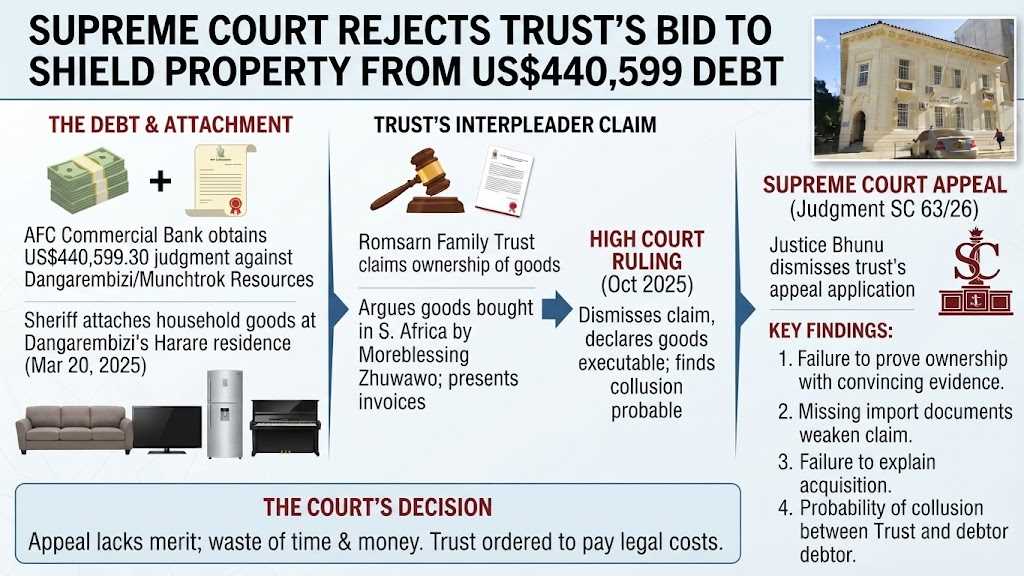
The Supreme Court has dismissed an application by the trustees of the Romsarn Family Trust seeking to appeal a High Court ruling allowing household property attached at a Harare residence to be sold to recover a US$440,599.30 debt owed to AFC Commercial Bank.
In judgment SC 63/26, Justice Chinembiri Bhunu ruled that the trust had virtually no prospects of success on appeal because it had failed to provide convincing evidence that it owned the disputed property.
The court ordered the trust to pay the costs of the proceedings after dismissing its application for condonation of non-compliance with court rules and an extension of time to file and serve a notice of appeal.
The dispute arose after AFC Commercial Bank obtained a judgment on March 9, 2025, against Munchtrok Resources (Private) Limited and Rodney Ndangariro Dangarembizi for US$440,599.30, with interest accruing at 19 percent, capitalised monthly, from June 6, 2024, until final payment.
To recover the debt, the Sheriff of Zimbabwe attached movable property at Number 4 Springfield Close, Chisipiti, Harare, on March 20, 2025, in the presence of Dangarembizi.
The goods included dining suites, televisions, deep freezers, a refrigerator, a washing machine, a piano, a microwave, speakers and other household items.
The trust claimed the property belonged to it, arguing that it had purchased the goods in South Africa through an intermediary, Moreblessing Zhuwawo. It relied on invoices to support its ownership claim.
However, AFC Commercial Bank argued that the goods belonged to Dangarembizi because they were found at his residence and in his possession. The bank also alleged collusion between the trust and the judgment debtor to defeat the execution of the court order.
In October 2025, the High Court dismissed the trust’s interpleader claim, ruling that it had failed to prove ownership of the property on a balance of probabilities. It declared the goods executable and ordered the trust to pay storage, attachment and legal costs.
The trust subsequently sought to appeal but its intended appeal was deemed abandoned after its legal practitioners failed to serve the notice of appeal on the registrar of the court that issued the original judgment, as required by the Supreme Court Rules.
Related Stories
Missing import documents weaken claim
In considering the application, the Supreme Court accepted that the procedural failure resulted from an oversight by the trust’s legal practitioners, who had pleaded ignorance of procedures governing the Integrated Electronic Case Management System.
Justice Bhunu criticised the lawyers’ failure to familiarise themselves with court procedures but said he was reluctant to punish the client for the mistakes of its legal representatives.
He accepted the explanation for the delay but found that the trust’s ownership claim lacked merit.
The trust’s sole witness, Tonderai Sarari, could not explain how the goods had been brought into Zimbabwe and admitted that he did not know how the trust had acquired the property, beyond saying Zhuwawo handled the logistics.
Sarari also acknowledged that he had no receipts for goods he claimed to have purchased in Zimbabwe as part of the business relationship.
The court rejected the trust’s criticism of the High Court’s reliance on Section 39(1)(a) of the Customs and Excise Act, which requires importers to declare goods at the port of entry.
Justice Bhunu said the trust had failed to provide sufficient evidence of the alleged importation and acquisition of the goods.
The court also upheld concerns about relationships between the trust’s members and Dangarembizi, including a marriage between the trust’s founder and the judgment debtor.
Justice Bhunu said it was difficult to fault the High Court’s finding that collusion was probable on the evidence presented.
He concluded that allowing the appeal to proceed would waste time and money, dismissing the application and ordering the trust to pay costs.







Leave Comments