







Zimbabwe needs to build formal investment channels capable of converting the diaspora’s financial flows and emotional attachment to home into long-term capital for infrastructure, businesses and other development projects, Securities and Exchange Commission of Zimbabwe acting chief executive Tichaona Mushambadope has said.
Mushambadope said Zimbabweans living abroad should be strategically reconnected with their communities of origin through instruments such as diaspora bonds and philanthropic investment partnerships, arguing that sentimental ties to the country could become an economic resource if supported by credible financial structures.
“The Diaspora should be strategically reconnected with their original homes to mobilize capital for various development projects, leveraging their deep emotional ties and nostalgic sentiment,” Mushambadope said.
He said formal investment channels could transform those connections into funding for infrastructure, education and businesses while also strengthening professional and commercial networks between Zimbabwe and its citizens abroad.
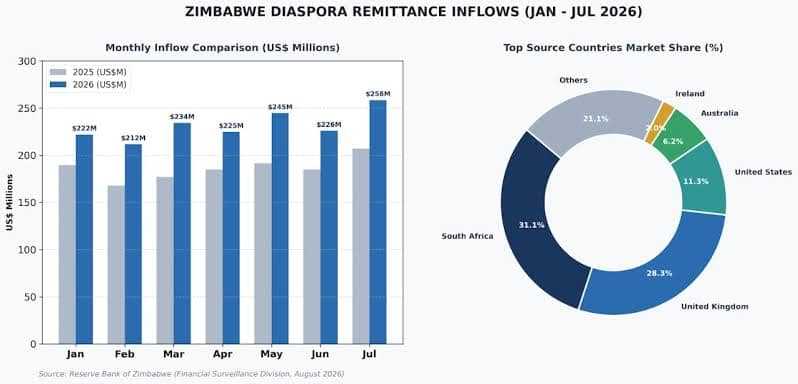
The proposal comes against the backdrop of a substantial diaspora contribution to Zimbabwe's foreign-currency position. Reserve Bank of Zimbabwe data shows diaspora remittances contributed US$1.094 billion in the first half of 2025, up 8.4 percent from US$1.009 billion in the corresponding period of 2024. They accounted for 15.1 percent of total foreign-currency receipts during the period.
By the end of 2025, diaspora remittances accounted for 13.5 percent of Zimbabwe's foreign-currency receipts, according to the central bank's annual quarterly snapshot.
Related Stories
A 2026 study by economists Daniel Makina and Rogers Dhliwayo estimates Zimbabwe's diaspora at between three million and five million people abroad and puts annual remittances at about US$2.15 billion in 2024. The researchers argue that remittances remain overwhelmingly geared towards consumption and that Zimbabwe lacks a fully developed, standalone diaspora investment framework with concrete financial instruments.
The Makina-Dhliwayo study notes that a US$50 million diaspora bond initiative launched through CBZ fell short of its target, raising about US$42.5 million. The researchers attribute the limited scale partly to the absence of enabling financial and legal instruments specifically supporting diaspora investment, as well as the costs associated with traditional remittance channels.
The World Bank has similarly identified diaspora bonds as one mechanism through which remittances and diaspora savings can be leveraged for development finance. Its migration economist Dilip Ratha has pointed to interest in such instruments across countries including Zimbabwe, while stressing that diaspora bonds need appropriate registration, consultation with diaspora communities and credible structures.
Zimbabwe's own institutions have begun moving towards greater diaspora engagement. The RBZ operates a Diaspora Desk within its Capital Flows Administration, Accounting and Management Division to facilitate investment proposals, provide information on investment opportunities and support diaspora remittance flows.
The central bank's 2026-2030 strategy also identifies diaspora remittances as an important component of Zimbabwe's external position and says efforts to leverage them to increase foreign-currency inflows and build reserves will be critical.
The tourism sector provides an immediate example of the potential market. Investment in tourism rose to US$132.3 million in the first half of 2026, from US$40.2 million during the same period in 2025, while domestic tourism trips reached 6.4 million.
The 2026 research proposes that diaspora instruments should be supported by ring-fenced use of funds, independent trustees, credible disclosure and appropriate regulation. It estimates that even diverting 5 to 10 percent of annual remittance flows into structured investment products could potentially generate between US$100 million and US$215 million a year, although the researchers stress that these are conditional scenarios rather than guaranteed inflows.







Leave Comments