






Zimbabwe’s agriculture sector does not primarily face a shortage of funding, but market distortions and rent-seeking are limiting the effectiveness of available financing, Africa Economic Development Strategies director-general Gift Mugano has said.
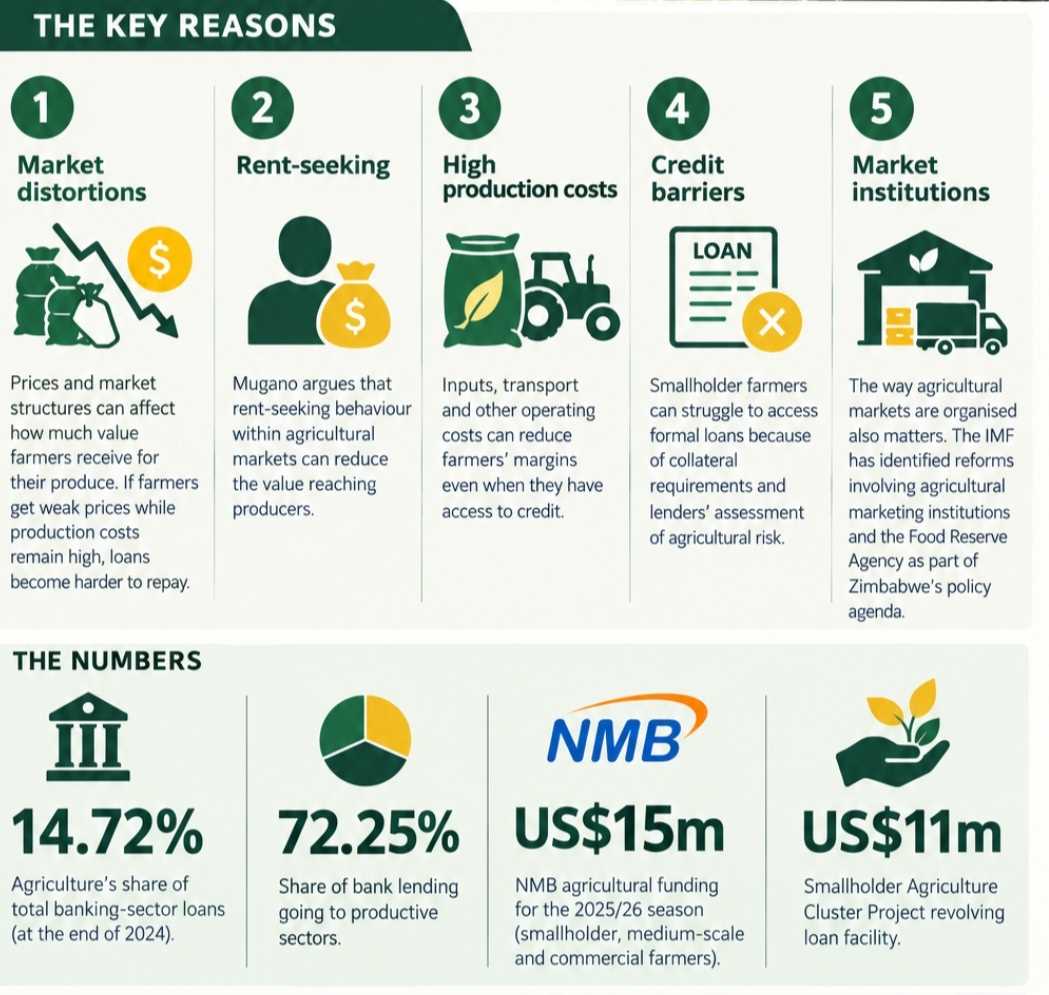
“Zimbabwe does not have a shortage of agricultural funding. The main challenge lies in market distortions and rent-seeking behaviour,” Mugano said at the National Agriculture Conference and Expo.
His comments come as banks, government and development-finance institutions continue to provide funding to the agriculture sector.
The Reserve Bank of Zimbabwe reported that agriculture accounted for 14.72 percent of total banking-sector loans at the end of 2024, while productive sectors collectively accounted for 72.25 percent of bank lending.
Banks have also continued to raise dedicated agricultural funding.
NMB Holdings secured US$15 million for the 2025/26 agricultural season, targeting smallholder, medium-scale and commercial farmers.
The Smallholder Agriculture Cluster Project also has a US$11 million revolving loan facility for agricultural producer groups, agribusinesses and other value-chain enterprises.
Related Stories
However, access to formal credit remains uneven, particularly among smallholder farmers.
A 2025 study on agricultural credit in Zimbabwe identified collateral requirements and perceived lending risk as some of the barriers affecting access to loans.
Mugano’s comments shift the financing debate towards how agricultural markets operate, particularly how value is distributed between farmers and other participants in the value chain.
For farmers, access to credit is closely linked to the prices they receive for their produce and the costs of inputs, transport and other production requirements.
These factors affect farmers’ ability to repay loans and finance the next production cycle.
The International Monetary Fund has also identified agricultural-market reforms as part of Zimbabwe’s policy agenda, including changes to the Food Reserve Agency’s role and measures to strengthen market information and agricultural marketing institutions.
Agricultural finance has therefore remained a combination of commercial lending, government-supported schemes and development-finance programmes, while farmers continue to face different levels of access depending on their scale, collateral and financial capacity.







Leave Comments