





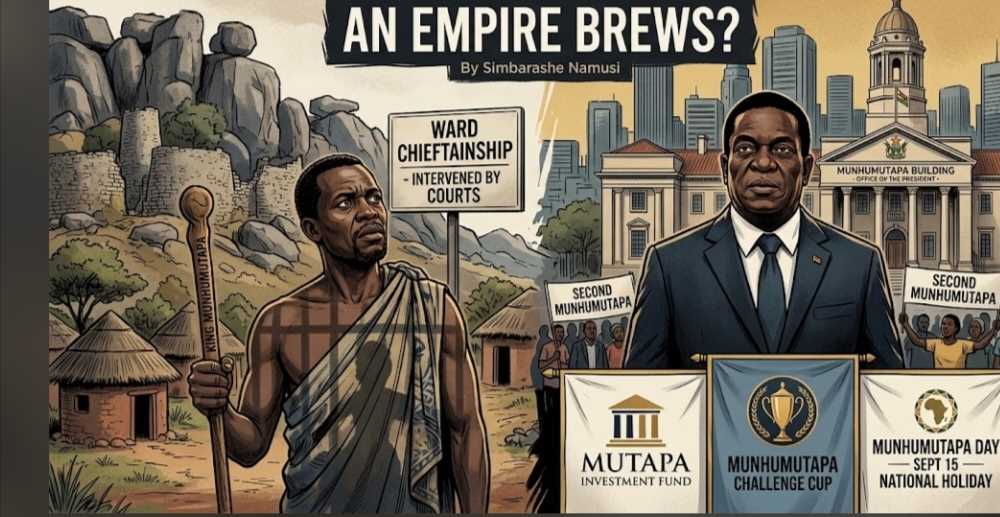
Mai Chenjerai lives in a ward where the chieftainship changed hands twice in one season. A man arrived saying the spirit mediums had named him King Munhumutapa, and that this gave him the power to decide who held the chieftainship.
He removed the sitting chief. Then the courts got involved, followed by the government, and the chief was reinstated.
Mai Chenjerai never followed the legal argument. She followed the confusion. For a season, nobody in her ward was entirely sure who was in charge.
The man was Timothy Chiminya.
Zimbabwe's state did not think there was room for another Munhumutapa.
Chiminya styled himself King Munhumutapa and claimed authority derived from the ancient Mutapa kingship. His activities eventually brought him into conflict with the state, which argued that he was creating structures and exercising authority that undermined the constitutional authority of the President. He was convicted and imprisoned before the High Court later overturned the conviction and sentence.
The irony is difficult to escape.
A man claiming the Munhumutapa mantle was treated as a threat to the state because Zimbabwe could not accommodate a competing centre of authority. Yet the same Munhumutapa name is now being attached increasingly closely to the country's President, Emmerson Mnangagwa.
The pattern did not begin with Chiminya's arrest, and it has not ended with his acquittal.
In 2023, Zimbabwe's sovereign wealth vehicle was renamed the Mutapa Investment Fund, absorbing more than 30 state enterprises under a brand drawn from the old empire's memory. This year, ZIFA launched the Munhumutapa Challenge Cup, a football tournament backed by a sponsorship package worth five million dollars a season.
The Munhumutapa Building has housed the Office of the President and Cabinet for years, embedding the name of an ancient African political institution in the physical architecture of modern government. And now, September 15, the President's birthday, carries the name of that ancient kingship as a national public holiday.
There is nothing inherently wrong with celebrating the Mutapa civilisation. Quite the opposite. Zimbabwe has every reason to reclaim and celebrate its pre-colonial history. The Mutapa state was a powerful African polity whose influence extended across large parts of present-day Zimbabwe and Mozambique. Its history speaks to African statecraft, trade, diplomacy and political organisation long before colonialism. That history belongs to Zimbabweans.
The interesting part is what happens when the history of a civilisation begins to merge with the political identity of one incumbent.
The framing is not something critics have projected onto Mnangagwa. The ZANU-PF Youth League said it themselves, two years before the state made it official. At a birthday celebration for the President held at the Great Zimbabwe Monument in Masvingo in September 2024, under the theme of youth empowerment and Vision 2030, the Youth League publicly styled him Zimbabwe's second Munhumutapa, citing his determination in building the nation.
Related Stories
The reference was not spontaneous. Weeks earlier, the founder of a church, Archbishop Andby Makururu, had described a vision of the President enthroned in royal regalia, including a golden crown and sceptre, with the title King Munhumutapa inscribed beneath him. The Youth League picked up the name almost immediately afterwards.
The language is more than historical decoration. It places a sitting political leader within the symbolic lineage of African kingship, using the party's own words, laid two years before the government turned the date into law.
The Cup's funding trail runs in the same direction, if more quietly. ZIFA launched the Munhumutapa Challenge Cup this year, backed by a sponsorship package worth five million dollars a season, the largest single-season investment in the history of Zimbabwean football. ZIFA has not officially disclosed where the money comes from.
A fund. A cup, reportedly bankrolled by the President's circle. A building. Now a birthday declared a holiday in perpetuity for a man the ruling party's own youth wing calls Munhumutapa by name. Each one, alone, is defensible as heritage. Four of them, arriving within three years and converging on one man, stop reading as coincidence and start reading as accumulation.
Zimbabwe remains a republic. Nothing about Munhumutapa Day changes the constitutional form of the state. No modern monarchy is being established, and no ancient royal title has been written into the Constitution. But political power is not expressed only through constitutions. It is also expressed through language, ceremonies, monuments, names and national rituals.
The question is no longer simply how Zimbabwe remembers its past. It is how that past is being used to frame the present.
A country can celebrate Great Zimbabwe without suggesting its current leaders are successors to its builders. It can teach the history of Mutota and the Mutapa state without transferring the authority of ancient kings into modern political office. The danger is not in remembering the empire. It is in allowing historical memory to become political mythology, particularly in a country where power has always been heavily personalised and where presidential tenure remains a live and sensitive question.
The Chiminya episode makes the contradiction sharper than any of the branding alone could. One man claimed the Munhumutapa title and was prosecuted for creating an alternative centre of authority. The state rejected that claim outright. Yet the same identity is now built into a sovereign fund, a football cup, a government building and a national holiday, all circling the very office whose authority Chiminya was accused of challenging.
The difference was never the name. It was who controls the narrative.
Munhumutapa belongs to the nation. Not to a political party. Not to an individual President.
Empires do not necessarily begin with armies crossing borders or kings occupying new territories. Sometimes they begin with stories about who has inherited the legitimacy of the past.
Mai Chenjerai's ward went back to normal once its chief was reinstated. She still could not tell you, if you asked her, what a Munhumutapa is supposed to be or where the title actually lives now. Neither, strictly, can the law.
The empire may not be returning.
The mythology, however, may already be here.
Simbarashe Namusi is a media expert writing in his personal capacity.







Leave Comments