


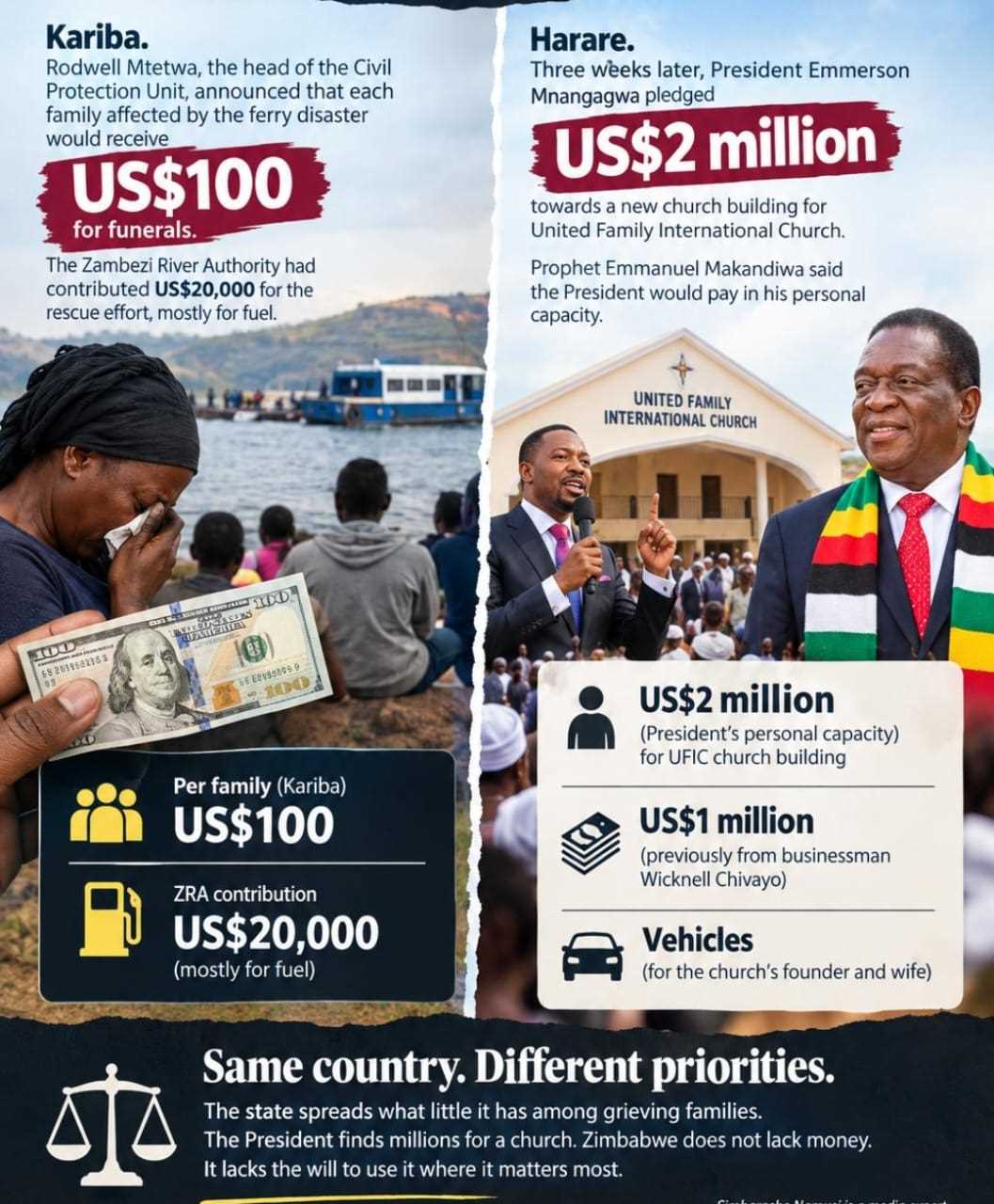
Rodwell Mtetwa stood at Kariba District Hospital in the middle of August and announced the number: US$100.
That was what the government would give each family affected by the ferry disaster that had, by then, killed more than 80 people. The money was meant to help with funerals.
Mtetwa chairs the Civil Protection Unit for the district. He said no one would be left out. The Zambezi River Authority had put in US$20,000 for the rescue effort, most of it for fuel.
Three weeks later, a different number moved through the same country.
President Emmerson Mnangagwa pledged US$2 million towards a new church building for United Family International Church in Harare.
Prophet Emmanuel Makandiwa announced it himself before 30,000 congregants at the church's Basilica in Chitungwiza. The President had heard the church was building again, Makandiwa said, and told him: inovakwa nevene vayo — it will be built by its own hands.
Start the work. Bring the quotations. He would pay in his personal capacity.
The US$100 came from the state. It came through the Civil Protection Unit, the government structure that exists precisely to respond to disasters like Kariba's.
It was the institution doing what institutions do when money is thin and the need is loud: spread what little there is as evenly as possible and call it done.
The US$2 million did not come from the state. Mnangagwa was careful about that. He gave it in his personal capacity, using his own networks, he said, to find the money.
Which means the President of Zimbabwe appears to carry two separate ledgers.
One is the state's, and it produced US$100 for a family that buried someone at Lake Kariba.
The other is his own, and this year it has found its way to UFIC more than once.
Related Stories
Weeks before the President's pledge, the same church displayed US$1 million in cash donated by businessman Wicknell Chivayo, followed soon after by new vehicles for the church's founder and his wife.
Chivayo has said the money was earned legally and he has not been convicted of anything. Whether those gifts are connected is not the question this piece is answering.
What is difficult to ignore, however, is the contrast critics have already pointed to: money in this country appears to move fastest towards institutions that can offer something back — a platform, a blessing, 30,000 witnesses to a man's generosity.
This is not really a story about a church.
A funeral in Kariba offers nothing back.
There is no congregation to applaud the giver, no prophet to thank the President by name, no footage of gratitude circulating on WhatsApp the next morning.
There is only a family, a body and US$100.
That is where the moral question begins.
If the President can mobilise US$2 million in his personal capacity for a church building, while the state can offer US$100 to families who have lost loved ones in a national disaster, what does that tell citizens about how value is assigned in Zimbabwe?
Nobody at the Basilica in Chitungwiza asked where the US$2 million was coming from.
Somebody should have asked why US$100 was the ceiling for a family that lost a father on Lake Kariba.
Neither question was asked out loud.
Both silences say something about the distance between those who have power and those who are left to count the cost of tragedy.
Simbarashe Namusi is a media expert writing in his personal capacity.



Leave Comments