



Shrinking donor funding is forcing Africa’s sexual and reproductive health and rights movement to reconsider how women-led organisations finance community work, advocacy and rights protection, with activists warning that financial pressures are increasingly intersecting with restrictions on civic space.
Jude Thaddeus Njikem, Sonke Gender Justice’s regional SRHR specialist, captured the pressure facing organisations after a year in which programmes were cut and institutions were forced to restructure.
“This room tells us that even when resources are reduced, our resolve must not be reduced,” he said. “We are still here, still organising, still learning, still existing, and still building.”
The statement points to a growing gap between the scale of the problems facing communities and the resources available to organisations working on them. Funding for sexual and reproductive health, bodily autonomy, gender justice, HIV programmes and comprehensive sexuality education has come under pressure, forcing organisations to reduce programmes or reconsider how they operate.
The issue is particularly significant for grassroots organisations, which often work on problems requiring sustained community engagement rather than short project cycles. When funding disappears, the immediate consequence is not simply fewer activities on an organisational calendar. It can mean fewer community programmes, weaker advocacy networks and reduced capacity to maintain services and support vulnerable groups.
For Zimbabwe, the Institute for Young Women’s Development brought that reality into the regional debate.
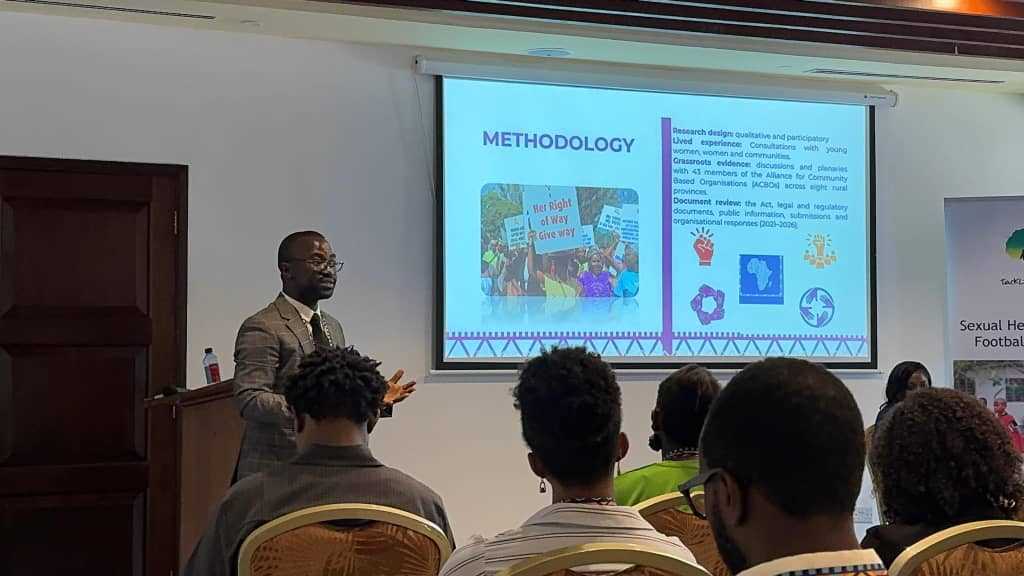
IYWD’s Knowledge Management, Documentation and Advocacy Coordinator, Kudakwashe Munemo, presented a paper co-created with Trócaire’s Donna Nyadete examining “The Gendered Effects of the PVO Amendment Act on Women’s Movements, Patriarchal Backlash and Civic Space in Zimbabwe.”
The presentation showed how administrative requirements, regulatory pressures and funding uncertainty can affect the ability of women-led organisations to organise, provide support and challenge harmful practices.
But the Mombasa discussions suggest that the problem cannot be reduced to regulation alone. The financial architecture supporting rights-based movements is itself changing.
The symposium’s organisers explicitly identified reduced funding as one of the major challenges facing SRHR work and called for “innovative, inclusive, and locally driven strategies and alternative financing models” to address global funding deficits.
For years, international development partners have played a central role in supporting advocacy, research, community mobilisation and service programmes. As those resources become less predictable, organisations are increasingly looking towards domestic public financing, philanthropy, private-sector partnerships, community financing and collaboration between movements.
Government funding can provide scale but could create tensions for organisations whose mandate includes holding authorities accountable. Corporate financing can bring new resources while creating questions about whether commercial interests could influence advocacy priorities. Community financing can deepen accountability to beneficiaries but may not generate enough money to sustain sophisticated research, legal, policy and national advocacy programmes.
Related Stories
That makes the search for alternative financing more than a fundraising exercise. It is becoming a question about the independence and long-term architecture of African civil society.
Ekenia Chifamba, founding director of Shamwari Yemwanasikana, said the movement was operating in an environment where both civic space and funding were under pressure.
“We are witnessing a growing resistance to gender equality and sexual and reproductive health rights. Civic space is shrinking... funding streams are also becoming increasingly constrained,” she said.
Chifamba argued that the response cannot simply be to document the crisis.
“We will not simply discuss these problems, but we will definitely also come up with solutions and the way forward,” she said.
For organisations such as IYWD, that shift could mean moving from a model centred primarily on individual projects towards stronger movement infrastructure, shared research capacity, pooled resources, legal and compliance support, stronger community networks and coordinated advocacy.
Chifamba, who works with young girls and women in Zimbabwe, warned against designing programmes for young people without giving them meaningful influence over decisions.
“Anything for the girls without the girls is not for the girls,” she said.
That principle has financial implications. If young women and grassroots communities are supposed to shape the future of SRHR movements, they also need influence over the resources and priorities determining what those movements actually do.
Bafana Khumalo, co-executive director and co-founder of Sonke Gender Justice, similarly argued that the movement cannot retreat because of political and financial pressure.
“As people of resilience, we say we still have to register progress because, despite everything, we are still here. We are still organising. We are still working very hard,” he said.
If international funding continues to contract, African movements will have to build financing systems that are locally rooted without allowing political, commercial or donor interests to determine which rights are defended and which are ignored.





Leave Comments