







Zambia’s 2026 presidential election remains clouded by serious electoral discrepancies after the Christian Churches Monitoring Group (CCMG) found evidence that votes were added in 30 constituencies, artificially increasing turnout and benefiting President Hakainde Hichilema’s United Party for National Development (UPND).
The findings, however, do not overturn Hichilema’s victory. CCMG’s independent verification indicates that he received more than the 50% threshold required to win the presidency outright, despite the anomalies it identified in the official results.
“The PRVT estimates clearly show that President Hichilema received the most presidential votes and more than the 50% threshold, but it also demonstrates that, for 30 constituencies, votes were added, artificially increasing turnout and undermining the integrity of the process,” CCMG said.
The organisation deployed 1,500 stationary observers to a nationally representative sample of polling stations across every province, district and constituency. Its observers remained at polling stations from 05:30 until counting was completed and the official results were announced and posted.
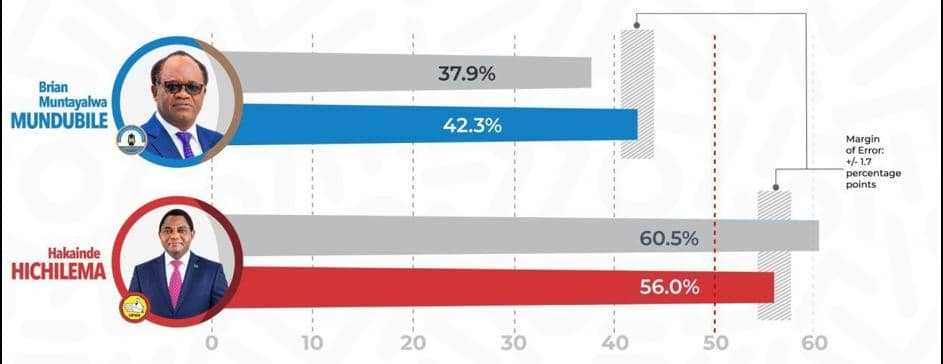
Based on results from 1,491 of the 1,500 sampled polling stations, CCMG estimated Hichilema’s vote share at 56.0%, plus or minus 1.7%, against 42.3% for National Reconciliation Party for Unity and Prosperity (NRPUP) candidate Brian Mundubile. Other candidates were estimated to have received no more than 0.5% each.
The organisation also estimated national turnout at 53.5%, plus or minus 0.6%, a sharp decline from the 70.6% recorded in the 2021 election.
But the pattern was dramatically different in the 30 constituencies CCMG identified as problematic. While turnout fell by an average of 15% across the other 196 constituencies compared with 2021, it increased by an average of 6% in the 30 flagged constituencies.
CCMG said the discrepancy was significant because “we should not expect drastic variances in turnout from constituency-to-constituency, as was reported in some cases by the ECZ.”
Lusangazi Central illustrates the problem. CCMG estimated turnout there at 44%, with NRPUP receiving 64% and UPND 33%. The official results, instead, recorded turnout of 66.4%, with UPND receiving 51% and NRPUP 46%.
CCMG said the official turnout was “12% more than what is plausible” and that “the voting trend reversed”.
The organisation’s concerns were reinforced by comparisons between polling-station results recorded by its observers and the official results used at constituency tally centres.
CCMG examined 24 sampled polling stations in four constituencies — Kalomo Central, Lufwanyama East, Lufwanyama West and Mongu Central. It found that results from 13 of the 24 stations matched completely, including rejected ballots.
However, UPND figures differed in 10 of the 24 stations, with the party’s tally-centre results averaging 178 votes higher than the results recorded by CCMG observers.
In Kalomo Central, CCMG cited two particularly striking examples. At Nameto Basic School-01, UPND votes increased by 113, while at Siachitema Secondary School-02 they increased by 170. The results for the other presidential candidates and rejected ballots remained unchanged.
Related Stories
Importantly, CCMG stressed that its methodology did not involve counting ballots itself or conducting an exit poll.
“PRVT estimates are entirely based on official polling station results as announced by ECZ polling officials,” the organisation said.
“PRVT monitors did not count the ballots. Only ECZ polling officials count ballots.”
The significance of the exercise is that CCMG was able to independently collect the results announced at sampled polling stations and use them to establish a statistically reliable national estimate against which the ECZ’s final results could be tested.
According to CCMG, the official presidential results for Hichilema, Mundubile and turnout “do not fall within the PRVT estimated range”.
It nevertheless concluded that the discrepancies did not change the presidential outcome.
“Importantly, however, the variances identified do not alter the overall outcome of the presidential election,” CCMG said.
The findings instead raise questions about the integrity of results in the affected constituencies and their potential consequences beyond the presidential race, particularly for parliamentary representation.
“These observations merit further review, particularly given the implications for the allocation of proportional representation seats,” CCMG said.
The organisation is now calling for full disclosure of polling-station-level results, arguing that transparency is essential if political parties, observers and voters are to independently reconcile the figures.
“The gold standard of electoral transparency is for the election management body to provide polling station level results in a bulk, analysable format according to Open Election Data Principles,” CCMG said.
It called on the Electoral Commission of Zambia to immediately publish all 226 “Record of Proceeding at the Totalling of Votes” documents covering the presidential and parliamentary elections, as well as images of GEN20 forms from all 13,529 polling stations.
CCMG also urged political parties and candidates to remain calm and pursue disputes through established legal mechanisms.
“These have been extremely challenging elections and sharply different from those in 2015, 2016 or 2021,” the organisation said, warning that Zambia would require “transparent, inclusive and technically sound electoral and regulatory reforms” to strengthen future elections.







Leave Comments