









ZimNow News Desk
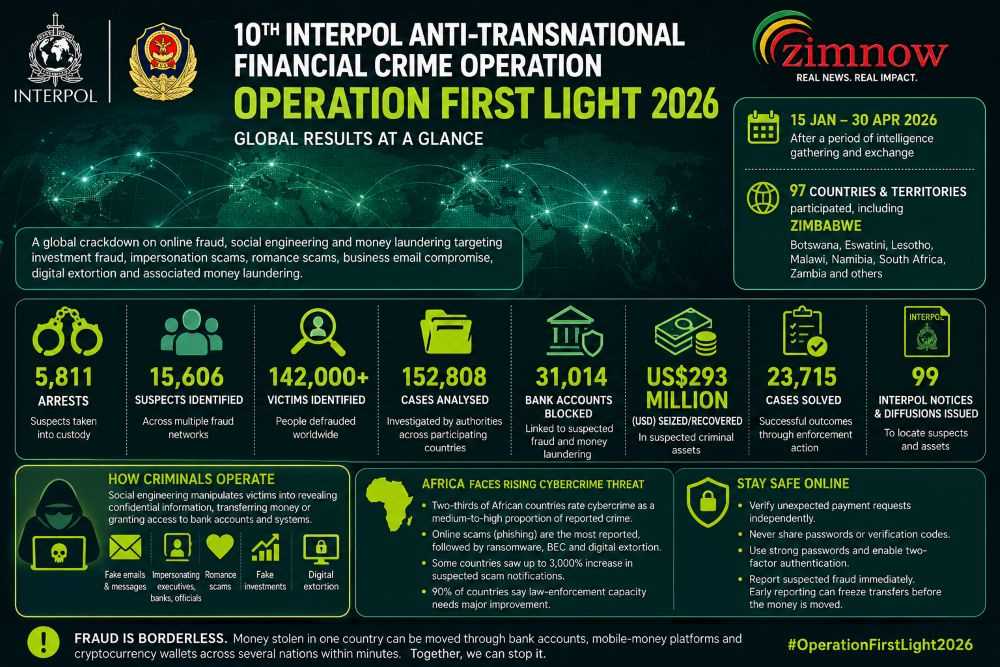
Zimbabwe participated in a global police operation that resulted in 5,811 arrests and the interception of US$293 million in suspected criminal assets, as international authorities warn that online fraud is expanding rapidly across Africa.
The INTERPOL-coordinated Operation First Light 2026 involved 97 countries and territories and targeted investment fraud, impersonation scams, romance scams, business email compromise, digital extortion and associated money laundering.
Zimbabwe was listed among the participating countries, alongside regional states including Botswana, Eswatini, Lesotho, Malawi, Namibia, South Africa and Zambia. INTERPOL did not disclose how many arrests, investigations or blocked accounts were linked specifically to Zimbabwe.
The operation ran from January 15 to April 30, following an initial period of intelligence gathering and exchange among participating countries.
Police raided identified premises, pursued high-value suspects and blocked bank accounts and cryptocurrency wallets linked to suspected fraud.
More than 142,000 victims were identified globally, while investigators analysed 152,808 cases, blocked 31,014 bank accounts and solved 23,715 cases.
Authorities also identified 15,606 suspects and issued 99 INTERPOL Notices and Diffusions during the operation.
The operation targeted social engineering, a form of fraud in which criminals manipulate victims into disclosing confidential information, transferring money or granting access to bank accounts and computer systems.
Common methods include emails or messages impersonating company executives, banks, government officials, potential romantic partners or investment advisers.
“Social engineering scams continue to pose a significant threat to our society,” INTERPOL Financial Crime and Anti-Corruption Centre director Tomonobu Kaya said.
“Criminal syndicates exploit human psychology to manipulate their targets, and no nation can stay safe unless all countries are equipped and committed to jointly fighting back.”
In one of the operation’s African cases, police in Eswatini arrested 82 people accused of running illegal online gambling, money laundering and impersonation scams.
Authorities seized 240 electronic devices, foreign currency and equipment used to create a replica Brazilian police station.
The suspects allegedly posed as Brazilian federal police officers during video calls and persuaded victims to transfer money for supposed “safekeeping”.
Elsewhere, authorities in Singapore and Oman blocked a US$6.6 million transfer after criminals impersonated a supplier to a commodity trading company.
Related Stories
Police in Thailand also uncovered cryptocurrency wallets allegedly used to launder proceeds from romance scams. One wallet linked to a 20-year-old suspect had processed more than US$122.5 million within 10 months.
Africa faces rising cybercrime threat
Zimbabwe’s participation comes as INTERPOL warns that cybercrime is becoming a growing share of reported criminal activity across Africa.
Its 2025 Africa Cyberthreat Assessment found that two-thirds of surveyed African member countries classified cyber-related offences as a medium-to-high proportion of reported crime.
Cybercrime accounted for more than 30 percent of reported offences in parts of Eastern and Western Africa.
Online scams, particularly phishing, were the most frequently reported cybercrimes, followed by ransomware, business email compromise and digital extortion. Suspected scam notifications increased by as much as 3,000 percent in some African countries.
INTERPOL warned that law-enforcement agencies and legal systems were struggling to match the speed and sophistication of the criminals.
Ninety percent of surveyed countries said their law-enforcement or prosecution capacity required significant improvement, while 95 percent reported inadequate training, limited resources and insufficient access to specialised tools.
Only 30 percent had an established cybercrime incident-reporting system, 29 percent maintained a digital-evidence repository and 19 percent had a cyberthreat-intelligence database.
A further 86 percent said their ability to cooperate internationally required improvement, even though online fraud frequently involves suspects, victims, technology companies and bank accounts located in different countries.
Zimbabwe has participated in other recent INTERPOL cybercrime crackdowns.
It was among 19 African countries involved in Operation Sentinel in late 2025, which resulted in 574 arrests, the recovery of approximately US$3 million and the removal of more than 6,000 malicious internet links.
The cases investigated during that operation were connected to estimated losses exceeding US$21 million. INTERPOL did not provide a separate breakdown of the results recorded in Zimbabwe.
Fraud us increasingly borderless, with money stolen from one country capable of being transferred through bank accounts, mobile-money platforms and cryptocurrency wallets in several other jurisdictions within minutes.
Authorities advise internet and mobile-banking users to verify unexpected payment requests independently, avoid sharing passwords or verification codes and report suspected fraud immediately, as early reporting can allow banks and police to freeze transfers before the money is withdrawn or moved abroad.








Leave Comments