





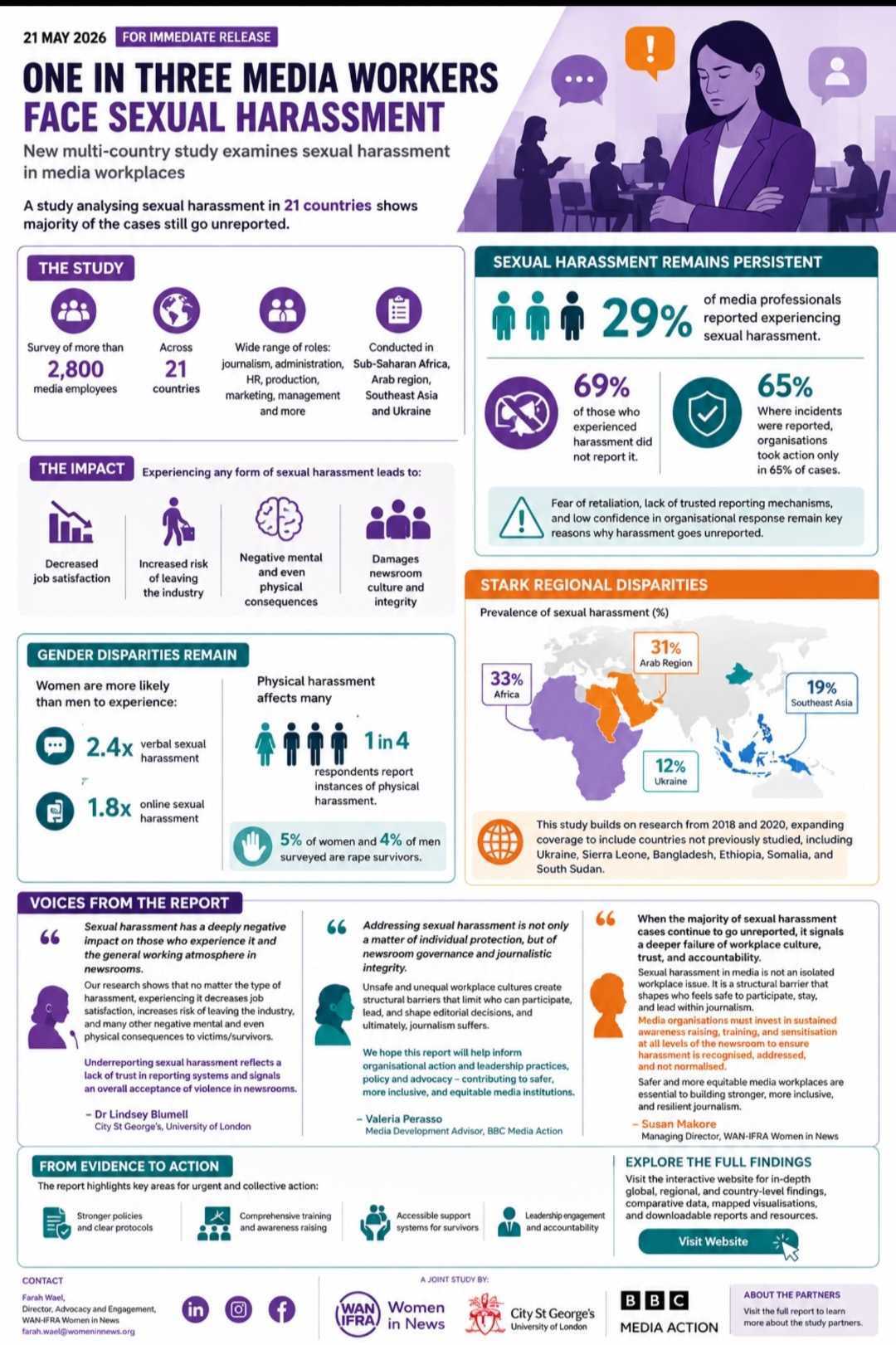
A new global study examining sexual harassment in media workplaces across 21 countries has revealed that nearly one in three media professionals have experienced some form of sexual harassment, with the majority of cases going unreported.
The report, released by the World Association of News Publishers’ Women in News (WAN-IFRA WIN), City St George’s, University of London, and BBC Media Action, analysed responses from more than 2,800 media employees working in journalism, administration, production, management, marketing and human resources.
Conducted across Sub-Saharan Africa, the Arab region, Southeast Asia and Ukraine, the 2025 study found that 29% of media professionals surveyed had experienced sexual harassment in the workplace.
The findings also exposed a major culture of silence within media organisations, with 69% of survivors choosing not to report incidents.
According to the report, fear of retaliation, weak reporting systems and low confidence in organisational responses remain among the biggest barriers preventing victims from speaking out.
“Sexual harassment has a deeply negative impact on those who experience it and the general working atmosphere in newsrooms,” said Dr Lindsey Blumell from City St George’s, University of London.
“Our research shows that no matter the type of harassment, experiencing it decreases job satisfaction, increases risk of leaving the industry, and many other negative mental and even physical consequences to victims/survivors,” she said.
Blumell added that the widespread underreporting reflects deeper institutional failures within newsroom cultures.
“Underreporting sexual harassment reflects a lack of trust in reporting systems and signals an overall acceptance of violence in newsrooms,” she said.
The report highlighted significant regional disparities, with Africa recording the highest prevalence rate at 33%, followed by the Arab region at 31%. Southeast Asia recorded 19%, while Ukraine, included in the study for the first time, recorded 12%.
Related Stories
Researchers also found that women remain disproportionately affected, with women being 2.4 times more likely than men to experience verbal sexual harassment and 1.8 times more likely to face online sexual harassment.
The study further revealed that a quarter of respondents had experienced physical harassment, while 5% of women and 4% of men surveyed identified themselves as rape survivors.
BBC Media Action Media Development Advisor Valeria Perasso said sexual harassment in media institutions goes beyond individual harm and directly affects journalism itself.
“Addressing sexual harassment is not only a matter of individual protection, but of newsroom governance and journalistic integrity,” said Perasso.
“Unsafe and unequal workplace cultures create structural barriers that limit who can participate, lead, and shape editorial decisions, and ultimately, journalism suffers,” she added.
Perasso said the report should help inform newsroom leadership practices, policy reforms and advocacy efforts aimed at building safer and more inclusive media institutions.
WAN-IFRA Women in News Managing Director Susan Makore said the findings point to deeper structural problems within media workplaces globally.
“When the majority of sexual harassment cases continue to go unreported, it signals a deeper failure of workplace culture, trust, and accountability,” said Makore.
“Sexual harassment in media is not an isolated workplace issue. It is a structural barrier that shapes who feels safe to participate, stay, and lead within journalism,” she said.
Makore called on media organisations to move beyond policy creation and invest in long-term awareness programmes, training and newsroom sensitisation initiatives.
“Safer and more equitable media workplaces are essential to building stronger, more inclusive, and resilient journalism,” she said.



Leave Comments