






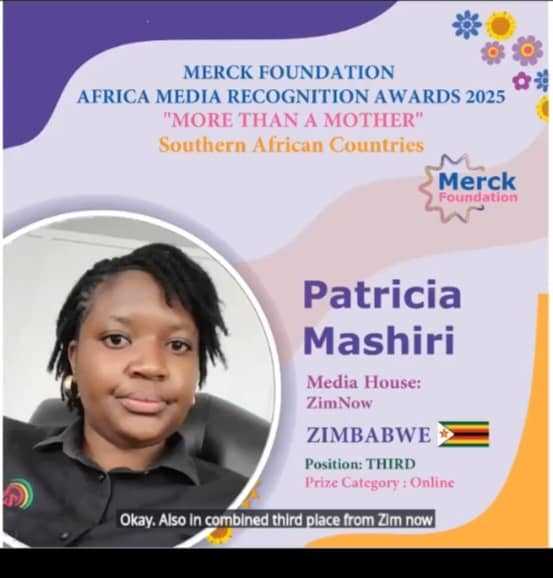
Patricia Mashiri of ZimNow has earned continental recognition after securing third place in the online category at the prestigious 2025 Merck Foundation “More Than a Mother” Africa Media Recognition Awards for Southern African countries.
The award places Mashiri among a growing number of journalists being recognised for using media to spotlight social justice issues affecting women and girls across the continent.
Speaking after receiving the honour, Mashiri said the recognition reflected years of advocacy journalism focused on ending child marriages, promoting sexual and reproductive health rights (SRHR), and confronting gender-based violence.
“Honoured and deeply grateful. My journey in amplifying the voices of girls and women working to end child marriages, advocate for sexual and reproductive health and rights, and fight gender-based violence has not always been easy, but it has always been purposeful,” she said.
“This recognition is not just for me; it is for every girl whose story deserves to be heard and every woman who refuses to be silenced.”
The award comes at a time when conversations around inclusive journalism and representation are increasingly shaping Africa’s media landscape, particularly on issues often overlooked in mainstream reporting.
Mashiri said the recognition reaffirmed the importance of public-interest journalism that gives visibility to vulnerable communities.
“Being recognised in the More Than a Mother Africa Media Recognition Awards is a reminder that telling these stories matters and that advocacy through journalism can create change,” she said.
She noted that journalism carries a responsibility to represent all sectors of society, particularly communities frequently excluded from dominant narratives.
“Journalism has a responsibility to reflect the realities of all people in society, not just those who are most visible or powerful,” Mashiri said.
Related Stories
“Telling stories that speak to different communities — especially women, young people, and groups often left out of mainstream coverage — is not just important; it is essential for building a more informed, inclusive, and just society.”
She added that stories centred on lived experiences often reveal the deeper impact of policies, social norms, and systemic inequalities.
“When we amplify the stories of women, young people, and marginalised communities, we help bring issues such as sexual and reproductive health rights, gender-based violence, and child marriages into public conversation where solutions can begin,” she said.
Mashiri also spoke candidly about the challenges of reporting on sensitive social issues, saying stigma and fear often make it difficult for affected communities to speak openly.
“One of the main challenges I have faced is accessing reliable information and sources from communities that are often marginalised or afraid to speak due to stigma, especially around issues like gender-based violence and sexual and reproductive health,” she said.
“There is also sometimes resistance from institutions that are uncomfortable with these stories being told.”
She said ethical storytelling and building trust within communities had become central to her reporting approach.
“For me, accuracy and inclusivity go hand in hand — listening deeply to communities ensures that their experiences are represented truthfully and respectfully,” she added.
Mashiri encouraged aspiring African journalists to embrace courageous and empathetic storytelling capable of driving social transformation.
“My message to aspiring journalists across Africa is to remember that journalism is a powerful tool for amplifying voices that are often unheard,” she said.
“Use your platform to tell stories with empathy, accuracy, and courage, especially for communities that are frequently marginalised.”
“When you centre dignity, listen to lived experiences, and report with integrity, your work can challenge harmful norms, inform policy, and inspire meaningful social change across the continent.”








Leave Comments