







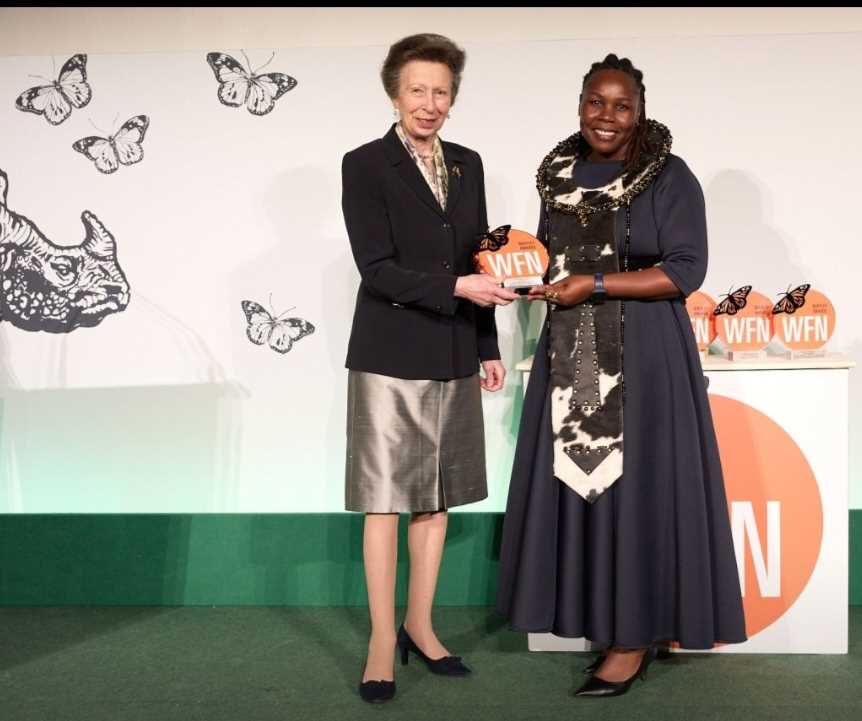
Zimbabwean conservationist Moreangels Mbizah has earned international recognition after receiving the 2026 Whitley Award — one of the world’s most prestigious conservation honours — for her pioneering work protecting both lions and rural communities living alongside wildlife.
Often referred to as the “Green Oscars,” the award, presented by the Whitley Fund for Nature, recognises grassroots leaders delivering practical environmental solutions. For Mbizah, the honour represents more than personal achievement; it reflects years of community-driven conservation work in some of Zimbabwe’s most conflict-prone wildlife areas.
In a statement shared after receiving the award, Mbizah described the recognition as a collective victory rooted in community trust and lived experience.
“This recognition means so much, not just to me but to a journey shaped by listening first and working side by side with communities at the heart of conservation,” she said.
Mbizah is the founder and executive director of Wildlife Conservation Action, an organisation focused on reducing human-wildlife conflict in northern Zimbabwe’s rural districts, where encounters between farmers and predators often result in economic loss and wildlife deaths.
In many communities bordering wildlife corridors, livestock attacks by lions can devastate household livelihoods. Retaliatory killings then threaten already vulnerable lion populations across Africa.
Rather than framing conservation as protection of animals alone, Mbizah’s approach centres people as partners.
Her team trains community guardians known locally as Batabilili — meaning “protectors” in the Tonga language — who monitor predator movements, warn farmers when lions enter grazing areas, and promote safer livestock management practices.
The initiative has introduced reinforced cattle enclosures, mobile livestock pens, and solar-powered flashing deterrent lights that discourage nocturnal lion attacks. According to project data, these interventions have reduced human-carnivore conflict by up to 98 percent in some wards where the programme operates.
Conservation rooted in communities
Mbizah’s work challenges traditional conservation models that historically excluded local communities from decision-making.
Instead, her programmes rely on local knowledge, participation, and ownership. Community members help design solutions, while farmers increasingly invest their own resources after witnessing successful results.
The Whitley Award — valued at £50,000 — will allow Wildlife Conservation Action to expand into additional rural wards, recruiting more community guardians and strengthening coexistence strategies between people and predators.
Related Stories
Women, Mbizah notes, have emerged as particularly effective conservation leaders because of their close daily interaction with households and farming systems.
“You have to care deeply about people and constantly engage with communities,” she has said of the role.
A conservation journey shaped by experience
Interestingly, Mbizah’s conservation path began later than many in the field. Her first direct encounter with wildlife came during postgraduate research on African wild dogs at age 25 — an experience that reshaped her professional direction and purpose.
Today, education has become central to her mission. Through conservation clubs in rural schools, children are introduced to wildlife not as a threat, but as a shared natural heritage worth protecting.
By exposing young learners to protected areas and environmental stewardship, Mbizah hopes to cultivate a generation that sees coexistence as possible rather than conflict as inevitable.
Protecting lions while protecting livelihoods
Across Zimbabwe’s mid-Zambezi Valley, expanding agriculture and settlement continue to push communities into wildlife migration corridors. As habitat pressure grows, so too does the likelihood of encounters with predators such as the African lion (Panthera leo), now considered vulnerable across the continent.
Mbizah’s work represents a delicate balancing act — ensuring families safeguard their income while enabling wildlife populations to recover.
Her long-term vision includes stabilising lion numbers while strengthening sustainable rural livelihoods, proving that conservation success depends as much on social solutions as ecological ones.
A win beyond recognition
Reflecting on the award, Mbizah framed the achievement as belonging to Zimbabwe itself.
“It’s a win for communities shaping solutions from the ground up. It’s a win for conservation rooted in lived experience. It’s a win for Zimbabwe,” she said.
At a time when global conservation increasingly recognises local leadership as essential, Mbizah’s work stands as a reminder that the future of wildlife protection lies not only inside national parks, but within the communities that live closest to nature.









Leave Comments