





Following the Trail of a Relentless Industrial Operator
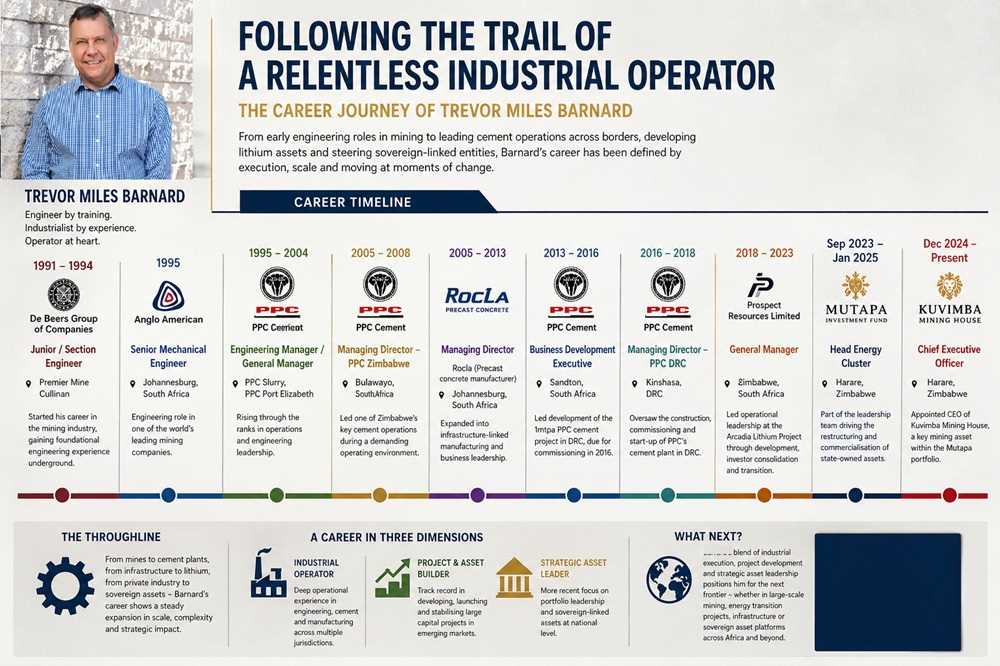
From early engineering roles to lithium and sovereign assets, Trevor Miles Barnard’s career has been defined by movement at moments of change. His latest exit raises a simple question: where does a builder of complex systems go next?
Because if there is one consistent thread in Barnard’s professional life, it is motion, but not the restless kind. His career has unfolded in deliberate stages, each tied to industries where scale, capital and execution matter.
He is not a public-facing corporate figure, nor a frequent voice in industry debates. Yet his career intersects with some of the most important industrial and resource developments across Southern and Central Africa over the past three decades. That alone makes his trajectory worth examining.
Barnard’s early career was rooted in technical roles within the mining sector. He began at De Beers Group, working at the Premier Mine in Cullinan from 1991 to 1994, before moving to Anglo American in 1995 as a senior mechanical engineer. These were not symbolic roles. They placed him inside large, complex operations where performance is measured in output, uptime and cost discipline.
His longest corporate chapter followed at PPC Ltd, where he spent more than a decade building industrial leadership experience. Between 1996 and 2004, he rose through engineering and general management roles within PPC’s South African operations, including Port Elizabeth and PPC Slurry. He was then appointed Managing Director of PPC Zimbabwe from 2005 to 2008, taking charge of a key player in Zimbabwe’s construction supply chain at a time when the operating environment demanded both resilience and efficiency.
After Zimbabwe, Barnard moved into a broader industrial leadership role as Managing Director of Rocla, a precast concrete manufacturer in South Africa, from 2008 to 2013. The shift signalled an expansion from cement production into infrastructure-linked manufacturing, adding another layer to his experience in capital-intensive industries.
Related Stories
He returned to PPC in 2013 as Business Development Executive, based in Sandton, where he led the development of a one-million-tonne-per-annum cement project in the Democratic Republic of Congo. By 2016, he had relocated to Kinshasa as Managing Director of PPC DRC, overseeing the commissioning and early operation of the plant. It was a classic frontier-market assignment, combining project development, execution and the challenge of establishing stable operations in a new environment.
By the time he exited PPC in 2018, Barnard had transitioned from technical specialist to cross-border industrial operator with a track record in building and stabilising large-scale projects. That profile carried directly into the next phase of his career.
In August 2018, he joined Prospect Resources Limited as General Manager, taking on a leadership role linked to the Arcadia lithium project in Zimbabwe. Over the next five years, the project moved through development, investor consolidation and eventual transition into new ownership under Chinese capital. This was a period when lithium shifted from niche mineral to strategic commodity, placing Zimbabwe into a global value chain tied to electric vehicles and energy storage. Barnard’s role during this phase placed him at the intersection of engineering reality, investor expectations and project scale-up.
His move into Mutapa Investment Fund in September 2023 marked a shift in scope. As Head of the Energy Cluster, he entered a structure designed to consolidate and reposition Zimbabwe’s state-owned enterprises, bringing private-sector discipline into assets that have historically struggled with performance and governance challenges. He later moved into the role of Chief Executive Officer at Kuvimba Mining House in December 2024, placing him back in an operational leadership position within a major mining group aligned to the Mutapa framework.
Taken together, Barnard’s career shows a steady expansion in scale and complexity. He has moved from plant-level execution to managing industrial businesses across borders, then into project development in emerging markets, and more recently into roles connected to national resource strategy. Each step has placed him closer to the centre of capital, infrastructure and strategic assets.
Which brings us to the present moment. His exit from the Mutapa-linked structure does not read like the closing chapter of a long career. It comes after more than three decades of continuous movement through demanding environments, and at a stage where his experience remains highly relevant to industries undergoing structural change.
There are a few grounded directions that emerge from his track record. His combined experience in cement, infrastructure and mining positions him for large-scale industrial or extractive projects, particularly in regions where new capacity is being developed.
His involvement in lithium places him within the global energy transition ecosystem, where demand for experienced operators remains strong. His time within a sovereign-linked structure adds familiarity with the intersection of capital, policy and state assets, a combination that is increasingly valuable in emerging markets.
What is less likely is a move into retirement. Careers built in this way tend to continue moving toward environments where systems are being built, expanded or restructured. For now, there has been no formal announcement of his next destination, but the arc of his career suggests that the current pause is temporary.
Barnard has consistently appeared at points where industries are shifting and assets are being repositioned. Where he surfaces next may well tell us as much about the direction of those industries as it does about the man himself.







Leave Comments