




The Rich Starry, owned by Shanghai Xuanrun Shipping Co., sanctioned by the United States for dealings with Iran, made the news for passing through the strait and exit since the US’s Persian Gulf blockade began.
Meanwhile the US has threatened to impose sanctions on two Chinese banks if they are found to be involved in handling money from Iran’s oil trade payments, a clear tactic to coerce China into taking its side against Iran, after China, along with other countries, declined Trump’s order to open the Strait of Hormuz by force.
China has cautioned the US against irresponsibility, which many analysts are reading as a clear warning to Trump. The incidents show how differently the world’s two superpowers wield their statuses.
The United States has spent the past 25 years proving that the cost of empire is not sustainable.
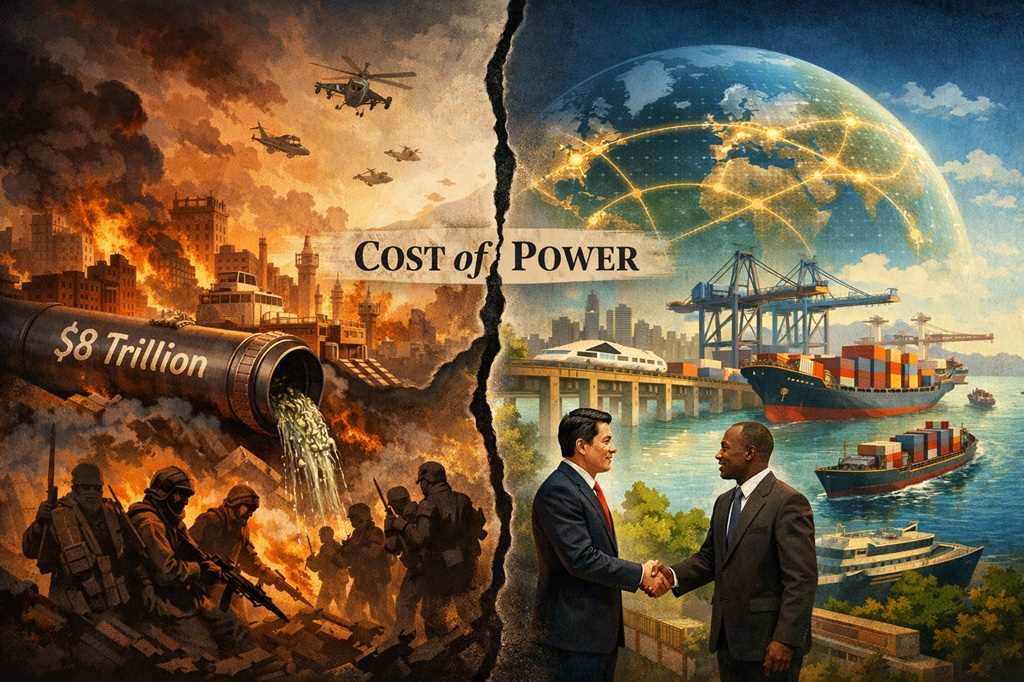
Since 2001, Washington has spent an estimated $8 trillion on post-9/11 wars across Afghanistan, Iraq, Syria, Pakistan, and elsewhere, according to Brown University's Costs of War Project. That figure includes $2.1 trillion by the Department of Defense, $1.1 trillion by Homeland Security, $884 billion to increase the Pentagon's base budget, and $465 billion in veterans' medical care alone. And the bill is not closed. The US is expected to spend at least $2.2 trillion more on veterans' care over the next 30 years.
What did $8 trillion buy?
Death, that is what the US has brought to the world. Roughly 940,000 people died from direct war violence across those conflict zones, including civilians, armed forces, contractors, journalists, and humanitarian workers. When indirect deaths are counted, from loss of food, healthcare, and war-related disease, the total rises to between 4.5 and 4.7 million people and counting.
Afghanistan ended with the Taliban back in power. Iraq became the incubator for the Islamic State. Jihadist groups proliferated in Iraq after the 2003 US invasion, and many eventually coalesced around Abu Musab al-Zarqawi, a Jordanian jihadist who had spent time in Afghanistan. That network became ISIS. The organisation that Washington went to war to destroy franchised itself across a dozen countries and is still operational today.
The Blowback Economy
There is a term for what happens when a superpower creates enemies faster than it can eliminate them: blowback. The concept is simple. Intervention generates grievance. Grievance generates recruits. Recruits generate attacks. Attacks justify more intervention. The cycle is self-funding, and the original power pays for all of it.
Al-Qaeda itself is a product of this logic. As Robin Cook, Britain's Foreign Secretary from 1997 to 2001, wrote in 2005, al-Qaeda and bin Laden were "a product of a monumental miscalculation by western security agencies," originally a database of thousands of mujahideen recruited and trained with CIA help to defeat the Soviet Union in Afghanistan. The West funded the fighters, the fighters won, the West walked away, and the fighters turned their training on their former sponsors.
The 9/11 attacks cost al-Qaeda roughly $500,000 to execute. The American response cost, at minimum, $8 trillion. The US government is currently conducting counterterrorism activities in 78 countries, practically designing recruitment posters for other groups with grievances, thus larger future invoices.
China's Counter-Model
China has five overseas military facilities. The US has over 750. China's military budget has grown at roughly 7 percent annually for a decade. Its nuclear stockpile reached 600 warheads in 2025, more than doubling since 2019, with the Pentagon forecasting it will reach 1,500 warheads by 2035. It has the world's largest navy by hull count and the largest ground force on earth.
But China hasn't fought a war since 1979. The US has been at war continuously since 2001. China's military spending remains focused primarily on security issues within the Indo-Pacific, not on global power projection. It is not chasing enemies but rather making itself scary to attack, always keeping diplomatic options open.
Related Stories
When the US and Israel struck Iran in mid-2025 and in early 2026, China took the same stance as in the Russia-Ukraine war. It called for negotiation and maintained its relationships.
The Narrative War China Is Winning Without Fighting
For decades, Western hegemony ran on a specific story of moral supremacy that worked because the West controlled the means of telling it. Legacy newspapers, wire services, broadcast television, and publishing houses in New York and London shaped how events were understood globally.
Today social media, independent journalism, and the digital diffusion of information have made it impossible to maintain a single authoritative narrative. When Israeli strikes on Gaza were livestreamed on phones in real time, the "rules-based international order" framing became very difficult to sustain. When photos of destroyed hospitals circulated before official statements were drafted, the gap between the story and the reality became visible to audiences worldwide.
Populations across the Global South, and increasingly Europe and within the US itself are drawing their own conclusions about which power model is producing which outcomes. A model that has spent $8 trillion generating 4.7 million deaths, destabilised multiple states, and produced the Taliban, ISIS, and al-Qaeda franchises across a dozen countries has a credibility problem that no communications strategy can fix.
Taiwan: The Live Experiment
The clearest current demonstration of China's approach is Taiwan. Western analysts have spent years predicting imminent Chinese military action. That narrative justified US arms sales to Taiwan and kept the conflict at the centre of Indo-Pacific strategy.
On April 10, 2026, KMT chairperson Cheng Li-wun met Xi Jinping at the Great Hall of the People in Beijing, the highest-ranking Taiwanese leader to meet Xi since 2015. Cheng told media before the trip that she aimed to show that Taiwan and China "are not destined for war, nor do they need to remain on the brink of military conflict."
In 2025, the KMT and organisations linked to former president Ma Ying-jeou sent at least nine delegations to China, seven more than in 2024, normalising contact and reactivating dormant channels.
China is not winning Taiwan through military threat. It is working the political seam, engaging the opposition, reducing the temperature, and making the war scenario look less inevitable to ordinary Taiwanese voters.
What the Model Actually Is
China is not building a world order based on overt aggression. The argument Beijing has always made to the Global South is this: we will invest, trade, and engage without ideological conditionality. We will not demand you restructure your government, privatise your utilities, or fight our enemies in exchange for access. China is careful not generate the kind of humiliation that turns populations into recruitment pools for groups committed to attacking them.
This is pragmatism framed as multipolarity. The world can have different systems. They do not need to converge. What they need to do is trade.
Whether one finds that model morally satisfying is beside the point. The question is whether it works. And the evidence so far is that a country that has not fought a war in 46 years, has built the world's second largest economy, is the top trading partner of more than 140 countries, and just engineered a diplomatic meeting with Taiwan's opposition while the expected war failed to materialise is doing something that deserves serious analysis.
Monica Cheru is the managing partner of Zim Now. The views expressed are personal. This is part one of a two-part analysis. Part two examines what China's model means concretely for Zimbabwe's resource diplomacy and the lithium beneficiation push. Read the second part here:- https://zimbabwenow.co.zw/articles/22242/zimbabwes-lithium-moment-will-be-won-by-strategy-not-posture





Leave Comments