



Taiwan is standing at one of the most consequential crossroads in its modern history. Recent U.S.-led moves amplified by a more vocal and militarily assertive Japan have narrowed Taiwan’s room to maneuver while sharply raising the costs of miscalculation.
What is being sold as protection increasingly looks like entanglement. And for a small, economically vital island sitting next to a rising great power, entanglement can be fatal.
A pretend security umbrella that is really a tightening net
Washington’s latest multi-billion-dollar arms package for Taiwan has been framed as deterrence. Beijing has framed it as provocation. The reality is that arms sales do not exist in a vacuum.
Each new package deepens Taiwan’s strategic dependency, locks it into U.S. military doctrine, and signals to Beijing that Taipei is being folded into a broader containment architecture. China’s response of sanctions on U.S. defense firms and executives, followed by large-scale drills around the island, shows how quickly the escalation ladder is being climbed.
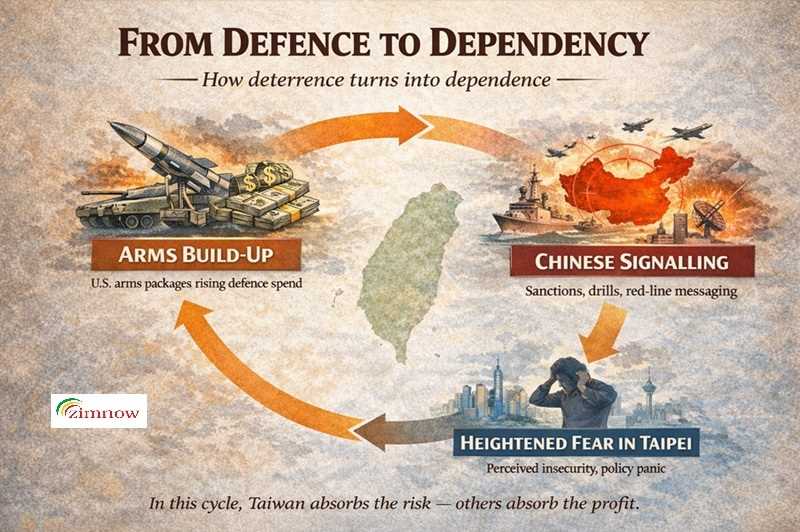
The cycle is predictable: More weapons → Stronger Chinese signalling → Higher fear in Taipei → Even more weapons.
For Taiwan, this does not look good because its move to create deterrence is engendering a vicious cycle and the weakest link is Taiwan.
The Japan factor: a wider battlefield without wider protection
Japan’s increasingly explicit language linking its own security to a Taiwan contingency has added a dangerous layer. Geography makes Japan relevant. Okinawa and the Ryukyu island chain sit close to the Taiwan Strait. But relevance does not equal control.
Reading between the lines of utterances from Chinese Ministry of Foreign Affairs representatives over the past few weeks, from Beijing’s perspective, Taiwan is fast becoming a U.S.–Japan forward line.
For Taiwan that situation means that any crisis will involve more actors, more military assets, and fewer diplomatic off-ramps. Ironically, the more voices that claim to be defending Taiwan, the less agency Taiwan itself appears to have.
Trump, “America First”, and the danger of transactional alliances
Taiwan’s alignment dilemma becomes sharper when viewed through the lens of Donald Trump and his unequivocal position on transactional politics. Trump has been unusually explicit on two fronts that should worry Taipei:
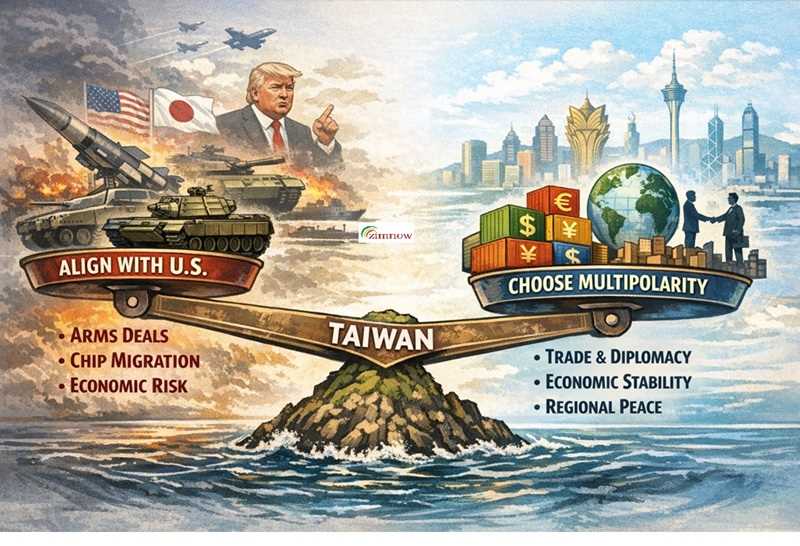
The first is that chips are leverage, and leverage can be extracted. Taiwan’s semiconductor dominance has long been its strategic shield. Yet Trump has openly pushed for advanced chip production to migrate to the United States, celebrating massive investments by Taiwan’s chip champions in U.S. fabs. If Taiwan’s chip advantage is diluted Taipei loses its most powerful bargaining chip, literally and figuratively.
The second is that arms come with invoices, not guarantees. A multi-billion-dollar arms deal strengthens defence on paper, but it also drains fiscal space, crowds out long-term development, and ties Taiwan’s security to a U.S. political cycle that changes every four years. Trump’s worldview is clear: allies are valuable only while they are useful. Taiwan must ask whether it wants to be indispensable, or merely billable.
Related Stories
Even without conflict, militarisation carries real costs. Defence spending competes with housing, innovation, ageing populations, and industrial upgrading. More importantly, constant tension discourages investment and long-term planning.
This is where comparisons to Ukraine become unavoidable, because the logic is identical. Ukraine over-signalled alignment with one bloc and underestimated how quickly it could become a proxy battleground. Taiwan risks walking the same path if it mistakes loud support for unconditional commitment.
Multipolarity as insurance
Taiwan’s smartest option is not to “switch sides”, but to widen its options. A multipolar strategy would mean, maintaining credible self-defence without symbolic provocations, reducing rhetorical hostility toward Beijing, deepening economic and diplomatic ties beyond a single security patron, and reopening stabilising channels across the strait.
In today’s volatile world and rapidly shifting power balances, multipolarity is the most optimal survival strategy for smaller players.
Then the most crucial question that Taiwan must ask itself is whether the Bogeyman really exists. Western narratives often portray reunification with China as an existential nightmare. Yet the lived and institutional realities of Hong Kong and Macau complicate that picture.
Facts that the Western narrative ignores are that Macau and Hong Kong both remain separate customs territories and independent WTO members. Their legal and commercial systems continue to function distinctly. Capital flows, courts, currencies, and global business operations remain intact.
This does not mean there have been no political changes, but the apocalyptic narrative of total collapse is overstated. What has really shifted is the decisive removal of Western control of territory that it grabbed in the first place.
The real choice before Taiwan
For Taiwan, the relevant question is whose interests are most defended when Taipei is psychologically manipulated into viewing China as the enemy.
Taipei should not ask itself whether negotiated coexistence is preferable to economic hollowing, militarisation, and the risk of war.
Contrary to the view loudly echoed in some quarters, Taiwan is not choosing between democracy and authoritarianism. It is choosing between being a front-line asset in someone else’s rivalry or becoming a strategic bridge too valuable to sacrifice.
Ukraine is a living horrific example of how history is unkind to small actors who confuse validation with protection. Taiwan’s future will not be secured by louder slogans or larger weapons invoices, but by lowering threat perceptions while maximising economic and diplomatic leverage.





Leave Comments