




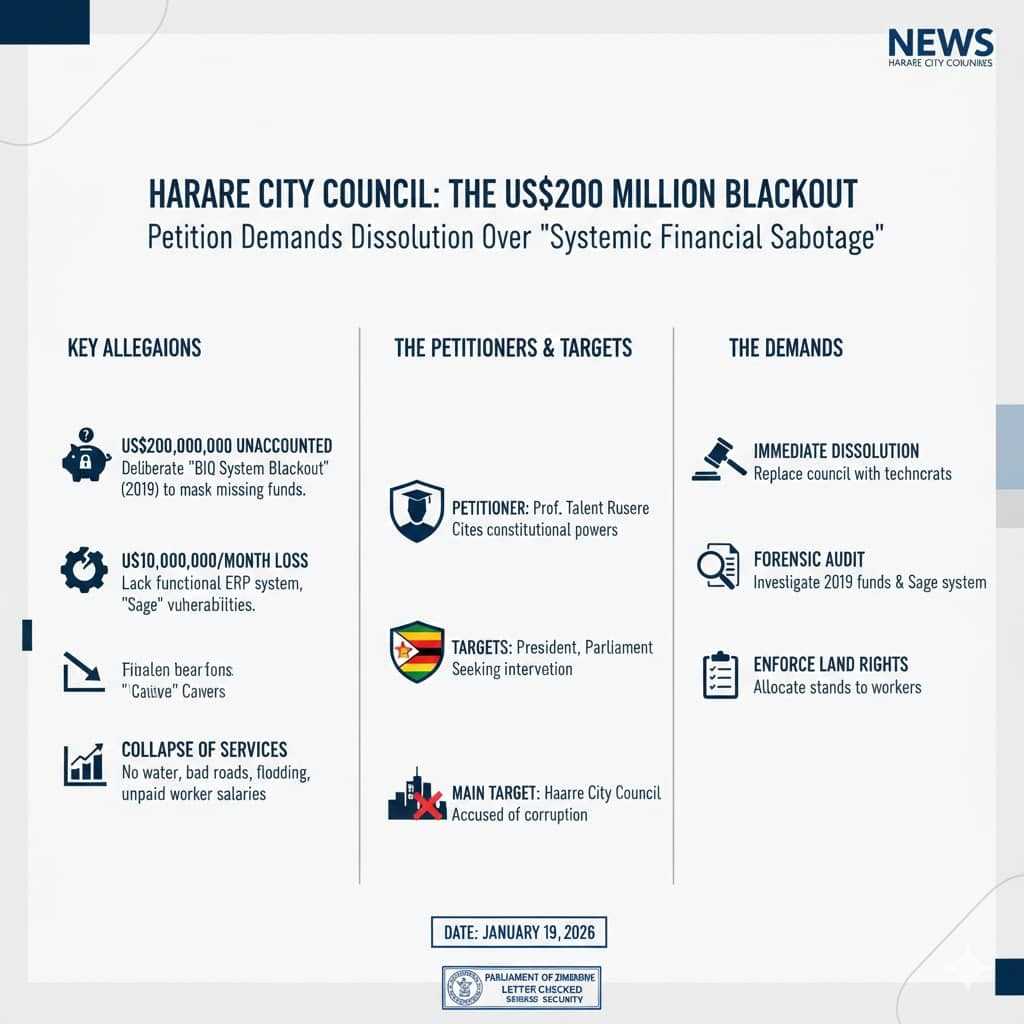
A petition has been filed with President Emmerson Mnangagwa and Parliament seeking the immediate dissolution of the Harare City Council, alleging that a deliberate "systemic blackout" was used to mask the disappearance of US$200 million in public funds.
The petition, authored by Professor Talent Rusere and stamped by Parliamentary security on January 20, 2026, alleges systemic corruption and a "catastrophic failure" of municipal governance.
The document outlines a series of grievances ranging from the manipulation of financial software to the total collapse of essential city services.
Allegations of Financial Malpractice
The petition centers heavily on the HCC’s transition between financial management systems.
Key allegations include claims that the council deliberately terminated the "BIQ" system in March 2019 to mask US$200 million in unaccounted funds, leaving the city without a receipting system for six months.
"The 2019 Blackout in March 2019. the MCC deliberately terminated the BBQ system to mask US$200 million in unaccounted funds. For six months, the city operated without a receipting system, rendering millions in revenue untraceable," the petition says.
The petitioner further asserts that the subsequent transition to "Sage" software allowed "Super Users" to disable audit servers and delete accounts without leaving a digital footprint.
Monthly Revenue Losses: Rusere’s financial analysis suggests the city is losing between US$5.8 million and US$10.8 million monthly due to the lack of a functional Enterprise Resource Planning system.
Labor and Service Delivery Concerns
Related Stories
Beyond financial figures, the petition highlights a breakdown in labor relations and infrastructure. It accuses the HCC of failing to honor a 2016-2017 agreement to provide residential land to workers in lieu of salary arrears. Furthermore, the Municipal Workers Union of Zimbabwe is accused of "union complicity," allegedly abandoning its mandate to fund luxury travel while workers face three-month salary backlogs.
Regarding the city's state, the petition describes a "total lack of water supply," a "disintegrated road network," and a drainage system that leads to flooding in the Central Business District within minutes of rainfall.
Legal Basis and Formal Demands
The petition cites Section 80 of the Urban Councils Act, which grants the President authority to appoint a commission to manage a council that is unable to perform its duties. It also references Sections 68 and 106 of the Constitution, regarding administrative justice and the state's duty to punish corruption.
The "Prayers" (formal demands) of the petition include:
Immediate Dissolution: Replacing the current HCC administration with an interim commission of "qualified technocrats."
Forensic Audit: A mandate for the Auditor-General and the Zimbabwe Anti-Corruption Commission to investigate the 2019 receipting void and Sage system logs.
Union Investigation: An inquiry into the MWUZ by the Ministry of Labour.
Land Rights Enforcement: The immediate allocation of residential stands to entitled workers.
The petition concludes by describing the Harare City Council as having transitioned into a "syndicate of financial sabotage."
In 2024, President Emmerson Mnangagwa appointed a Commission of Inquiry led by Justice Maphios Cheda to investigate deep-seated corruption, mismanagement, and governance failures at the Harare City Council dating back to 2017.
The commission uncovered extensive financial losses, illegal land sales, abuse of authority by senior officials, excessive executive salaries, and the failure to implement critical systems such as an Enterprise Resource Planning platform.
Public hearings were held, during which council officials and other witnesses gave testimony that exposed widespread graft within the local authority.
The findings were presented to Mnangagwa in mid-2025.








Leave Comments