






CFI Holdings Limited has posted a return to profitability for the year ended 30 September 2025, marking a sharp turnaround from the previous year’s losses despite operating in a difficult macroeconomic environment characterised by tight liquidity and rising competition from the informal sector.
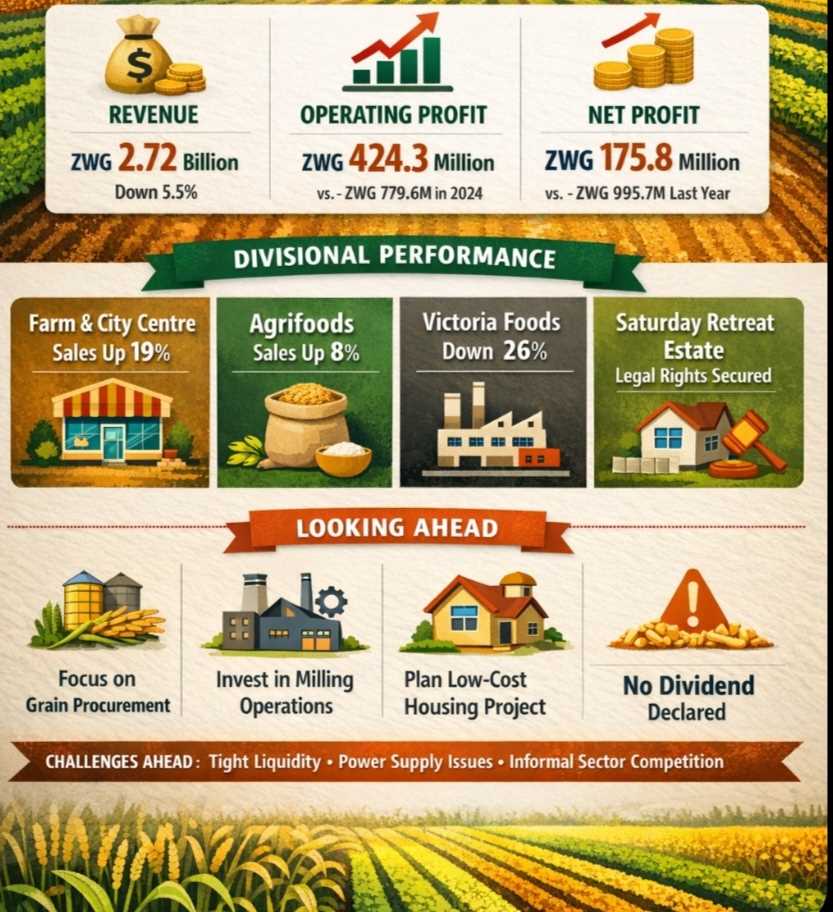
In its abridged audited financial results released this week, the agri-industrial group reported a profit for the year of ZWG$175.8 million, reversing a loss of ZWG$995.7 million recorded in 2024. Operating profit improved significantly to ZWG$424.3 million from an operating loss of ZWG$779.6 million in the prior year, underpinned largely by unrealised exchange gains and improved operational efficiencies.
Inflation-adjusted revenue, however, declined by 5.5 percent to ZWG$2.72 billion from ZWG$2.87 billion in 2024, reflecting subdued consumer demand and intensifying competition, particularly from informal traders.
Commenting on the performance, CFI Holdings chairperson Ms I.V. Pasi acknowledged the challenging trading environment but said the Group had demonstrated resilience under pressure.
“The operating environment remained difficult, marked by tight liquidity and heightened competition from the informal sector. Despite these challenges, the Group recorded a return to profitability, driven largely by unrealised exchange gains on foreign currency-denominated obligations and strengthened operational discipline,” Pasi said.
She added that management remained cautiously optimistic going forward, noting that internal systems and controls were being reinforced to sustain the recovery.
Operationally, the group delivered a mixed performance across its divisions. The Retail division recorded strong volume growth, with Farm & City Centre achieving a 19 percent increase in key sales volumes, supported by improved agricultural activity. Agrifoods also posted an 8 percent rise in sales volumes during the period.
In the Farming division, Glenara Estates maintained stable operations across summer cropping, potato production and cattle activities, providing a measure of consistency amid broader market volatility.
Related Stories
However, performance in the Milling division weakened, with Victoria Foods recording a 26 percent decline. The Group attributed the drop to prolonged power supply disruptions and ongoing challenges in securing raw materials.
CFI’s Properties division also recorded a notable development during the year after the Constitutional Court confirmed the Group’s legal rights to Saturday Retreat Estate, clearing the way for the formulation of a development strategy.
“The confirmation of our legal position on Saturday Retreat Estate represents a significant milestone for the Group and allows us to begin planning value-enhancing development initiatives,” Pasi said.
The group said the operating environment showed signs of stabilisation during the year following the introduction of tighter monetary policies, which helped curb inflation but also constrained liquidity.
While higher commodity prices and diaspora remittances supported economic activity, the rapid expansion of the informal sector continued to erode volumes in the formal retail space, contributing to the decline in turnover.
CFI Holdings said it would focus on sustainable growth, with particular emphasis on strengthening procurement strategies for grain commodities and investing in milling operations to enhance long-term competitiveness.
A longer-term objective remains the development of low-cost housing in Harare South once all outstanding issues affecting the Group’s land banks are resolved.
“Our priority is to balance financial recovery with long-term value creation. We will continue to invest prudently in our core operations while positioning the Group for future growth opportunities,” Pasi said.
Despite the return to profitability, the Board resolved not to declare a dividend for the year, citing the Group’s existing debt position and the need to preserve capital for operational requirements and strategic investments.
CFI Holdings warned that future performance remains subject to risks including persistent liquidity constraints, unreliable power supply, raw material procurement challenges in the milling division, and sustained competition from the informal sector.








Leave Comments