



British American Tobacco South Africa’s decision to close its Heidelberg cigarette manufacturing plant by the end of 2026 is more than a routine corporate restructuring. It is a clear signal that South Africa’s legal cigarette market has reached a tipping point, overwhelmed by illicit trade to the extent that formal manufacturing has become economically untenable.
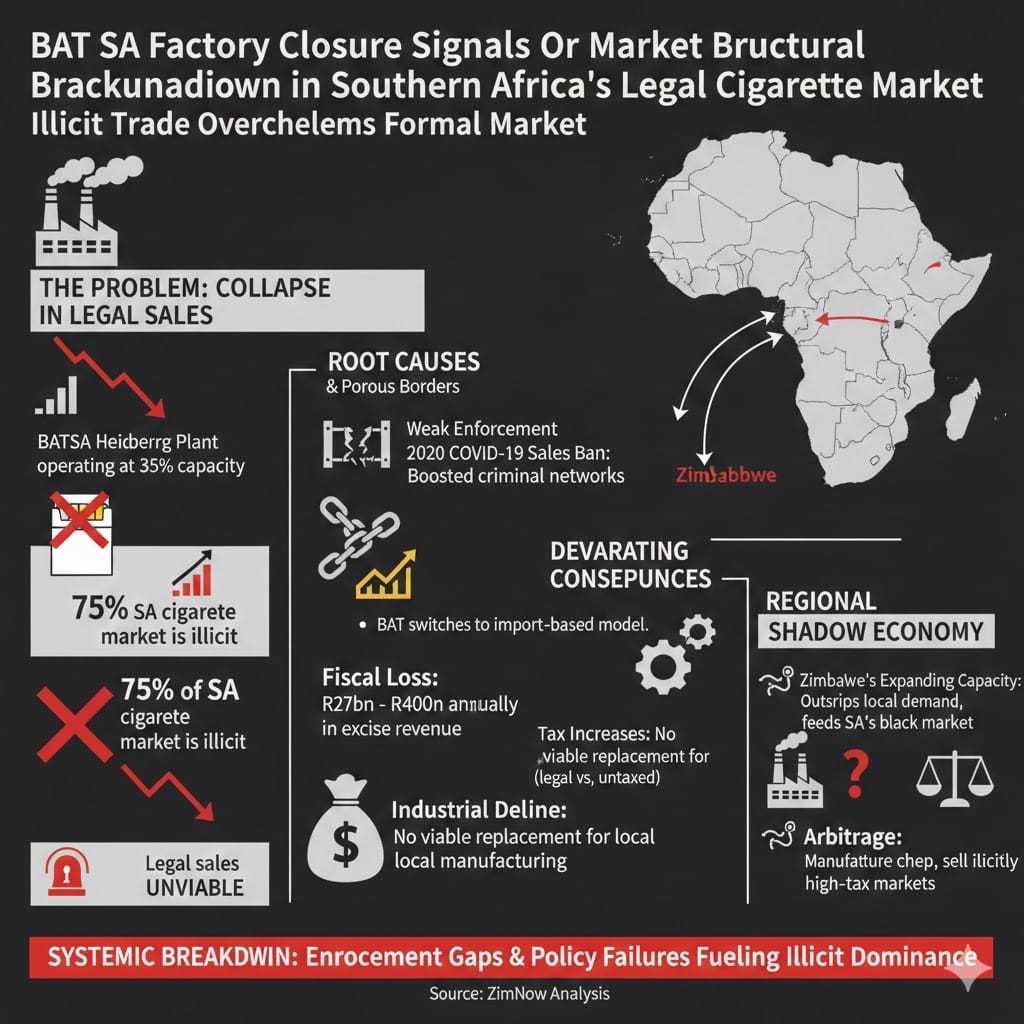
At the centre of BATSA’s decision is a collapse in legal sales volumes. The company says its only local factory has been operating at about 35% capacity, a level that makes sustained production unviable regardless of efficiency or scale.
With illicit cigarettes estimated to account for roughly 75% of all cigarettes sold in South Africa, legal manufacturers are effectively competing for a shrinking fraction of the market.
This outcome reflects a structural failure rather than a cyclical downturn. For years, South Africa maintained a strong formal tobacco industry supported by domestic manufacturing, predictable tax collection, and a regulated retail environment. Prior to 2020, BATSA alone controlled more than 70% of the legal market.
That foundation has since eroded, driven by a combination of weak enforcement, porous borders, and policy shocks that permanently altered market behaviour.
The 2020 COVID-19 cigarette sales ban marked a decisive rupture. By abruptly removing legal supply while demand persisted, the ban created space for criminal networks and informal traders to scale up distribution. Once entrenched, these networks proved resilient.
Subsequent tax increases, implemented in pursuit of public health objectives, further widened the price gap between taxed and untaxed products, reinforcing consumer migration to illicit brands.
The fiscal consequences are stark. Estimates suggest South Africa is losing between R27 billion and R40 billion annually in cigarette excise revenue. Revenue authorities have repeatedly pointed to stagnant excise collections despite stable smoking prevalence as evidence that legal products are being displaced, not that consumption is falling. From a market perspective, this implies that the industry has not shrunk; it has simply moved outside the tax net.
BATSA’s exit from domestic manufacturing exposes another critical weakness: the absence of a viable legal replacement. In theory, other multinational or local producers could step in.
In practice, no rational investor is likely to commit capital to large-scale manufacturing in a market where three-quarters of sales are illicit and enforcement remains inconsistent. The economics do not work, regardless of labour costs or production efficiency.
BAT’s decision to switch to an import-based supply model underscores this reality. While imports may reduce fixed costs and allow production in lower-cost jurisdictions, they do not solve the fundamental problem of market capture by illegal products.
Related Stories
Legal imports still carry excise duties and compliance costs, leaving them structurally disadvantaged against untaxed competitors.
The implications extend well beyond South Africa’s borders. The illicit cigarette economy in southern Africa is inherently regional, shaped by cross-border trade, tax differentials, and uneven enforcement.
Neighbouring countries such as Zimbabwe, Mozambique, and Eswatini feature prominently in analyses of supply routes feeding South Africa’s informal market.
Zimbabwe’s role is particularly contentious. While its domestic cigarette consumption is relatively small and largely stagnant, manufacturing capacity has expanded sharply. New factories, including facilities reportedly capable of producing several times local demand, raise difficult questions about end markets.
On purely commercial grounds, such capacity expansion is hard to justify if the primary destination is the formal export market, where high excise taxes erode competitiveness.
This mismatch between capacity and legitimate demand suggests that enforcement gaps, rather than market fundamentals, are shaping investment decisions. In effect, weak regional coordination creates arbitrage opportunities: cigarettes can be manufactured cheaply in one jurisdiction and sold illicitly in another at prices that undercut all legal alternatives.
The result is a shadow supply chain that rewards scale without accountability.
Not all manufacturers benefit equally from this environment. BAT Zimbabwe, for example, operates within a multinational compliance framework that limits its exposure to grey or informal channels. While it enjoys cost advantages over South African production, it still faces currency risk, logistics costs, and regulatory scrutiny that illicit operators do not.
This asymmetry helps explain why formal players struggle to compete even when production shifts to lower-cost countries.
The broader economic lesson is that illicit trade does not merely reduce tax revenue; it reshapes industrial geography. As formal manufacturers exit high-tax, weak-enforcement markets, production either migrates to jurisdictions with lower costs or disappears from the formal economy altogether. Over time, this hollows out domestic industrial capacity, erodes employment, and weakens regulatory control.
BATSA’s factory closure therefore represents a warning sign. It shows that once illicit trade reaches a critical mass, policy options narrow. Enforcement becomes harder, not easier, as illegal networks gain scale and legitimacy in the eyes of consumers. Tax increases yield diminishing returns, and formal investment retreats.
Reversing this trajectory would require more than incremental policy adjustments. It would demand sustained enforcement, regional coordination on customs and excise, effective tracking and tracing systems, and a recalibration of tax policy to align public health goals with enforcement capacity. Without such measures, the legal cigarette market in South Africa risks further contraction, while the regional shadow economy continues to expand.
In that sense, BATSA’s withdrawal is not an isolated corporate event. It is evidence of a systemic breakdown in how the tobacco market is governed in southern Africa, with consequences that extend far beyond cigarettes.









Leave Comments