






A wave of disturbing claims and confessions involving domestic workers keeps spilling from private homes into national conversation, forcing employers, workers and advocates to confront uncomfortable realities about power, poverty and trust inside Zimbabwean households.
Most of the most viral anecdotes hit raw nerves: an employer says she found blood stains on kitchen linen and was told it had been used during menstruation; another claims a maid used rituals for the children to “love her more than their mother”; another describes returning home to find her maid breastfeeding her baby.
On the other side of that same conversation are domestic workers describing a daily life as long hours, unclear duties, eating leftovers, being barred from household utensils, and being dismissed without notice.
In that reality, a “shocking” act can be less about witchcraft or depravity and more about desperation, anger and an unequal power relationship that has no rules, no oversight
The numbers behind the tension
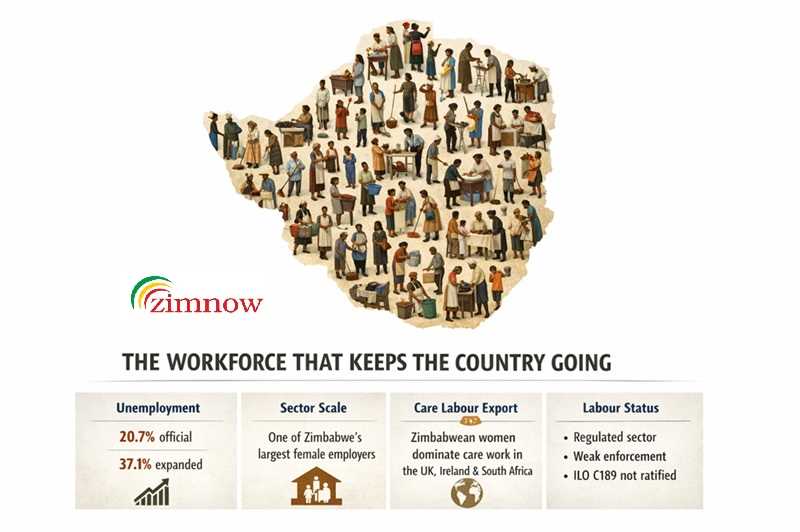
Zimbabwe’s domestic work sector is huge, but it is also statistically slippery because it sits in informality. ZIMSTAT’s Quarterly Labour Force Survey for the second quarter of 2025 put the official unemployment rate for people aged 16+ at 20.7%, with an “expanded” unemployment and potential labour force measure at 37.1%. Youth unemployment was far higher on both measures. In that economy, domestic work is one of the few survival jobs available to women with limited options.
Wages are another pressure point. Domestic workers fall under sector-specific regulations and amendments that set grades and wage structures for yard workers, cooks, housekeepers and child minders.
This fragmented system is exactly the kind of gap that produces a sector where employers believe they are doing someone a favour, while workers know they are trapped in a job that is essential, intimate, and routinely undervalued.
What the law says, and where it fails in real life
The Labour (Domestic Workers) Employment Regulations lay out basics around payment, leave, termination and other conditions, and worker education materials aligned to Zimbabwe’s framework emphasise that employers must provide written contracts.
But the gap is enforcement. A private household is not a factory floor. Labour inspectors do not casually walk through bedrooms and kitchens. Abuse and exploitation can persist because the “workplace” is shielded by privacy, culture and fear of conflict. Even where legal rights exist on paper, they are often unknown, unenforced, or negotiated away in the name of “we are family”.
There is also the social protection gap. Domestic workers and their unions have raised concerns about exclusions that leave domestic workers outside key protections, including workplace injury cover, precisely because the workplace is a private home.
And there is the international standards gap. The International Domestic Workers Federation has noted that Zimbabwe has not ratified ILO Convention 189 on decent work for domestic workers, even as domestic workers push for stronger recognition and collective bargaining.
All of this creates a sector where trust is demanded, but accountability is optional.
Case studies that show the system.
Menstruation as a workplace risk.
If a domestic worker cannot afford sanitary products, menstruation becomes a monthly crisis managed in secrecy. Worker education materials and union advocacy frequently frame “dignity at work” as including access to basic welfare needs. What the viral towel story reveals is not merely “bad hygiene”, but a poverty problem playing out inside an
The home as a high-conflict workplace.
Domestic workers often work without clear job descriptions and boundaries, while employers expect loyalty, gratitude and silence. The regulations create employment rules, but the lived reality is blurred: work ends when the household sleeps, and conflict has no HR office. In that environment, petty retaliation and paranoia become more likely, not because domestic workers are inherently dangerous, but because the workplace is structurally combustible.
Related Stories
Zimbabwe’s domestic labour exported.
In South Africa, domestic work is a massive sector. A 2025 academic paper referencing Statistics South Africa (2024) notes about 861,000 domestic workers in the country, and highlights that migrant domestic workers, including Zimbabweans, form a significant part of this workforce even when exact numbers are hard to pin down. For Zimbabwe, it means domestic work is not only a local class arrangement but also a regional migration strategy.
Further afield, Zimbabwean care labour is a known pathway in the diaspora. An IOM study on Zimbabweans abroad found that in the UK, the most common reported jobs included carers/care assistants (13%) and nurses (12%). The care sector also has well-documented exploitation risks for migrant workers, including recruitment fee abuse and sponsorship dependency, as detailed in research and union reporting in the UK context.
The pattern is consistent: Zimbabwe’s women are doing the intimate labour that keeps other societies functioning, often under conditions that are tolerated precisely because the work is hidden.
Voices calling for order: unions, worker groups, and rights advocates
The Zimbabwe Domestic and Allied Workers Union (ZDAWU), an affiliate of ZCTU, is part of a growing push to treat domestic work as real work with real protections. Regional and global domestic worker federations have also tracked Zimbabwe’s organising efforts, including movement toward collective bargaining, while underscoring gaps like the absence of ILO C189 ratification.
The Southern African Development Community Protocol on Employment and Labour (2014) sets out regional principles to promote decent work, social protection, non-discrimination and improved working conditions across all sectors of labour, including informal work such as domestic work, by encouraging harmonised employment and labour policies among SADC Member States.
This fits in with rights-based worker education resources that insist on written contracts, defined duties, lawful termination, and dignity at work as enforceable labour standards.
The fixes Zimbabwe can implement now, without pretending it is complicated
Professionalising domestic work is not a slogan. It is a checklist Zimbabwe can actually execute.
Start with universal written contracts and basic job descriptions that define duties, hours, rest days and termination terms, grounded in existing regulations and worker rights guidance.
Then build a light-touch registration system through local authorities or a recognised workers’ association so the sector becomes legible enough for enforcement without turning homes into police zones.
Next, set minimum dignity standards that are non-negotiable: access to clean bathrooms, safe sleeping arrangements for live-in workers, and basic welfare needs that prevent desperation from becoming “scandal”.
Finally, strengthen social protection coverage so domestic workers are not excluded from protections simply because their workplace is private.
Zimbabwe’s current moment is an opportunity. The allegations and confessions grabbing attention are symptoms. The disease is informality, weak enforcement, and a national habit of treating essential labour as disposable.
The question is not what happens behind closed doors. The question is why Zimbabwe keeps building workplaces where anything can happen, and then acting surprised when it does.








Leave Comments