







Econet Wireless Zimbabwe’s third-quarter trading update for the period ended 30 November 2025 signals a deliberate shift from scale-driven expansion to asset clarity and shareholder value optimisation, as the telecoms group deepens network investment while preparing for a landmark infrastructure spin-off.
At a time when capital markets are increasingly rewarding balance sheet transparency and predictable cash flows, Econet is positioning its infrastructure assets as a standalone growth story, even as its core mobile and financial technology businesses continue to post strong operating momentum.
“The Group continued to demonstrate resilience and adaptability in a dynamic digital landscape,” Econet said, reaffirming its commitment to “becoming a leading digital services provider” through sustained investment in network infrastructure and intelligent technologies.
Infrastructure as the new growth anchor
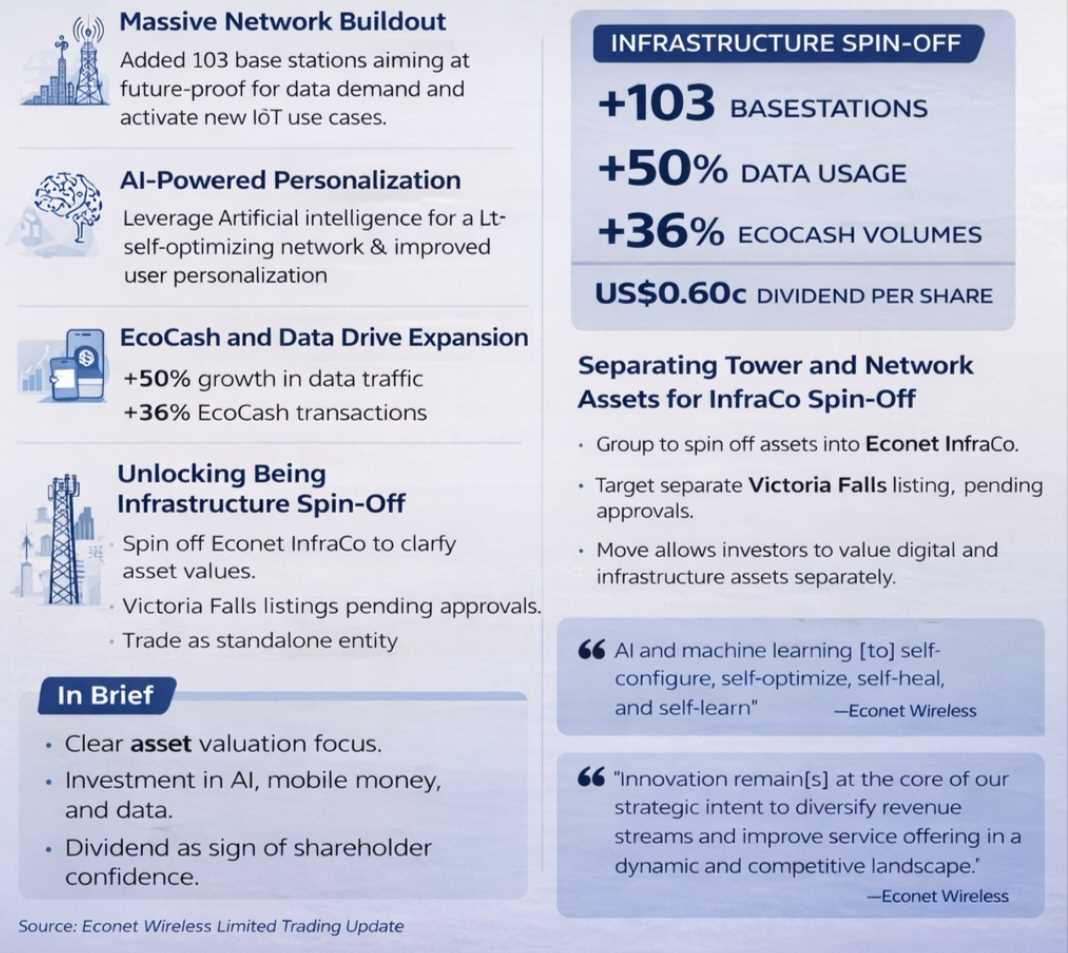
During the quarter, Econet rolled out 103 additional base stations nationwide, 27 of which were lightweight, cost-effective units targeting underserved urban and rural areas.
Management said the expansion is aimed at future-proofing the network for rising data demand and emerging digital use cases.
“These installations form the backbone for future innovations, enabling the business to introduce new product offerings and activate a range of internet of things use cases to unlock new markets,” the Group said.
Beyond physical rollout, Econet completed a core network expansion for voice and data, a move it says will enhance service quality and support rising usage volumes. The company also highlighted progress on a new billing and subscription platform designed to automate business processes and deliver more personalised, customer-centric digital experiences.
Econet is increasingly embedding artificial intelligence into its operations, a strategy that reflects a broader industry shift toward predictive and self-healing networks.
“Artificial intelligence continues to be a key enabler to support and accelerate digital transformation,” the group said, noting that AI and machine learning are being used “to prevent and mitigate disruptions” and enable the network to “self-configure, self-optimise, self-heal, and self-learn.”
The operator is also leveraging AI-powered analytics to track customer usage trends in real time, allowing it to design and deliver highly personalised solutions, a capability that is becoming critical as competition intensifies across data and digital services.
Operationally, data remains the backbone of Econet’s revenue growth. The Mobile Network Operations segment recorded a more than 50 percent increase in data usage compared to the same period last year, while voice usage grew by 35 percent.
Related Stories
“Data usage remained the primary growth driver,” the company said, adding that continued infrastructure investment is essential to sustain volumes and improve customer experience.
In financial technology, EcoCash posted a 28 percent increase in customer activity, while transaction volumes rose 36 percent. Wallet funding grew 39 percent year-on-year, underlining the platform’s deepening role in everyday transactions.
The group said its strategy of expanding mobile financial services accessibility has driven an “increase of 88% in footprint compared to the same period last year,” reinforcing EcoCash’s position as a core pillar of Econet’s digital ecosystem.
Econet’s insurance operations also recorded steady gains. The Group reported volume growth across the board, with life insurance registering a 10 percent increase in individual policies.
Short-term insurance policyholders rose by 81 percent, while medical aid membership grew by 9 percent.
Though still a smaller contributor relative to telecoms and fintech, the insurance segment is increasingly viewed as a complementary revenue stream that benefits from Econet’s distribution reach and data capabilities.
The most consequential development, however, lies in the Group’s post-quarter restructuring, which saw the consolidation of real estate and passive telecoms infrastructure assets into a dedicated entity, Econet Infrastructure Company.
The company said the reorganisation is intended to “enable clearer visibility of asset values, focused capital allocation, and a distinct operational strategy for infrastructure deployment and management.”
Econet has begun engagements with the Zimbabwe Stock Exchange to finalise a proposed voluntary delisting, alongside the simultaneous listing of Econet InfraCo on the Victoria Falls Stock Exchange, subject to shareholder and regulatory approvals.
Once completed, the move is expected to reshape how investors value Econet, separating infrastructure-heavy, capital-intensive assets from higher-growth digital and services businesses.
In a signal of confidence, the Board declared and paid an interim dividend of US0.60 cents per share for the quarter.
Econet said it remains focused on improving customer experience and process efficiencies through AI-driven solutions, including fraud detection and hyper-personalised services.
“Innovation will remain at the core of our strategic intent to diversify revenue streams and improve service offering in a dynamic and competitive landscape,” the group said.










Leave Comments