





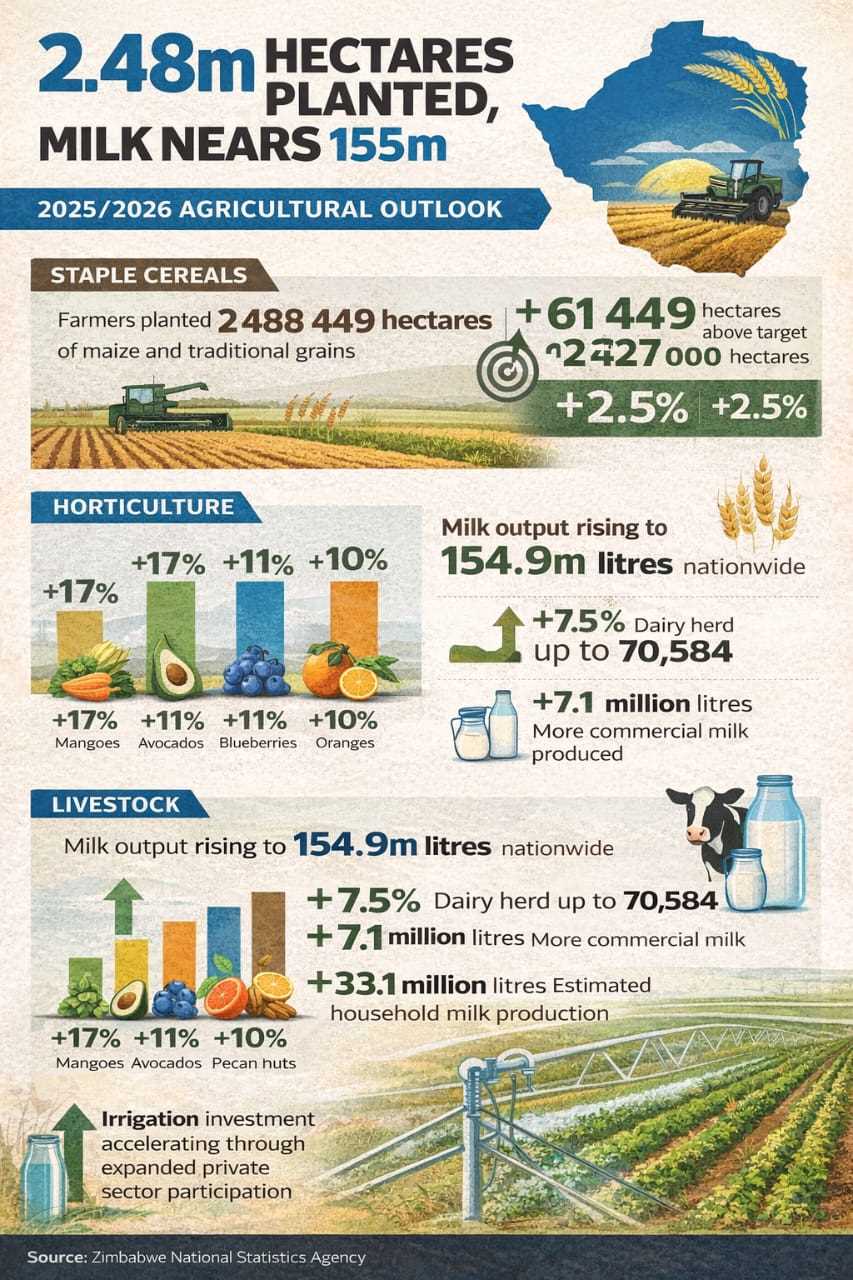
Zimbabwe’s agricultural sector has exceeded its cereal planting target for the 2025/2026 season, with 2 488 449 hectares now under staple crops against an initial target of 2 427 000 hectares, while national milk production has surged to approximately 154 947 843 litres signalling firm recovery momentum across crop and livestock value chains.
The latest national assessment, conducted by the Zimbabwe National Statistics Agency, shows expanded uptake of maize and traditional grains, reflecting improved coordination and farmer participation across provinces.
Lands, Agriculture, Fisheries, Water and Rural Development Minister Anxious Jongwe Masuka said the gains reinforce the need to consolidate resilience mechanisms within the sector.
Minister Masuka said government will accelerate climate-proofing agriculture at both household and national levels, through the Pfumvudza/Intwasa initiative, underscoring the importance of conservation farming and climate adaptation in sustaining productivity gains.
High-value horticulture crops also registered notable growth, strengthening prospects for agro-processing and export earnings.
Related Stories
Mango production rose by 17 percent, avocado by 11 percent, blueberries by 11 percent, oranges by 10 percent and pecan nuts by 10 percent. The upward trend reflects diversification within commercial agriculture and growing participation in fruit and nut markets linked to regional and international demand.
Livestock indicators present a mixed but generally positive outlook. The national beef herd increased marginally by 0.3 percent from 5 741 397 in 2024 to 5 760 678 in 2025, while the dairy herd expanded by 7.5 percent from 65 659 to 70 584. The dairy expansion translated into a 6.2 percent rise in commercial raw milk production, from 114 699 440 litres in 2024 to 121 846 916 litres in 2025.
Household dairy output was estimated at 33 100 927 litres, bringing total national milk production to nearly 155 million litres. The combined increase strengthens domestic supply chains and supports import substitution in the dairy sub-sector.
He said irrigation development will be intensified through encouraging increased private sector participation to expand the functional irrigation areas, positioning irrigation as a stabilising factor against rainfall variability.
He added that agro-ecological tailoring of production and soil fertility management would be maintained through enhanced agricultural information management systems.
The Minister further indicated that community participation in strengthening the Strategic Grain Reserve would be enhanced, while Rural Development 8.0 interventions would be accelerated to empower local communities and anchor agricultural growth at grassroots level.
With planted area exceeding projections, horticulture output rising and dairy production trending upward, the sector is consolidating recovery underpinned by climate adaptation, irrigation expansion and production diversification key pillars for sustaining food security, agro-industrial growth and rural incomes.








Leave Comments