









Zim Now Analysis Desk
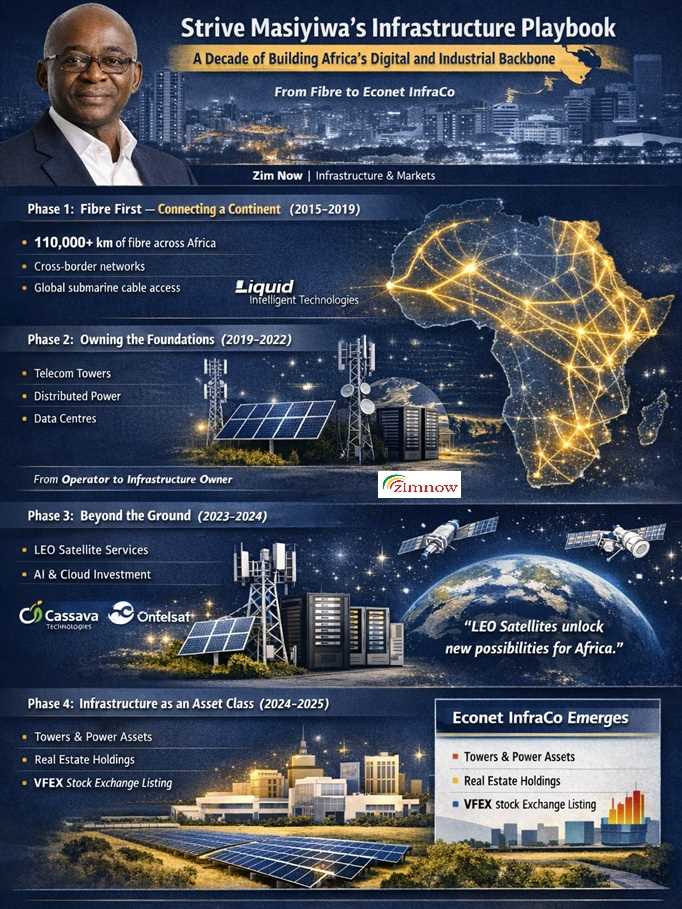
In a development poised to reshape Zimbabwe’s capital markets and investment landscape, Econet Wireless Zimbabwe sheared off its infrastructure assets into a new entity, Econet Infrastructure Company Ltd. (Econet InfraCo), for listing on the Victoria Falls Stock Exchange.
The move, driven by decades of under-appreciation of the company’s asset value, reflects a strategic refocus on unlocking shareholder value and positioning the business for deeper engagement with USD-based capital markets.
Under the restructuring, Econet Wireless is segregating passive infrastructure, including towers, real estate, distributed power, and data centers, into Econet InfraCo. This structure follows global and regional precedent where telecommunications groups separate their towerco and infrastructure units to attract infrastructure-focused investors and realize clearer valuation metrics.
According to the company’s cautionary announcements, the parent group’s shares have long traded at a substantial discount relative to African peers whose infrastructure divisions have been unbundled and monetized, typically trading at six to eight times enterprise value to EBITDA. The VFEX, trading in US dollars, offers a more fitting venue to reflect the intrinsic worth of infrastructure assets and attract global capital.
Industry observers see this as a significant pivot for Zimbabwe’s capital markets. As Business Insider Africa notes, the enterprise value gap stems from comparables in Africa, where tower spin-offs have unlocked considerable investor interest, and Econet’s plan mirrors these international best practices.
Parallel to the listing strategy, Econet InfraCo has unveiled its first major development project: a 300-hectare industrial park near Harare’s Robert Mugabe International Airport. The park will be underpinned by a 100 MW solar power facility and a large-scale data center, delivering foundational infrastructure for manufacturing, logistics, and export-oriented businesses.
Econet Group CEO Douglas Mboweni summarized the vision: “Our vision is to create the infrastructure, such as power and water facilities, needed for a modern industrial park. This will make it easier for investors to come in, take advantage of the location, and create jobs.”
Mboweni emphasized the project’s alignment with national industrialization and export-led growth agendas, positioning the park as one of the largest private-sector developments since Zimbabwe’s independence.
Related Stories
While Econet InfraCo is Zimbabwe’s latest corporate incarnation, the broader network of Strive Masiyiwa’s ventures underscores a continental infrastructure push beyond national borders.
One of the most consequential is Liquid Intelligent Technologies, the pan-African digital infrastructure company within the Econet/Cassava Technologies ecosystem. Its fiber network exceeds 110,000 km, linking major markets across the continent and facilitating international connectivity—a backbone that underpins everything from cloud services to cross-border digital trade corridors.
In a major connectivity advance, Liquid partnered with Eutelsat Group to introduce Low-Earth-Orbit (LEO) satellite services across multiple African markets. Ahmed El Beheiry, CEO of Liquid Intelligent Technologies, described the agreement as “a milestone in bringing cutting-edge LEO services to our customers across multiple countries in Africa, empowering them with high-speed solutions and unlocking new possibilities for connectivity.”
This integration of satellite and terrestrial infrastructure not only expands reach in underserved regions but also fortifies resilience, essential for enterprise adoption of digital services such as cloud computing and real-time applications.
Further afield, Masiyiwa’s Cassava Technologies is advancing AI “factories” across five African countries, including South Africa, Nigeria, Kenya, Egypt, and Morocco. Masiyiwa said these facilities would empower African businesses, start-ups, and researchers with access to advanced AI infrastructure, reducing reliance on foreign cloud platforms and accelerating local innovation.
Econet InfraCo’s proposed listing on VFEX represents an opportunity to attract global infrastructure capital in US dollars, potentially boosting liquidity and investor confidence in the broader economy. If executed successfully, this could also set a precedent for other capital market reforms and value-unlock strategies in the region.
From a corporate strategy perspective, separating infrastructure from operating businesses provides clearer investment narratives: passive assets like towers and solar can appeal to yield-focused institutional investors, while digital services remain agile and innovation-centric.








Leave Comments