








Cut Rag Processors (CRP) has positioned sustainability, domestic processing and farmer support as key pillars of its strategy, underscoring the company's role in strengthening Zimbabwe's tobacco value chain.
In a statement this week, CRP said its operations are aligned with the Tobacco Industry and Marketing Board’s vision for environmentally responsible production, including sustainable curing practices and the protection of natural resources. The company also underscored its commitment to increasing local processing of tobacco as part of Zimbabwe’s broader industrialisation agenda.
“As we step into 2026, Zimbabwe’s tobacco industry stands at the intersection of growth and responsibility,” CRP said. “We are proud to contribute through excellence in cut rag processing while championing the farming communities that power our golden leaf.”
The company highlighted value addition as a key pillar of its strategy, noting that processing more tobacco domestically helps retain economic benefits within the country. CRP also said it is strengthening partnerships with growers, describing farmers as the backbone of the industry.
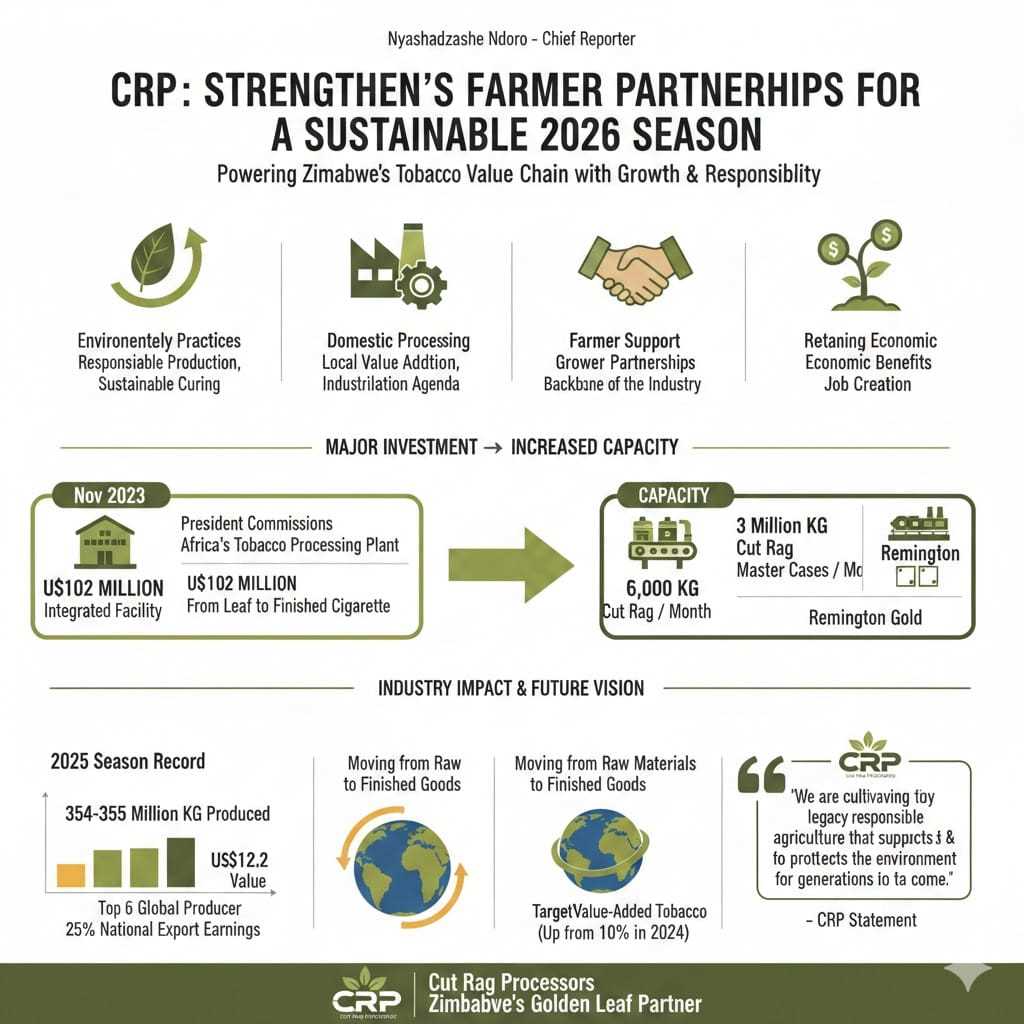
The statement comes against the backdrop of major recent investments in the sector. In November last year, President Emmerson Mnangagwa commissioned a multi-million-dollar expansion at CRP, making it Africa’s largest tobacco processing plant. The facility has the capacity to process three million kilogrammes of cut rag per month and produce up to 60 000 cigarette master cases monthly.
The US$102 million integrated plant, which combines primary and secondary manufacturing lines, enables tobacco to be processed from leaf to finished cigarettes within a single operation. CRP is one of Zimbabwe’s largest exporters of cut rag and manufactures the Remington Gold cigarette brand.
Related Stories
The commissioning followed a record 2025 tobacco marketing season in which Zimbabwe produced about 354–355 million kilogrammes of tobacco, valued at approximately US$1,2 billion. The output cemented the country’s position among the world’s top six tobacco producers and reinforced the crop’s role as a major source of foreign currency, contributing more than 25 percent of national export earnings.
At the launch, President Mnangagwa described the CRP investment as evidence of Zimbabwe’s industrial resurgence and growing private-sector confidence, linking it to government reforms aimed at reducing bureaucratic barriers to investment. He said the plant would help shift the country from exporting raw materials to finished goods.
CRP management has also emphasised the economic impact of the expansion. General manager Lesley Malunga previously said the facility would allow Zimbabwe to capture more value locally by exporting refined cut rag and finished cigarettes rather than unprocessed leaf, while creating hundreds of jobs in processing, packaging and support services.
Despite Zimbabwe being Africa’s largest tobacco producer, most of its crop is still exported in semi-processed form. Industry data shows that in 2024 only about 10 percent of tobacco earmarked for value addition was actually processed locally. Under the Tobacco Value Chain Transformation Plan, authorities aim to raise value-added tobacco to 25 percent of total output.
Analysts say investments such as CRP’s significantly expand processing capacity and represent a practical step toward that target, though they caution that value addition must be matched by efficiency gains and market development.
CRP said its approach for the new season is anchored in balancing growth with responsibility. “Together, we are not just processing tobacco,” the company said, “we are cultivating a legacy of responsible agriculture that supports livelihoods and protects our environment for generations to come.”








Leave Comments