






As Zimbabwe and China mark 45 years of diplomatic relations, the winning essays from the “45 Years On: My Views on China–Zimbabwe Friendship” competition reveal interesting perspectives on the relationship between the two countries.
They show how Zimbabweans, especially younger voices, are perceiving power, development, and survival in a fast-shifting global order.
They are stories of reflection, pragmatism, and, in places, pushback against how Africa is often told to see the world.
Natasha Machaya: History as strategy, not nostalgia
Machaya’s winning essay anchors the China–Zimbabwe relationship in shared history—but not sentimentality. Liberation-era solidarity is presented as strategic memory, not emotional attachment.
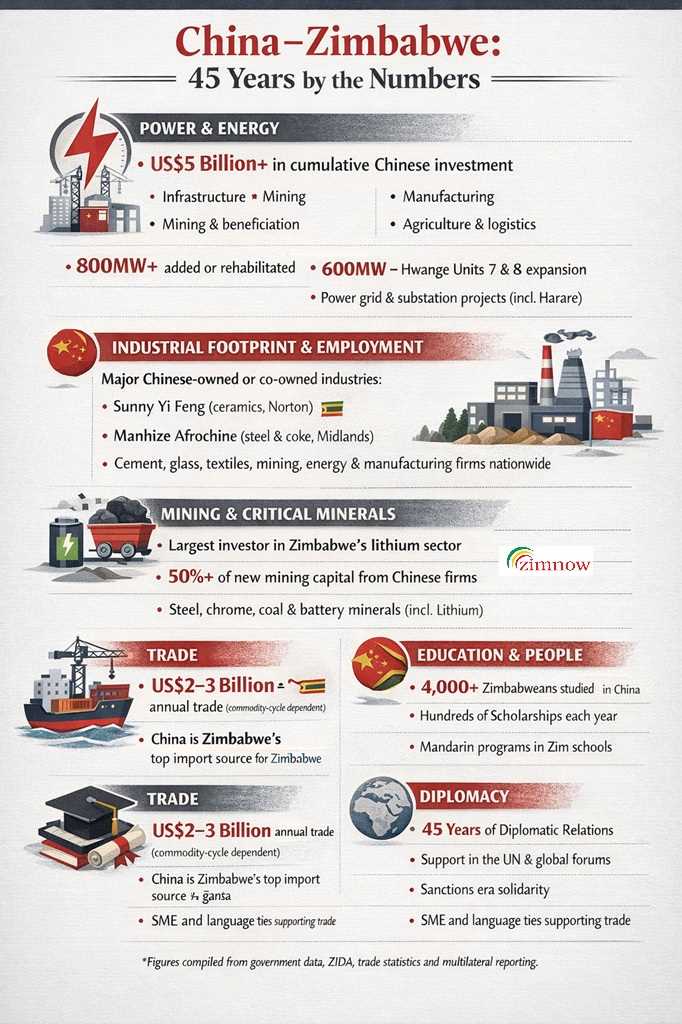
Zimbabwe remains under Western sanctions more than two decades later, while China has steadily expanded its footprint. Since 2000, China has emerged as Zimbabwe’s largest source of foreign direct investment, accounting for an estimated US$4–5 billion in cumulative investment, according to government and ZIDA figures.
Machaya’s argument reflects a wider Global South view: partners who stand with you when options are limited matter more when geopolitics tightens.
Michael-Angelo Kunashe Magadza: Development without apology
Magadza strips development of ideology and looks at outcomes, including roads, energy, skills, and production. The framing fits Zimbabwe’s reality. Chinese firms are involved in:
- Over 70% of Zimbabwe’s large-scale infrastructure projects in the past decade
- Power generation, including the Kariba upgrade and Hwange 7 & 8 (600 MW expansion), as well as smaller projects such as the Nyabira solar plant.
- Major mining investments in lithium, chrome and coal
Globally, his argument mirrors a trend: results-driven development is the way forward, especially as Western aid budgets shrink and conditional lending faces backlash across Africa.
Lodwin Gatsi: Where the relationship actually lives
Gatsi shifts attention away from megadeals to people—students, language, culture, and daily interaction.
The numbers back this up:
- More than 4,000 Zimbabwean students have studied in China over the past two decades
- Mandarin is now taught at several Zimbabwean universities and schools
- Small-scale traders and suppliers increasingly interface directly with Chinese counterparts
This is the quiet layer of diplomacy—less visible, but often more durable.
Robert Chirima: Sovereignty in a Sanctions World
Chirima’s essay hits a nerve Zimbabweans know well: who shows up when you are isolated.
In a world where sanctions are routinely used, from Russia and Venezuela to parts of Africa, China’s policy of non-interference remains appealing to governments that feel politically targeted.
That stance explains why Zimbabwe continues to deepen ties with China even as relations with the West thaw somewhat.
Related Stories
Inzwirashe Chauke: The Future, Not the Flag-Waving
Chauke draws parallels between China’s development path and Zimbabwe’s ambitions, challenging the idea that success must follow a Western script.
Globally, this thinking is gaining traction as countries revisit state-led industrial policy, once dismissed but now openly embraced even in Europe and the US.
Rejoice Govera: The Hard Questions
Govera brings gender and inclusion into the conversation—asking who really benefits from cooperation.
It’s a timely question. While Chinese projects generate jobs, concerns around labor conditions, skills transfer, and local participation continue to surface. Her essay subtly reminds policymakers that legitimacy today is social, not just economic.
Rangarirai Joseph Dumbuka: Time for the present, not the past
Dumbuka’s focus is youth, not as spectators, but as drivers.
With over 60% of Zimbabwe’s population under 30, the future of China–Zimbabwe relations will be shaped less by liberation memories and more by jobs, technology, mobility, and opportunity.
Clive Chiridza and Shepherd Gudyani: Balancing the equation
Chiridza cuts through sentiment and calls the relationship what it is: mutual interest. In today’s multipolar world, that honesty may be its strongest asset.
Gudyani places China–Zimbabwe ties in a bigger frame, a push toward multipolarity, where smaller nations seek options rather than alignment.
That idea is now openly discussed across Africa, Asia, and Latin America as global institutions strain under geopolitical pressure.
What These Essays Really Show
Together, the essays reveal a shift in Zimbabwean thinking towards a space, a more pragmatic view of international relations informed by heightened awareness of global power games.
They neither romanticize China nor seek Western approval. Instead, they ask a harder question: In a world that is fragmenting, who actually shows up, and on what terms?
Zimbabweans, especially younger, educated voices, are reimagining partnership, power, and choice in a contested global moment.






Leave Comments