






Zimbabwe has moved to restrict foreign participation in 13 designated sectors of the economy, as the Ministry of Industry and Commerce issued detailed guidelines to enforce Statutory Instrument 215 of 2025.
The regulations reserve specific industries exclusively for Zimbabwean citizens, with government saying the policy is aimed at protecting local enterprise while steering foreign capital toward high-investment, job-creating activities that support industrialisation.
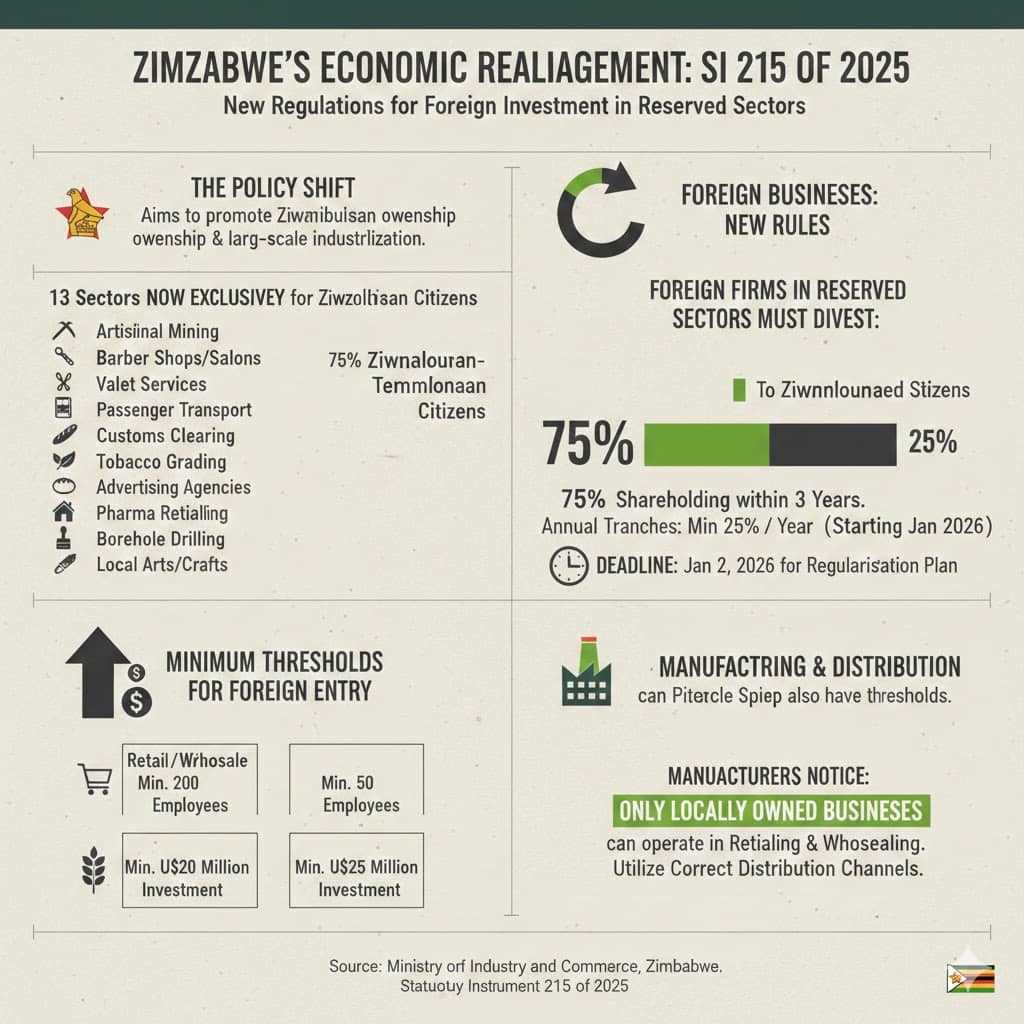
The reserved sectors include artisanal and small-scale mining, barber shops and beauty salons, employment agencies, valet services, passenger transport such as buses and taxis, customs clearing, tobacco grading and packaging, bakeries, advertising agencies, estate agencies, pharmaceutical retailing, borehole drilling, and the marketing and distribution of local arts and crafts.
Foreign-owned businesses currently operating in these sectors are required to dispose of at least 75 percent of their shareholding to Zimbabwean citizens within three years.
The divestment must be done in annual tranches of no less than 25 percent, leaving foreign investors with a maximum retained stake of 25 percent at the end of the transition period.
Related Stories
The Ministry also introduced strict minimum capital and employment thresholds for foreign investors seeking to operate in other controlled sectors. Retail and wholesale trade, for example, now requires a minimum investment of US$20 million and at least 200 employees, while grain milling requires US$25 million in capital and a workforce of no fewer than 50 employees.
Similar thresholds apply to haulage, logistics, and shipping and forwarding.
To manage the transition, foreign-owned firms operating outside the new requirements must submit regularisation plans within 30 days from January 2, 2026. The Ministry said applications will be assessed within 60 days, with additional information requested where necessary.
The Ministry also warned manufacturers that only locally owned entities are permitted to operate in retail and wholesale trade, urging compliance with the revised distribution framework.
“Manufacturing companies are hereby notified to utilise the correct distribution channels, as only locally owned businesses are allowed to operate in the retailing and wholesaling sector,” the Ministry said.







Leave Comments