



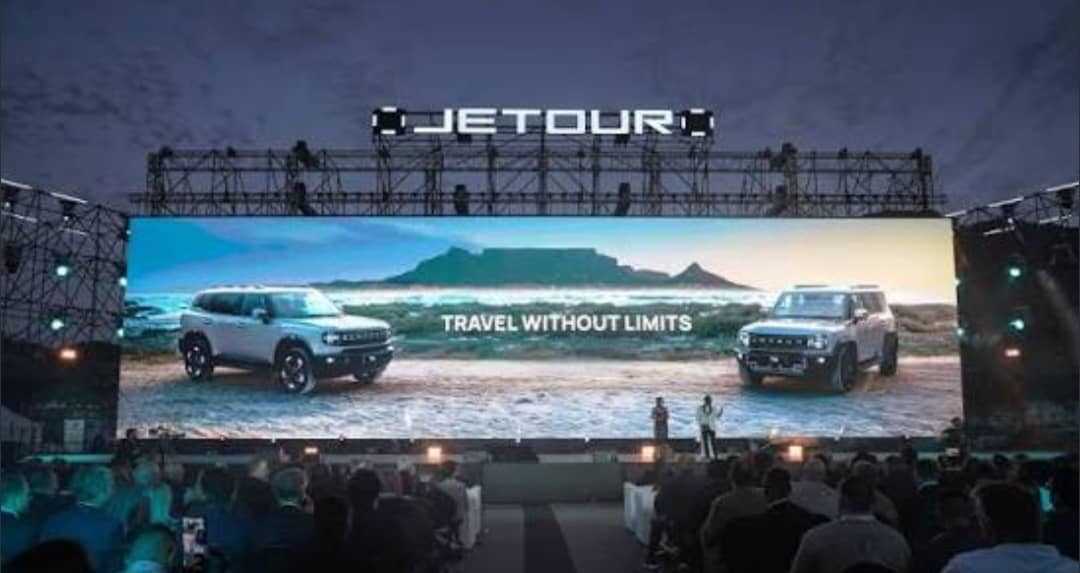
Jetour’s entry into Zimbabwe comes as the country’s SUV market becomes increasingly competitive, with established Japanese and American brands facing growing pressure from Chinese manufacturers offering more technology, longer warranties and aggressive pricing.
The Chinese marque officially launched in Harare on Friday with the Dashing, X70 Plus, T1 and T2, marking its entry into the Zimbabwean market.
Dealer principal Michael Hove said Jetour would compete on technology, comfort and durability while offering customers a 10-year or one-million-kilometre engine warranty, supported by a local parts supply chain and certified technicians.
“Jetour is here to set a completely new benchmark for automotive assurance in this country,” Hove said.
The warranty could help address one of the biggest concerns surrounding newer Chinese brands: after-sales support and long-term reliability.
Jetour is entering Zimbabwe with experience from the larger Southern African market. The company launched in South Africa in 2024 and says it sold 622,590 vehicles globally in 2025.
Its South African performance provides an indication of the potential for regional expansion, although Zimbabwe’s market is considerably smaller.
The T2 has been central to Jetour’s growth. The model won the 2026 South African Car of the Year title, becoming the first Chinese-branded vehicle to win the competition in its 40-year history.
That gives Jetour a useful marketing advantage in Zimbabwe, where it is introducing a brand that has already gained recognition elsewhere in the region.
But the local market remains challenging.
ZimStat vehicle-registration data shows that 18,214 vehicles were registered in the first quarter of 2025, rising to 21,128 in the second quarter. New light-motor-vehicle registrations increased by 18.1 percent between the two quarters.
Jetour therefore does not need South African volumes to establish a viable Zimbabwean operation. Its immediate challenge will be building a customer base large enough to support dealerships, technicians, parts supply and resale demand.
Competition intensifies
Jetour enters a segment traditionally dominated by brands such as Toyota, Ford and Isuzu.
Toyota’s Fortuner, Ford’s Everest and Isuzu’s mu-X compete for buyers seeking family practicality, durability and off-road capability.
Jetour must also contend with Chinese brands that are already changing consumer expectations across the region.
The South African market demonstrates how quickly this competition is developing. Chinese manufacturers have expanded their market share through competitive pricing and increasingly sophisticated model ranges.
Related Stories
Reuters reported this week that Chinese vehicles accounted for about 40 percent of vehicles financed by WesBank in July 2026, compared with virtually none a decade ago.
For Jetour, that presents both an opportunity and a warning.
Consumers are becoming more receptive to Chinese vehicles, but they also have more brands to choose from. Jetour will therefore need to differentiate itself rather than simply position itself as another affordable Chinese SUV.
Its product range gives it several entry points.
The Dashing targets the urban crossover market, the X70 Plus is a seven-seat family SUV, while the T1 and T2 are aimed at buyers seeking more rugged vehicles.
The T2 is likely to attract particular attention in Zimbabwe because its design and specifications are suited to varied road conditions.
Zimbabwean motorists drive on everything from urban roads and highways to gravel roads, farming areas and rough terrain around tourism and mining operations.
That creates demand for vehicles with greater ground clearance, capable suspension, traction and durability.
Jetour’s range allows it to target both urban motorists attracted by technology and design and customers seeking vehicles for more demanding conditions.
An early Zimbabwean owner, Greg Sebborn, told Xinhua that he had driven his Jetour for eight months through dry and wet conditions, sand, mud and rocky terrain and was satisfied with its performance.
That remains anecdotal evidence, however, rather than independent long-term durability testing.
For Jetour, parts availability and technical support could ultimately matter more than specifications showcased at the launch.
Hove said the Zimbabwe operation would have certified local technicians and a parts supply chain.
Established brands retain an advantage through large dealer and repair networks, while buyers of newer Chinese brands can be concerned about parts availability, resale values and long-term support.
Jetour’s long engine warranty is intended to address some of that perceived risk.
Zimbabwe’s relatively small new-vehicle market means Jetour is unlikely to replicate its South African sales trajectory in absolute terms.
However, if it can establish a sustainable customer base, maintain parts availability and build a reputation for reliability, the Zimbabwe operation could provide a platform for further expansion.
The wider market is increasingly favourable to Chinese manufacturers as consumers become more exposed to vehicles offering large infotainment screens, advanced driver-assistance systems, powerful engines and premium interiors at prices below many established competitors.
For Jetour, the challenge will be turning that growing consumer interest into lasting brand loyalty in Zimbabwe.





Leave Comments