




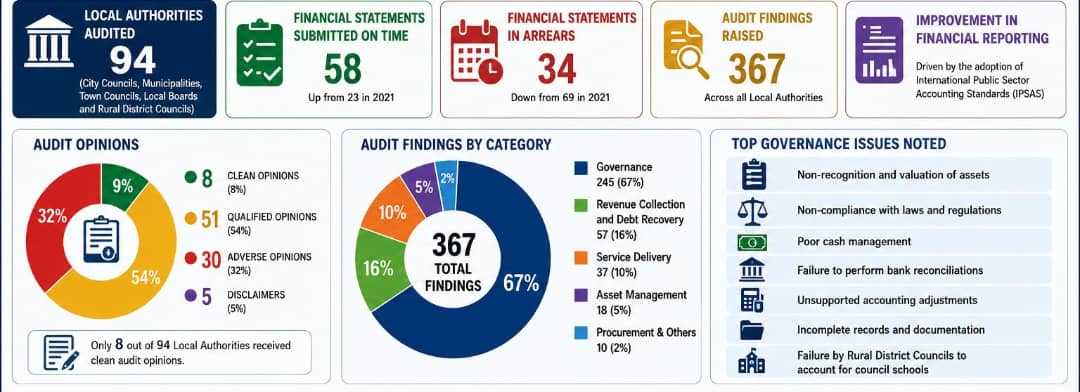
Governance failures have emerged as the single biggest challenge affecting Zimbabwe's local authorities, with the 2025 Auditor-General's Report on Local Authorities revealing that weak internal controls, poor record-keeping, inadequate financial management and non-compliance with laws continue to undermine transparency, accountability and service delivery across councils.
Of the 367 audit findings recorded in the report, 245 (67%) were governance-related, making governance failures by far the most common weakness identified by the Auditor-General. Revenue collection and debt recovery accounted for 57 findings (16%), followed by service delivery with 37 findings (10%), while asset management, employment issues and procurement made up the remainder.
The report notes that governance problems worsened despite improvements in financial reporting.
"There was a marked relative increase of approximately forty-three percent (43%) in governance issues per audited Local Authority," the Auditor-General said.
The increase was attributed to persistent weaknesses, including the failure to recognise and value assets, weak inventory controls, non-compliance with laws and regulations, poor cash management, failure to perform bank reconciliations, unsupported accounting adjustments, incomplete records, and the continued failure by Rural District Councils to account for council schools.
One of the recurring themes throughout the report is councils' continued reliance on manual systems.
The Auditor-General found that many local authorities have been slow to digitise their financial management processes, resulting in delayed financial reporting, poor document management and weak accountability.
According to the report, most councils still operate manual or partially automated business processes, leading to the late submission of financial statements and incomplete accounting records. It recommends greater adoption of information and communication technologies to improve financial management.
Despite these weaknesses, the report identifies some encouraging progress.
Related Stories
The number of local authorities submitting financial statements on time increased significantly, with 58 councils now up to date, compared to just 23 in the 2021 report. Over the same period, the number of councils with outstanding financial statements fell from 69 to 34. The Auditor-General attributes much of this improvement to the implementation of the International Public Sector Accounting Standards (IPSAS) framework, which has strengthened financial reporting across local authorities.
However, improved submission rates have not translated into better audit outcomes.
Only eight of the 94 local authorities audited received clean audit opinions, while 51 received qualified opinions, 30 received adverse opinions and five received disclaimer opinions, indicating that the overwhelming majority of councils still failed to produce financial statements that fully complied with accounting standards. The report attributes these outcomes to non-compliance with IPSAS, incomplete accounting records, unsupported expenditure, payroll irregularities, poor asset valuation and weaknesses in financial reporting.
Revenue collection also remains a major concern.
Although findings relating to revenue collection and debt recovery declined from 92 to 57, the Auditor-General found that many councils still lack automated revenue collection systems, resulting in cash-based accounting, inaccurate billing and significant revenue leakages. Other common problems include incomplete customer databases, non-revenue water losses caused by leaks and illegal connections, malfunctioning water meters, and unresolved discrepancies between revenue records and financial statements.
The report suggests that the challenges facing local authorities are increasingly systemic rather than isolated. Weak governance structures continue to affect virtually every aspect of municipal administration, from financial reporting and procurement to service delivery and asset management.
For residents, these governance failures often translate into deteriorating roads, erratic water supplies, delayed refuse collection, inadequate maintenance of public infrastructure and declining public confidence in local government institutions.
The findings also come at a time when the Government is pursuing reforms to strengthen local governance, including the recently approved Municipal Police and Courts Bill, which seeks to enhance councils' enforcement powers under the constitutional devolution framework.
However, the Auditor-General's report suggests that strengthening institutional governance, financial management and accountability may be just as important as expanding councils' enforcement powers.








Leave Comments