







While public attention has largely focused on Constitutional Amendment No. 3's provisions on extending the terms of office of the President, Parliament and local authorities, constitutional lawyers and political analysts say one of the Bill's least discussed amendments could ultimately prove to be among its most politically consequential.
The repeal of Section 94(3) of the Constitution appears, on its face, to be a technical amendment. Justice, Legal and Parliamentary Affairs Minister Ziyambi Ziyambi told Parliament that the provision had become redundant following Constitutional Amendment No. 2 of 2021.
"Clause 4 repeals Section 94(3), which had required a Vice-President assuming the Presidency after a vacancy to take the oath of office," Ziyambi said during debate.
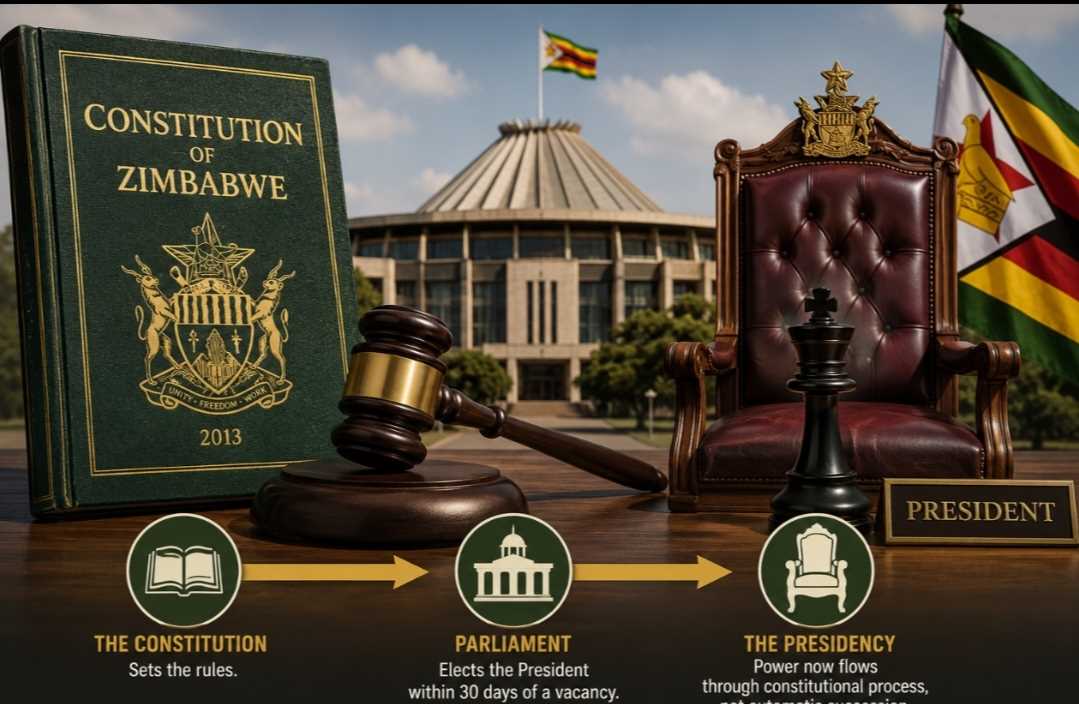
"He noted that this provision became redundant after Amendment No. 2 of 2021, which established that Parliament elects a new President within 30 days of a vacancy. He emphasized that the repeal ensures the Constitution reflects current law."
Parliament adopted the amendment, paving the way for the Bill to be transmitted to President Emmerson Mnangagwa for assent.
Legally, the amendment is straightforward. Since Constitutional Amendment No. 2 removed the constitutional mechanism that would have allowed a Vice President to automatically become President, the oath prescribed under Section 94(3) no longer had practical effect.
Politically, however, analysts argue the amendment completes a constitutional shift that began in 2021 and further changes the dynamics of presidential succession.
The running mate clause introduced under the 2013 Constitution was intended to ensure that voters elected both a President and Vice Presidents on a single ticket, with one of the Vice Presidents automatically succeeding the President in the event of death, resignation or incapacity.
Before the clause could ever take effect, Constitutional Amendment No. 2 abolished it, returning the appointment of Vice Presidents to the President and replacing automatic succession with a process in which Parliament elects a new President within 30 days of a vacancy.
By repealing Section 94(3), the Constitution now removes one of the last remaining references that still contemplated a Vice President assuming the Presidency automatically.
Human rights lawyer and constitutional analyst D. Tinashé Hofisi argues that Constitutional Amendment No. 3 should not be viewed as a collection of isolated amendments but as a constitutional redesign.
Writing for ConstitutionNet, Hofisi describes the Bill as "executive consolidation by constitutional disruption," arguing that its cumulative effect is "a fundamental reordering of the constitutional system which increases presidential authority while weakening mechanisms for popular participation and democratic accountability."
That context has fuelled political interpretations that the succession framework is steadily moving away from constitutional certainty and towards political discretion.
Political analyst Kudakwashe Muneno believes the repeal of Section 94(3) is far more significant than government suggests.
"My reading is that the repeal of Section 94(3) should not be treated as a mere technical amendment because it carries clear succession implications and appears to weaken any assumed automatic route for a Vice President to take over in the event of a vacancy," he said.
Muneno said it would be difficult to state as fact that the amendment represents a direct departure from the widely reported but never officially confirmed "gentleman's agreement" between Mnangagwa and Vice President Constantino Chiwenga following the 2017 military intervention.
Related Stories
"It would be difficult to state as fact that this is a direct change to the reported gentleman's agreement between ED and Chiwenga. Politically, however, the effect is difficult to ignore because it shifts succession into a more controlled political and parliamentary process."
He described the provision as "one of the dark horse clauses" of Constitutional Amendment No. 3.
"While public attention has focused on term extension, the 2030 agenda and changes to presidential elections, this clause quietly touches the real centre of power."
Muneno predicts that once the Bill becomes law, "the succession question will not disappear, but may instead intensify internal bargaining, factional manoeuvring, coded political messaging and possible legal contestation."
Former Citizens Coalition for Change leader Jameson Timba argues the amendment changes the political significance of temporary presidential appointments.
"Who becomes Acting President may soon matter more than who is Vice President," Timba wrote.
He argues that because the amended Constitution provides that the Vice President who most recently acted under Section 100 becomes Acting President upon a vacancy, every future acting appointment assumes greater political importance.
"Constitutions do not merely distribute power—they create political incentives that shape behaviour long before a crisis occurs."
Timba says this could fundamentally alter how political actors view acting appointments, making them strategic indicators of future succession even where they confer no automatic right to become substantive President.
Journalist Hopewell Chin'ono believes the repeal of Section 94(3) completes a constitutional journey that began four years ago.
"The journey to this moment began with Constitutional Amendment Bill No. 2 in 2021, when President Mnangagwa removed the running mate clause. That clause had guaranteed that a Vice President would automatically assume office if the President died, resigned or became incapacitated. Its removal placed succession firmly under the President's control," Chin'ono wrote.
He argues that Constitutional Amendment No. 3 "completes that process" by ensuring Parliament, rather than an automatic constitutional mechanism, determines who becomes President if a vacancy arises, "significantly reducing any constitutional pathway for the Vice President to automatically succeed."
Constitutional watchdog Veritas Zimbabwe similarly notes that CAB3 represents a restructuring of Zimbabwe's constitutional order, while critics argue several provisions reduce direct public participation in choosing a President and further centralise executive authority.
National Constitutional Assembly president Professor Lovemore Madhuku has been one of the Bill's fiercest critics, describing the amendments as "totally unacceptable" and arguing that they erode key democratic safeguards contained in the 2013 Constitution. He has also mounted legal challenges questioning the Bill's constitutional validity.
Although none of the amendments explicitly mention Vice President Constantino Chiwenga, the cumulative constitutional changes have intensified speculation that they progressively diminish the institutional significance of the office he occupies.
The first major shift came in 2021 with the abolition of the running mate clause. The second came with Parliament replacing automatic succession as the mechanism for choosing a President after a vacancy. The latest repeal of Section 94(3) removes constitutional language that still contemplated a Vice President assuming the Presidency.
Taken together, critics argue, the amendments increasingly make presidential succession dependent not on constitutional entitlement but on presidential discretion, parliamentary arithmetic and internal ruling party dynamics.






Leave Comments