







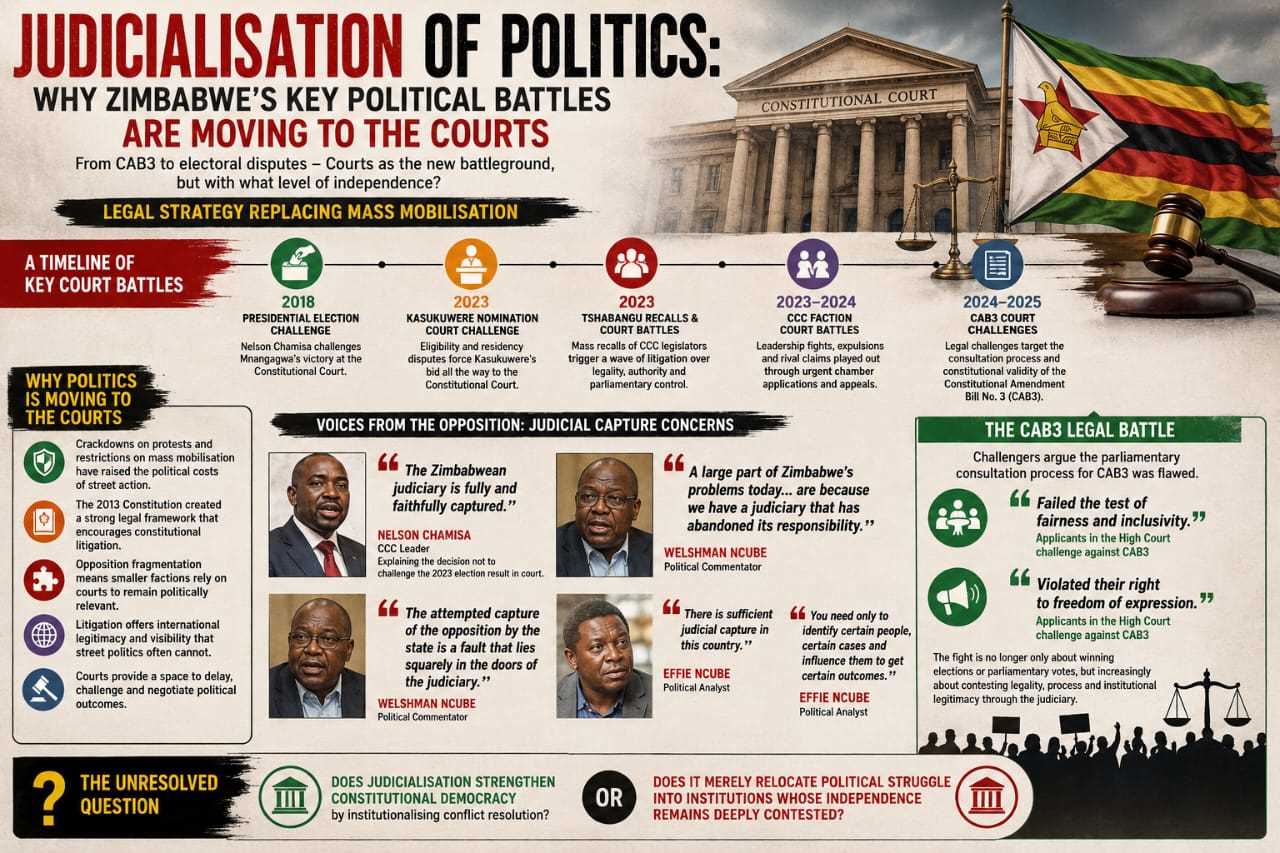
Zimbabwe’s political contestation is undergoing a fundamental structural shift, moving away from the traditional theaters of rallies, street demonstrations, and mass mobilisation toward a sophisticated landscape of litigation, constitutional interpretation, and procedural warfare.
From the landmark 2018 presidential election petition to the internal succession battles within the Citizens Coalition for Change, and from the disqualification of presidential aspirants like Saviour Kasukuwere to the current resistance against Constitutional Amendment Bill No. 3 (CAB3), the judiciary has emerged as the country’s primary political battleground.
This transformation raises profound questions about the nature of democratic competition and the perceived independence of the bench in an increasingly litigious environment.
To understand this shift, one must examine the long and turbulent history of contested mandates that has defined Zimbabwe since independence in 1980. The transition from a liberation movement to a multi-party democracy has been marked by a recurring pattern of electoral disputes that were not always settled in the courtroom.
In the 1980s and 1990s, challenges to ZANU-PF’s dominance, such as those posed by Edgar Tekere’s Zimbabwe Unity Movement, were often met with direct political and security responses. However, the true modern era of judicial contestation began with the 2002 presidential election.
When Morgan Tsvangirai challenged Robert Mugabe’s victory, the legal petition languished in the High Court for years without a final determination. This delay sowed the early seeds of skepticism regarding the judiciary's ability to act as a swift arbiter of political will.
The subsequent 2008 electoral crisis, which required regional mediation and the formation of a Government of National Unity, further demonstrated the limitations of the legal system when faced with a total breakdown of political consensus.
The adoption of the 2013 Constitution was intended to remedy these historical failures by creating an independent Constitutional Court and providing a robust framework for civil liberties. Paradoxically, this expanded legal architecture provided the very "hooks" that have accelerated the judicialisation of politics.
By creating more specific rights and procedures, the constitution effectively invited political actors to settle their grievances through legal technicalities. In the post-2017 environment, after the military-assisted transition, the cost of traditional street-based politics rose significantly.
Related Stories
Tighter regulations on protests and the fragmentation of opposition structures pushed political actors toward the courtroom, where a single legal filing could achieve what thousands of marchers could not.
The defining moment of this new era occurred after the 2018 presidential election.
When Nelson Chamisa challenged President Emmerson Mnangagwa’s victory, the live-broadcasted Constitutional Court proceedings signaled that the highest political questions would henceforth be settled by judges rather than through prolonged confrontation in the streets.
While the court ultimately dismissed the challenge, the precedent was set litigation had become both a shield for the incumbent and a weapon for the challenger. This trend deepened during the 2023 election cycle, where the courtroom became an extension of the campaign trail.
The disqualification of Saviour Kasukuwere on residency grounds proved that procedural interpretation could be more decisive than public persuasion.
Perhaps no entity has felt the weight of this judicial shift more than the CCC. The party’s internal crisis following the 2023 elections transformed the courts into an arena for determining party legitimacy and parliamentary control. The emergence of Sengezo Tshabangu and the subsequent wave of legislator recalls forced the judiciary to decide on the very identity of the opposition.
As parliamentary seats and local authority control became dependent on judicial recognition, opposition figures began to argue that the courts were no longer neutral referees but were instead being used to enable state interference.
Several structural realities explain this transition. The political costs of mass mobilisation have become prohibitive, and opposition fragmentation has weakened the organisational capacity required for sustained protest.
Litigation offers a mechanism for smaller factions to remain politically relevant and provides a veneer of international legitimacy that resonates with diplomatic observers. However, the growing judicialisation of politics carries grave risks. When courts become the central arbiters of power, public confidence in judicial independence becomes the bedrock of national stability. In a polarised environment, even technically sound judgments are often viewed through a lens of political bias.
Ultimately, the judicialisation of politics risks narrowing democracy into an elite contest dominated by lawyers and constitutional specialists. As political discourse becomes saturated with the language of jurisdiction, standing, and procedural defects, there is a danger that ordinary citizens will feel increasingly distanced from the democratic process.
While the courtroom remains one of the few institutional spaces where the state can still be challenged, the health of Zimbabwe’s democracy will depend on whether its courts are seen as independent defenders of the constitution or merely as the final frontier of a political struggle.






Leave Comments