







As central banks around the world accelerate their accumulation of gold reserves amid rising geopolitical tensions and uncertainty in the international monetary system, fresh debate is emerging over whether Zimbabwe’s gold-backed currency, the Zimbabwe Gold, is built on the most credible foundation possible.
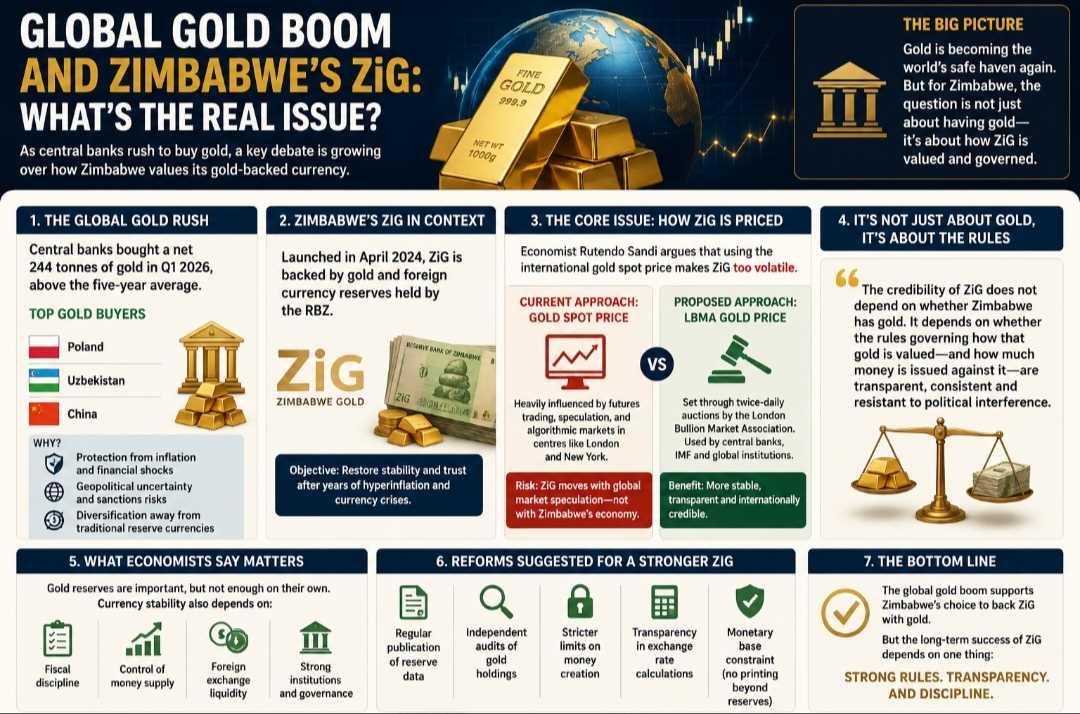
The discussion comes as global demand for official gold reserves continues to rise. According to international market data highlighted by INVEST Magazine, central banks purchased an estimated 244 tonnes of gold on a net basis during the first quarter of 2026, surpassing both the previous quarter and the five-year quarterly average.
Countries such as Poland and Uzbekistan were among the leading buyers, while China continued a long-running accumulation strategy aimed at diversifying reserves and reducing exposure to traditional reserve currencies.
The renewed appetite for gold reflects growing concern among policymakers over inflation risks, geopolitical fragmentation, sanctions exposure, and the long-term stability of the global financial system.
“Gold is regaining strategic importance at the centre of national reserve management,” INVEST Magazine noted, arguing that the precious metal remains one of the few reserve assets that carries no direct issuer or counterparty risk.
For Zimbabwe, the global shift toward gold has particular significance.
In April 2024, the Reserve Bank of Zimbabwe (RBZ) launched ZiG, a currency backed by gold and foreign currency reserves, in what authorities described as a major step toward restoring monetary stability after decades of currency crises, hyperinflation, and repeated policy reversals.
However, a new policy paper by independent monetary economist Rutendo Sandi argues that while the concept behind ZiG is sound, the methodology used to value the currency may contain a critical weakness.
The paper contends that the RBZ’s use of the international gold spot price as a reference point for determining ZiG’s value exposes the currency to unnecessary volatility and speculative pressures.
“Spot-price anchoring transforms ZiG from a reserve-backed currency into a derivatives-linked currency,” Sandi argues.
“The gold in the RBZ vault is valued at a price set largely by speculative futures positions—not by the physical gold market.”
According to the study, the international gold spot price is heavily influenced by futures trading, algorithmic transactions, and speculative positioning in major financial centres such as New York and London.
As a result, sudden movements in global gold markets can directly affect the value of ZiG, even when there has been no change in Zimbabwe’s underlying economic fundamentals.
Instead, Sandi proposes that Zimbabwe should anchor ZiG to the London Bullion Market Association (LBMA) Gold Price, a benchmark determined through a twice-daily auction process used by central banks, the International Monetary Fund (IMF), and major financial institutions for reserve valuation.
Related Stories
The paper argues that the LBMA benchmark provides greater stability, transparency, and international credibility than continuously fluctuating spot prices.
“The credibility of ZiG does not depend on whether Zimbabwe has gold,” the paper states.
“It depends on whether the rules governing how that gold is valued—and how much money is issued against it—are transparent, consistent, and resistant to political interference.”
The debate comes at a time when gold’s role in the global economy is undergoing a significant reassessment.
While gold once appeared to be losing relevance in a world dominated by digital finance and fiat currencies, central banks have increasingly embraced the metal as a strategic asset capable of preserving value during periods of financial stress.
The United States remains the world’s largest official holder of gold reserves with more than 8,100 tonnes, followed by Germany, Italy, and France. Meanwhile, emerging powers such as China and Russia have spent years steadily expanding their gold holdings.
Analysts say the trend reflects a broader restructuring of the international monetary landscape.
Gold’s appeal lies not only in its scarcity but also in its neutrality. Unlike government bonds or foreign currency deposits, gold is not tied to the creditworthiness or political decisions of any single country.
For Zimbabwe, whose economic history has been shaped by recurring currency instability, this characteristic makes gold particularly attractive as a monetary anchor.
Yet economists caution that gold reserves alone cannot guarantee currency stability.
The INVEST Magazine analysis notes that reserve strength must be assessed alongside fiscal discipline, sovereign debt levels, foreign exchange liquidity, and broader macroeconomic fundamentals.
Sandi’s paper reaches a similar conclusion, arguing that the long-term success of ZiG depends less on the quantity of gold held by the RBZ and more on the institutional rules governing its management.
Among the reforms proposed are regular publication of reserve data, independent audits of gold holdings, stricter limits on money creation, and greater transparency in exchange-rate calculations.
The study also advocates for a formal monetary base constraint that would prevent the expansion of ZiG beyond levels supported by reserve assets.
Without such safeguards, the paper warns, Zimbabwe risks repeating mistakes that contributed to previous currency collapses.
“The deeper lesson of Zimbabwe’s monetary history is that institutional constraints matter more than institutional intentions,” Sandi writes.









Leave Comments