




Njabulo Ncube
The November 2025 ZIMSEC Ordinary Level results shocked Lupane District: less than 1% of candidates passed five or more subjects. Out of nearly 1,800 candidates, only 16 students managed to secure passes, according to Zimbabwe Schools Examinations Council (ZIMSEC) November 2025 examination data released early 2026.
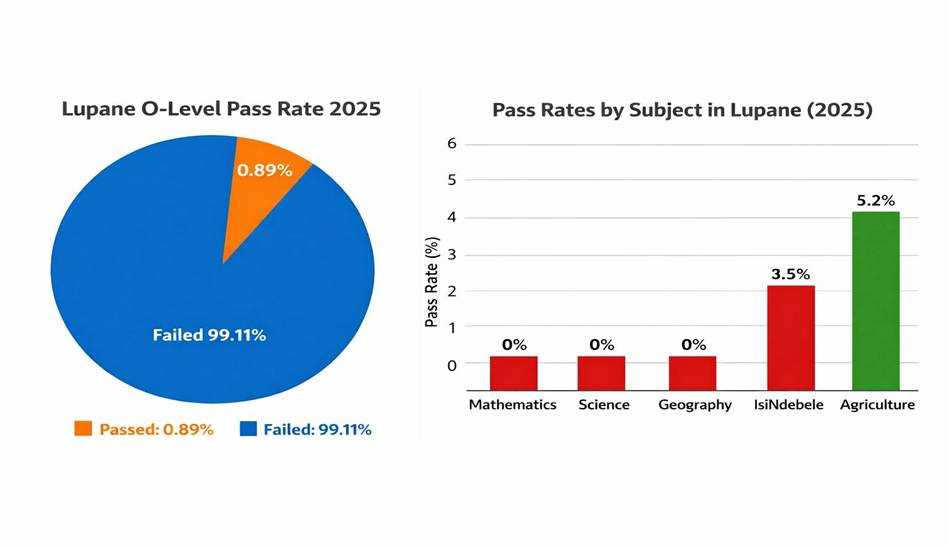
Several schools, including Lupane Secondary and Somhlolo High, recorded zero percent pass rates in Mathematics, Science, and Geography.
By contrast, Isindebele and Agriculture were the only subjects where students managed to scrape through, with pass rates hovering around 3–5%.
Voices from a district left behind
A Lupane schools inspector, speaking on condition of anonymity, admitted:
“We have schools where no child passed Mathematics or Science. Teachers are demoralized, and parents are losing faith in the system.”
Teachers echoed the sentiment, citing shortages of textbooks, overcrowded classrooms, and delayed government grants.
Takavarasha Zhou, the leader of the Progressive Teachers Union of Zimbabwe, PUTZ, says the shocking Lupane statistics confirm that a pass has become meaningless in Zimbabwe due to deindustrialisation and more than 90 percent unemployment.
At any rate our students see uneducated people becoming successful in Zimbabwe, says Zhou.
He pointed out that Lupane is just like many other remote districts in Zimbabwe such as Gokwe, Mberengwa, Chiredzi and Mwenezi, among others that are drought stricken and survival is more important than learning.
Zhou further noted that all rural areas such as Chivi, Chiredzi and Mwenezi are no different from Lupane, pointing out that Mwenezi is the worst with many schools getting 0% and overall scoring less than 5%.
This is the normal trend for all borderlands areas where pupils have realised that there is nothing glittering in education, and picking oranges in neighbouring South Africa is better than 15As at 'O' level or even 30 points at 'A' level. There is an urgent need for political and economic hygiene that can ultimately inspire pupils to pursue their education with hope for a better future.
Hungry pupils cannot excel in school while the poverty stricken and unemployed parents have very little to support their children's learning. Hunger and poor environments affect pupils' performance. Pupils walk long distances to nearby schools and are exhausted so much that they have no time to concentrate on their studies, he said.
They also fetch water from distance areas thereby affecting their study time. Teachers are also affected as they have less contact time with their students due to fetching water far from school stations and may spend some days traveling to urban areas and back due to bad transport networks thereby affecting contact time with their students. Over and above there are no teaching and learning materials in schools and schools in remote areas like Lupane have no access to ICT, let alone connectivity.
Data perused by this reporter indicate that the consequences of such dismal results emerging from Lupane are devastating for the timber rich district of Matabeleland North.
- Girls drop out for early marriages, often citing lack of school fees.
A Form 4 student at St. Luke’s Secondary confessed:
“We repeat exams with no joy. Without textbooks, we guess answers. Some of my friends have already left for South Africa.”
- Boys migrate to Botswana and South Africa, seeking menial jobs, while others drift to Bulawayo for informal work.
Related Stories
- Parents lament the financial burden of repeat exam fees, with many unable to afford ZWL 120,000 per subject.
Daniel Molokela, the legislator for nearby Hwange constituency, says the dismal pass rate in the Lupane resonated with other districts of Matabeleland North, pointing out that more is needed to empower the region which is estimated to have a large population that has migrated to neighbouring South Africa.
This is not surprising to us in Matabeleland North. As the Bible says: You reap what you sow. There has been no sowing in Matabeleland North since 1980. Look at the state of development projects in Lupane, including the Gwayi Shangani Dame, the Methan Gas Project, the state of Lupane Hospital, they are all lagging behind compared to those in other regions of the country. We need affirmative action and this is not a matter of education only but a whole spectrum of issues that need to be addressed in rural Matabeleland North, he said, adding that Lupane and its hinterlands urgently need more schools and teachers.
Structural Inequalities
The teacher–pupil ratio in Lupane stands at 1:87, far above the recommended 1:40.
ZIMSTAT data shows Matabeleland North has over 12,000 secondary learners, yet Lupane schools remain underfunded. Government grants are often delayed, leaving schools dependent on parents’ contributions.
This ratio illustrates the structural strain on Lupane’s education system. Teachers face overwhelming workloads, limiting their ability to provide quality instruction. The shortage of qualified educators, coupled with delayed government grants, has turned classrooms into survival zones rather than learning spaces. The data shows how staffing gaps directly contribute to Lupane’s near‑zero pass rates in ZIMSEC exams.
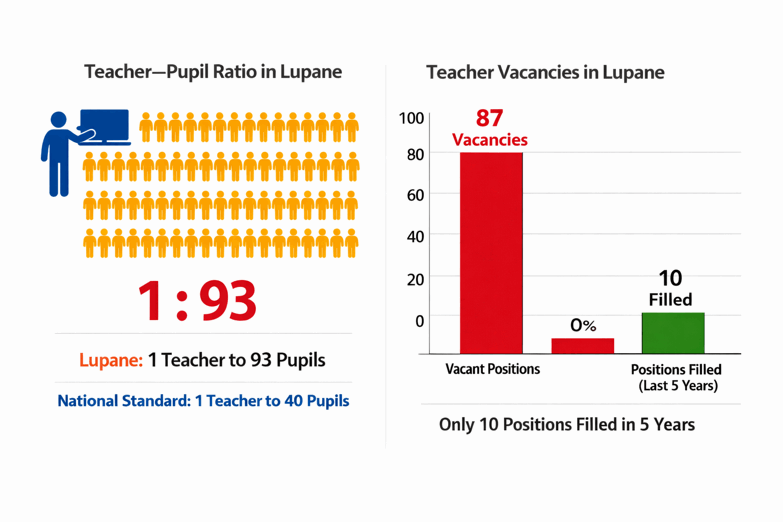
This bar chart exposes the chronic under‑staffing crisis confirmed by Ministry of Primary and Secondary Education (MoPSE) data. The failure to fill vacancies has crippled rural education delivery, especially in STEM subjects. Without urgent recruitment and retention strategies, Lupane’s schools will remain trapped in a cycle of poor results and high dropout rates.
The Ministry of Public Service, Labour and Social Welfare (MPSLSW) reports youth unemployment in Matabeleland North at 98.8%, compared to the national average of 42%. Poor exam outcomes feed directly into this unemployment crisis, as rural youth lack the qualifications for formal jobs.
STEM Failure and National Impact
Nationally, STEM subjects recorded pass rates above 65%, but Lupane’s average was 0% in Mathematics, Science, and Geography.
Education experts warn that this failure undermines Zimbabwe’s push for industrialization and digital transformation. Without rural STEM graduates, the country risks widening inequality between urban and rural economies.
Governance and Accountability
School inspectors revealed that government grants to rural schools are inadequate and often swallowed by administration costs. Teachers anonymously noted, raising questions about governance, accountability, and whether rural districts like Lupane are being deliberately neglected.
For Zhou, the president of PUTZ, the solution to Lupane's pupils' education challenges and poor results lie in a functional state, industrialisation and reward of educated people through employment opportunities.
Equally important should be provision of teaching and learning materials, ICT facilities and connectivity, as well as nearness to schools and reliable water sources. But most importantly should be the intrinsic motivation of teachers teaching in remote rural areas. As PTUZ we have always argued for payment of 30% of basic salary as rural and hardship allowance to teachers in areas like Lupane and all other rural areas, he said.
A Call for Urgent Reform
Lupane’s 0.89% pass rate is not just a statistic, it is a national crisis. It reflects systemic inequality, poor resource allocation, and governance failures. While urban schools celebrate near-perfect pass rates, rural learners are trapped in cycles of failure, poverty, and migration.
Unless urgent reforms are made: teacher recruitment, textbook provision, equitable funding, and STEM investment; Lupane’s children will continue to fail, not because they lack ability, but because they lack opportunity.
They will remain a lost generation.







Leave Comments