
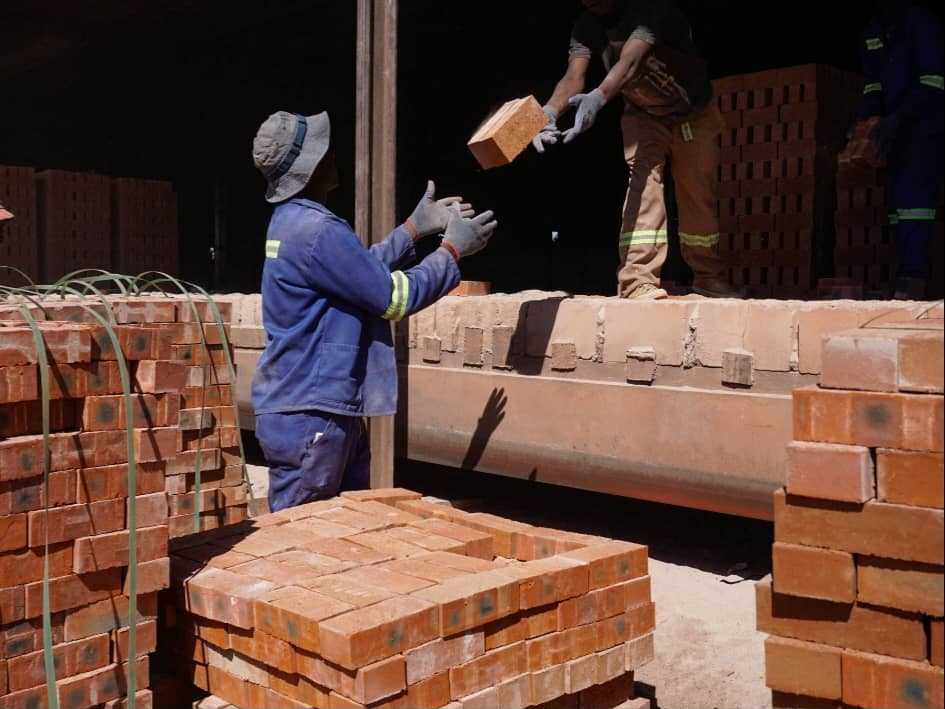


Zimbabwe’s brickmaking industry, long credited with lowering construction costs, creating thousands of jobs, and saving millions in foreign currency, is facing fresh uncertainty following the introduction of Statutory Instrument (SI) 215 of 2025.
While the government’s push for local empowerment has been broadly welcomed, economists and industry players warn that poorly sequenced implementation could trigger unintended consequences, including job losses, supply disruptions, and rising prices.
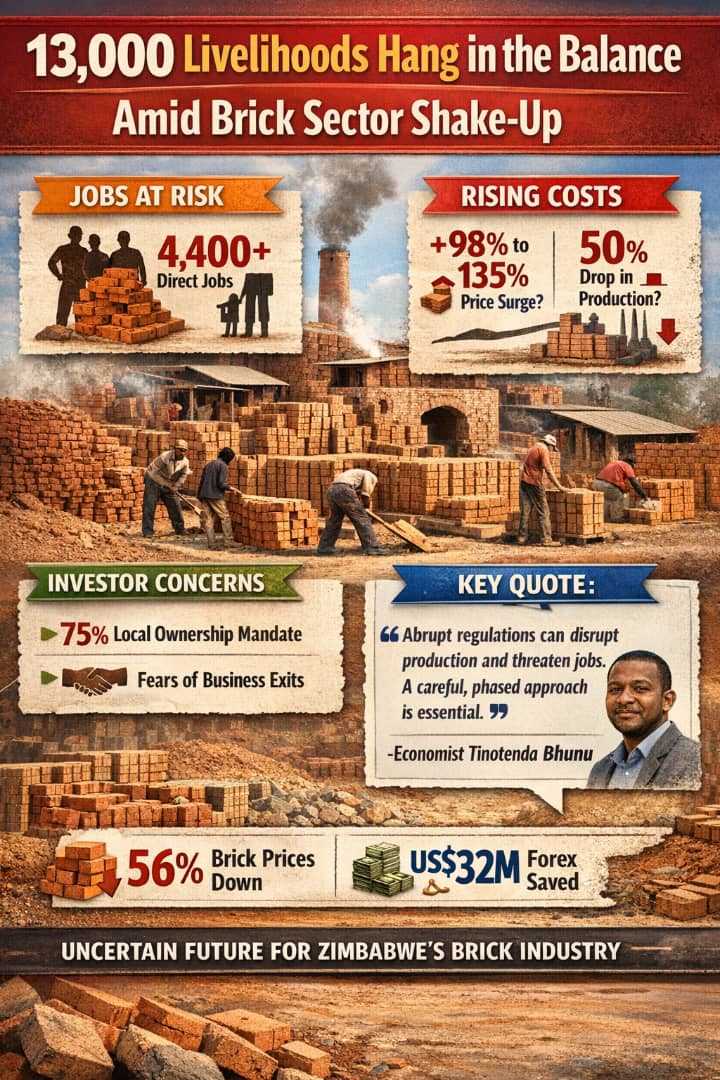
A comprehensive assessment shows that the sector currently supports more than 4,400 direct jobs and between 12,800 and 13,200 livelihoods across the value chain, highlighting its growing economic significance.
Economist Tinotenda Bhunu cautioned that the risk lies not in the policy itself but in how it is executed.
“Regulatory changes are not inherently problematic, but the way they are implemented matters a great deal. In a sector already supporting thousands of jobs, any abrupt or poorly managed transition can easily disrupt production,” Bhunu said.
Production and Prices Under Threat
Over the past decade, increased competition, particularly from new market entrants, has driven down brick prices by about 56 percent, significantly improving affordability for consumers and lowering construction costs. At the same time, local production has nearly eliminated imports, generating cumulative foreign currency savings estimated at US$32–35 million.
Analysts warn that these gains could be reversed if regulatory changes disrupt existing producers. Industry modeling suggests that a severe disruption scenario—such as forced exits or operational constraints—could slash national production capacity by up to 50 percent, pushing prices up by as much as 98–135 percent.
Such shocks would not only affect builders and home seekers but also drive up costs for major infrastructure projects, including housing programmes.
Jobs and Livelihoods on the Line
Related Stories
Employment risks are emerging as a central concern. Under a worst-case scenario, up to 2,000 direct jobs could be lost, with total livelihoods affected rising to between 4,700 and 6,300 due to knock-on effects in transport, quarrying, and construction.
“Firms may scale back, postpone investment, or in some cases exit altogether. The knock-on effects are immediate: reduced supply, rising prices, and growing uncertainty,” Bhunu said.
Investor Confidence at Stake
SI 215 requires foreign investors in reserved sectors to divest at least 75 percent of their shareholding to locals over three years, with strict annual thresholds and compliance timelines. Business groups, including the Zimbabwe National Chamber of Commerce, have warned that compressed timelines and rigid requirements could undermine investor confidence.
“Businesses can adapt to regulation, but they struggle with uncertainty. Clear rules, consistent enforcement, and respect for property rights are essential,” Bhunu emphasized.
Calls for a Measured Approach
Analysts argue the key challenge is balancing empowerment objectives with economic efficiency. While increasing local participation is necessary, rigid ownership thresholds may be counterproductive if they discourage investment or reduce output. Alternative approaches, such as joint ventures, skills transfer, and local supply chain integration, are being recommended as more sustainable pathways to empowerment.
“There is a need to refine the framework rather than disrupt it. Addressing inclusion gaps is important, but it should not undermine a sector already delivering jobs, lower prices, and forex savings,” Bhunu said.
Policy Test Ahead
With Zimbabwe’s construction sector expanding and demand for building materials rising, the brickmaking industry has become a critical pillar of economic activity. Analysts say the success of SI 215 will depend on whether it strengthens domestic participation without destabilizing production.
Efforts to obtain an official response from the Ministry of Industry and Commerce were unsuccessful. Questions sent to both the Permanent Secretary and the Ministry’s Public Relations Officer were acknowledged but had not been answered by publication time.






Leave Comments