
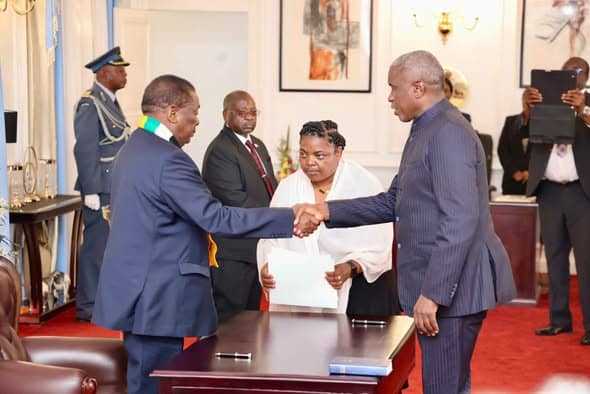







A few months ago, a group of mapostori gathered on the grounds of State House, clutching boxes of fried chicken and chips.
The moment—popularly remembered as “Sapatina Sapatina”—was not about music or celebration. It was about access. About proximity to power made visible, and rewarded.
This week, similar images have circulated again.
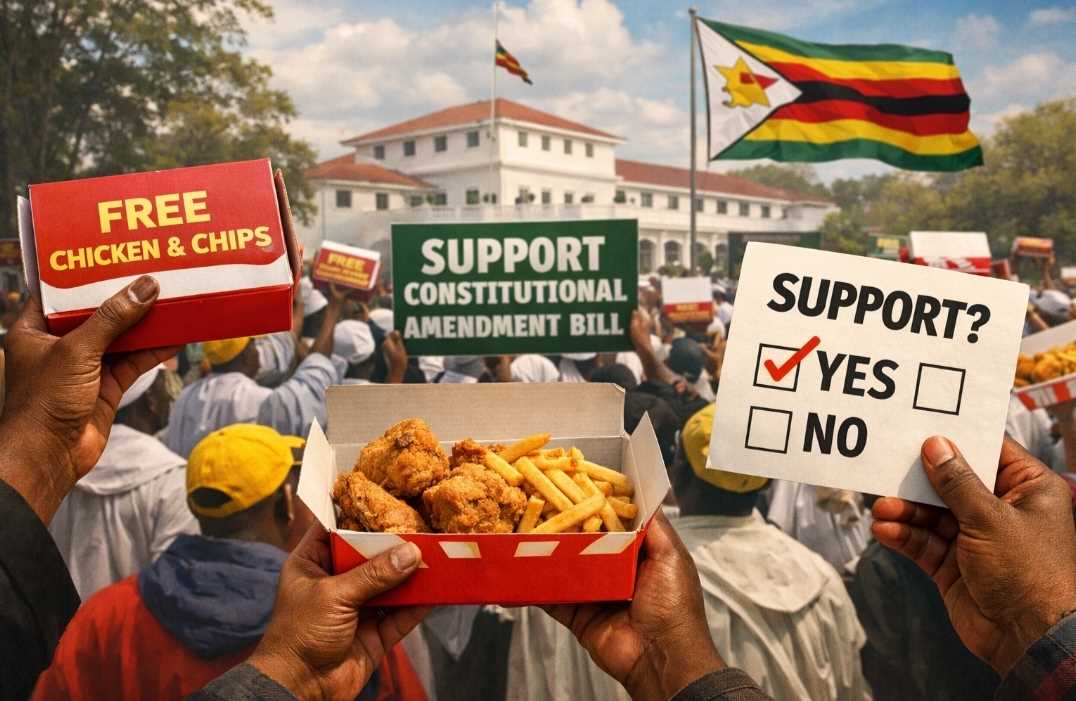
Supporters of the Constitutional Amendment Bill, following public demonstrations of support, were given boxed fried chicken and fries. The optics are unmistakable. The continuity is difficult to ignore.
In Zimbabwe, the chicken has become political shorthand.
Not for agriculture or livelihoods, but for reward. Immediate, visible reward.
A box handed over after a show of support compresses politics into transaction. It reduces participation to something that can be acknowledged and compensated on the spot. It is simple, direct, and highly legible: support is seen, and support is rewarded.
This sits within a longer, well-documented pattern. Zimbabwe’s politics has, for years, been shaped by systems of patronage—distribution of inputs, food aid, and other material incentives tied, implicitly or explicitly, to political alignment. What is notable here is not the existence of patronage, but its form.
The chicken box is different.
It is not mediated through structures or processes. It is immediate. It is personal. And crucially, it is performative. It is designed to be seen—by those receiving it, and by those watching.
It communicates two messages at once: we have noticed you, and this is what participation yields.
In an economy where many households face real constraints, that message carries weight. A meal is not insignificant. It has value. It meets an immediate need. Accepting it is neither irrational nor unusual.
But it complicates how public political expression is read.
Support, in these contexts, cannot be understood as purely ideological. It exists at the intersection of belief, necessity, and incentive. It reflects both political positioning and economic reality.
That intersection matters, particularly in the context of a constitutional process.
Related Stories
The Constitutional Amendment Bill is not a routine political event. It concerns the structure of governance, the balance of power, and the long-term trajectory of the state. Public engagement around such a process is expected to be robust, contested, and grounded in open debate.
Yet when expressions of support are visibly and materially rewarded, the conditions for that debate shift.
Participation begins to carry uneven incentives. Alignment is affirmed in tangible ways. Dissent, by contrast, has no comparable visibility or benefit—and in some cases, carries risk.
This does not require overt suppression to have an effect.
It narrows the field indirectly. It shapes who speaks, who is heard, and how positions are publicly performed. Over time, it privileges demonstration over deliberation, and affirmation over scrutiny.
The result is not the absence of dissent, but its marginalisation.
The recurring image of the chicken box captures this dynamic with unusual clarity. It is a small, everyday object. But within the current political context, it functions as a signal.
It signals inclusion. It signals recognition.
It signals what political participation looks like in practice.
And in doing so, it redefines expectations. Engagement is no longer only about ideas or persuasion. It becomes tied to immediacy—to what is received, here and now.
There is nothing remarkable about people accepting food in difficult economic conditions. That is a rational response to lived reality.
What is remarkable is the consistency with which food appears at moments of political expression—and the clarity of the exchange it represents.
Because when participation is followed so directly by reward, the line between consent and incentive becomes increasingly difficult to draw.
A politics that feeds on hunger will always struggle to nourish debate.
And when that line blurs, it is not only political behaviour that shifts.
It is the quality of the conversation itself.
Simbarashe Namusi is a peace, leadership and governance scholar as well as media expert, writing in his personal capacity.






Leave Comments