







Government has approved sweeping reforms to reduce licences, permits and regulatory fees in the real estate development sub-sector, a move aimed at lowering the cost of doing business and stimulating growth in construction.
The decision, adopted by Cabinet, targets regulatory bottlenecks that developers have long cited as major barriers to investment and housing delivery in Zimbabwe.
According to the Cabinet position, “the review process is aimed at reducing the cost of doing business, increasing competitiveness, enhancing investor confidence and stimulating the growth and expansion of the domestic construction sector.”
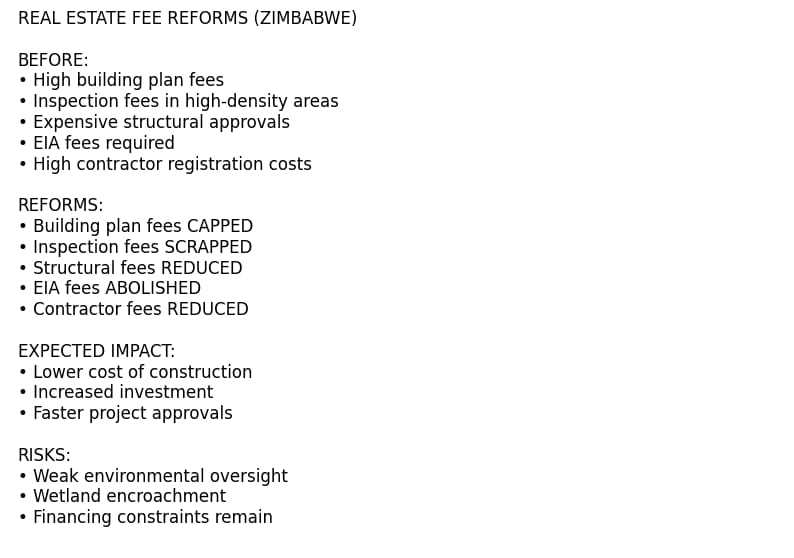
Among the approved measures are caps on building plan approval fees for both high-density and industrial developments, the removal of inspection fees for high-density housing, and reductions in structural engineering approval and contractor registration fees.
Cabinet also approved the abolition of Environmental Impact Assessment (EIA) fees, a move expected to significantly lower upfront project costs for developers.
Government said it will proceed with the “streamlining of duplicated and overlapping regulatory licences and permits, the removal of unnecessary levies and fees, and the lowering of unjustifiably high charges within the real estate sub-sector.”
Authorities say the reforms form part of a broader agenda to improve competitiveness, attract investment and expand domestic construction activity.
However, while the fee reductions address regulatory costs, they do not directly resolve deeper structural constraints that continue to limit growth in the sector.
One of the most pressing challenges remains access to finance. Zimbabwe’s construction and real estate industries are constrained by limited long-term funding, with high interest rates and short-tenure loans making it difficult for developers to undertake large-scale housing projects.
Related Stories
Cabinet acknowledged this gap, indicating that reforms will extend beyond government fees to include a review of private sector charges and broader cross-cutting issues such as constrained credit facilities.
This signals recognition that regulatory reform alone may not unlock housing supply without parallel adjustments within the financial sector.
The inclusion of informal settlements in the reform agenda also suggests a shift in policy direction. Government signalled plans to accelerate the regularisation of informal housing through structured programmes supported by infrastructure development under a “user-pay” principle.
While the approach could help formalise large segments of urban housing, it raises affordability concerns, as many residents in informal settlements may struggle to meet infrastructure-related costs, potentially limiting the programme’s effectiveness.
The decision to abolish EIA fees is also likely to attract mixed reactions. While it reduces costs and speeds up approvals, it introduces environmental policy risks that could undermine long-term sustainability.
Environmental Impact Assessments have historically served as critical safeguards against construction in ecologically sensitive areas such as wetlands, floodplains and fragile ecosystems.
In cities such as Harare, where wetland encroachment has already contributed to flooding, water pollution and infrastructure damage, easing EIA requirements could unintentionally encourage development in high-risk zones.
This creates a policy dilemma: short-term gains in construction activity may translate into long-term economic losses through disaster mitigation costs, infrastructure failures and environmental degradation.
In practical terms, the reforms could lower entry barriers for developers and marginally reduce project costs. However, whether these savings will translate into lower housing prices remains uncertain.
Zimbabwe continues to face a significant housing deficit, estimated in the hundreds of thousands of units, driven by rapid urbanisation, population growth and limited formal housing supply.
Without addressing financing constraints, infrastructure deficits and land servicing challenges, the impact of fee reductions may largely improve project viability rather than significantly expand access to affordable housing.










Leave Comments