







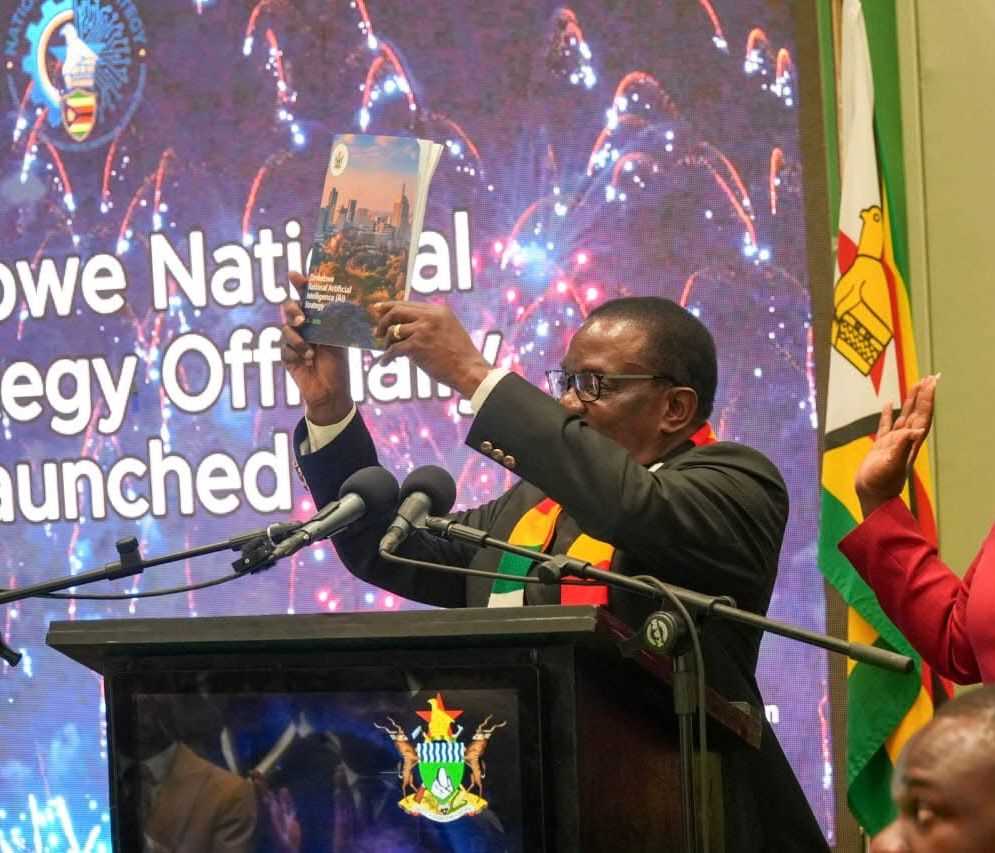
Zimbabwe has officially launched the National Artificial Intelligence Strategy (2026–2030), marking a major step toward positioning the country within the rapidly evolving global digital economy.
Speaking during the launch, President Emmerson Dambudzo Mnangagwa said artificial intelligence and emerging technologies are central to the technological transformation reshaping economies and societies across the world.
“Artificial Intelligence and accompanying technologies are at the very heart of the ongoing seismic technological transformation, reshaping economies and societies at an unprecedented pace,” he said.
He said the shift toward digital technologies has created an urgent need for countries to strengthen their digital systems and technological sovereignty.
“Further, the current paradigm brings to the fore the urgent need to increase capacities towards digital architecture and sovereignty,” he said.
President Mnangagwa said Zimbabwe must embrace innovation to unlock opportunities that will drive national development.
“The Zimbabwe we all envision must be digitally robust and agile. We have the duty to embrace emerging technologies to unlock numerous Artificial Intelligence driven opportunities that will propel modernisation, industrialisation and sustainable socio-economic growth,” he said.
The President described the launch of the strategy as a significant milestone for the country’s development agenda.
“It is therefore with immense jubilation that I address this occasion as we launch the Zimbabwe National Artificial Intelligence Strategy, which will undoubtedly ignite a new chapter in our country’s ongoing development trajectory.”
He said artificial intelligence adoption will be critical in transforming both public and private sector services.
“The Third Pillar relates to Artificial Intelligence adoption and service transformation. I challenge all stakeholders to be guided by the outlined roadmap for the seamless and widespread adoption of this strategy across all sectors,” he said.
President Mnangagwa added that Government would support businesses that adopt artificial intelligence technologies.
“On its part, my administration stands ready to offer incentives to businesses that integrate Artificial Intelligence to augment efficiencies and productivity,” he said.
He also highlighted several key areas where artificial intelligence will be deployed within the public sector.
“In the public sector, flagship projects are set to be rolled out in key areas such as precision agriculture, predictive healthcare diagnostics, smart mining operations, together with Artificial Intelligence driven systems to improve service delivery and fight corruption,” he said.
President Mnangagwa said Zimbabwe is already seeing the early impact of local innovation within the artificial intelligence ecosystem.
“On a broader scale, I am encouraged by the positive spill-offs from our own home-grown Artificial Intelligence ecosystem which have taken root. These are driven by the ingenuity of our young talented boys and girls, academics and tech-savvy entrepreneurs. Well done. Makorokoto. Amhlophe.”
He said the country’s innovation hubs and support for start-ups were already producing solutions designed to solve community challenges.
“These include chat-bots in local languages to assist farmers, machine learning models predicting commodity market prices and computer vision systems for early detection of crop diseases,” he said.
President Mnangagwa expressed confidence that Zimbabwe will successfully harness artificial intelligence for development.
“The ability to achieve greatness is in our nature. This new age of Artificial Intelligence shall equally be conquered and leveraged to quicken socio-economic growth and a higher standard of living for our people,” he said.
Related Stories
“A smarter, more efficient and prosperous Zimbabwe, driven by the proficiency of our people and the promise of technology, is a reality.”
Meanwhile, Minister of ICT, Postal and Courier Services Tatenda Mavetera said the strategy reflects Zimbabwe’s determination to actively participate in the global digital transformation.
“History shows that each generation adapts uniquely to technological changes. As Zimbabwe aims for Vision 2030, we are ready to engage with the global economy,” she said.
“The National Artificial Intelligence Strategy 2026–2030 highlights our commitment to the Fourth Industrial Revolution and our progress toward a unified digital vision for Zimbabwe.”
Mavetera said the strategy was developed through an extensive national consultation process involving different sectors of society.
“The National Artificial Intelligence Strategy emerged from an extensive policy development process by the Ministry of ICT, informed by the UNESCO AI Readiness Assessment for Zimbabwe through the Kadoma draft and subsequent nationwide consultations with stakeholders such as farmers, healthcare professionals, entrepreneurs, educators and notable figures,” she said.
She also expressed appreciation to President Mnangagwa for guiding the initiative.
“I want to express my gratitude to His Excellency the President, Dr Emmerson Dambudzo Mnangagwa, whose leadership has guided this initiative,” she said.
Quoting the President’s foreword in the strategy, Dr Mavetera said the country was entering a new technological era.
“We stand at the dawn of a new era, a time of unprecedented technological advancement that will reshape our world, where the 21st century is defined by the rapid pace of technological change and at its heart lies Artificial Intelligence,” she said.
“This is not merely a technological shift; it is a fundamental reordering of our societies and economies.”
Mavetera said Zimbabwe’s development philosophy remained rooted in national ownership and innovation.
She also outlined five key initiatives that will be implemented during the first phase of the strategy.
“I am excited to announce five key initiatives to launch our national AI mission within the first 18 months,” she said.
These include the AI Grand Challenge, a national competition that will provide funding and exposure to innovators, the National AI and Data Platform, the AI for Every Zimbabwean campaign, the National AI Regulatory Sandbox, and the National AI Innovation Fund designed to support start-ups.
Minister Mavetera said partnerships will play a crucial role in implementing the strategy.
“Key stakeholders include universities for research, the private sector for technology adoption and job creation, civil society for ethical innovation, development partners for capacity building and the diaspora for valuable skills and networks,” she said.
She said despite the challenges ahead, Zimbabwe has the capacity to build a thriving artificial intelligence ecosystem.
“The path ahead will be challenging but with determination, collaboration and visionary leadership we can navigate these obstacles,” she said.
“This strategy marks the start of our journey towards an innovative, inclusive and prosperous AI-enabled Zimbabwe. Now is the time for action.”









Leave Comments