







Zambia’s recent move to allow tax and royalty payments in Chinese Yuan has generated significant attention in African economic circles.
While the policy is hailed as a historic step in improving trade efficiency, economists caution that for Zimbabwe, a similar approach would offer technical gains rather than a solution to entrenched monetary instability.
Zambia’s decision reduces repeated currency conversions from local currency to US dollars and then to Yuan, cutting transaction costs and lowering exposure to exchange-rate volatility. With China among Zambia’s largest investors and trading partners, particularly in mining, infrastructure, and industrial equipment, the measure aligns revenue collection more closely with trade and debt obligations.
Efficiency, Not Symbolism
Analysts stress that Zambia’s policy works within a broader macroeconomic framework anchored by fiscal discipline, policy credibility, and functioning financial institutions. These fundamentals are key to ensuring that alternative currency settlement translates into tangible economic benefits.
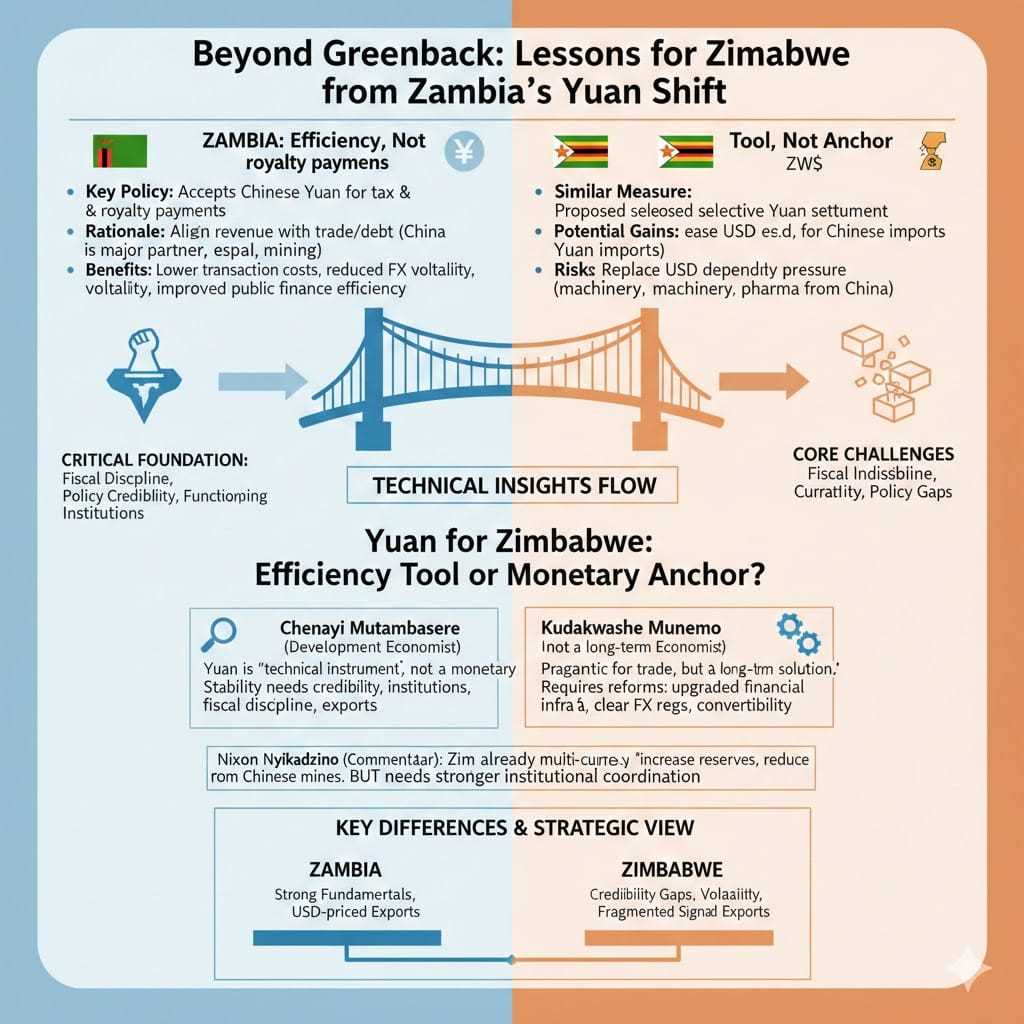
“Zambia’s policy is about efficiency, not a symbolic cure for monetary instability,” says development economist Chenayi Mutambasere. She notes that Zimbabwe’s long-term stability will come not from changing the currency of settlement, but from rebuilding credibility, strengthening institutions, restoring fiscal discipline, and expanding productive exports.
Mutambasere acknowledges that selective Yuan settlement has clear economic logic for Zimbabwe, given that a large share of its imports — machinery, pharmaceuticals, industrial inputs, and equipment — come from China.
Direct RMB settlement for these imports could marginally ease pressure on scarce US dollar liquidity.
She also points to a reserve management advantage: the Yuan’s inclusion in the IMF’s Special Drawing Rights basket gives it global legitimacy, and holding RMB reserves aligned with actual payment obligations could improve diversification.
However, she warns that shifting from dollar dependence to Yuan dependence would simply replace one vulnerability with another. “Zimbabwe’s currency instability is not primarily caused by the choice of settlement currency, but by deeper issues: confidence, fiscal discipline, reserve adequacy, policy credibility, and the structure of the economy itself,” she says.
Related Stories
Confidence Remains Key
Renowned economist Kudakwashe Munemo echoes this perspective. “Settling trade with China in Yuan makes pragmatic sense given the bilateral trade volume, as it reduces transaction costs and dollar dependence for those exchanges. But it is not a long-term solution to Zimbabwe’s monetary and fiscal challenges,” he explains.
Munemo highlights persistent macroeconomic weaknesses, fiscal deficits, parallel exchange rates, and low confidence in the domestic currency as the central constraints. For Yuan settlement to function smoothly, he argues, Zimbabwe would need substantial reforms, including upgraded financial infrastructure linked to China’s payment systems, clear foreign exchange regulations, and credible currency convertibility. Without these structural and policy changes, adopting the Yuan offers only limited short-term relief.
A Strategic Perspective
Economic commentator Nixon Nyikadzino adds that Zimbabwe already operates under a multicurrency regime in which the Yuan is formally recognised. He points to Zimbabwe’s extensive economic ties with China, including Chinese ownership in key mining assets, Chinese-funded loans, and reliance on Chinese imports such as mining equipment, manufacturing machinery, and consumer goods.
“Allowing Chinese firms to settle obligations in Yuan could help increase reserves, reduce transaction costs, and ease pressure on the financial system, particularly when royalties and taxes are paid by Chinese-owned mines,” Nyikadzino notes. Even so, he stresses that such benefits assume stronger institutional coordination and policy clarity than currently exists.
Key Differences with Zambia
Analysts consistently caution that Zambia’s success rests on fundamentals Zimbabwe has yet to restore. Zambia’s policy operates within a framework of improving fiscal discipline, clear reserve management rules, and stronger confidence in monetary authorities. By contrast, Zimbabwe continues to grapple with credibility deficits, currency volatility, and fragmented policy signals.
Moreover, Zimbabwe’s major exports, including minerals and agricultural commodities, remain priced in US dollars, ensuring continued structural demand for USD liquidity regardless of any expansion in Yuan settlement.
Conclusion
While Zimbabwe can draw technical lessons from Zambia’s Yuan policy, economists agree that currency settlement is a tool, not an anchor. Real stability will require comprehensive reforms, strengthened institutions, and restored policy credibility. For now, the Yuan can help marginally ease trade frictions with China, but it is no substitute for addressing the structural issues that underpin Zimbabwe’s monetary challenges.








Leave Comments