





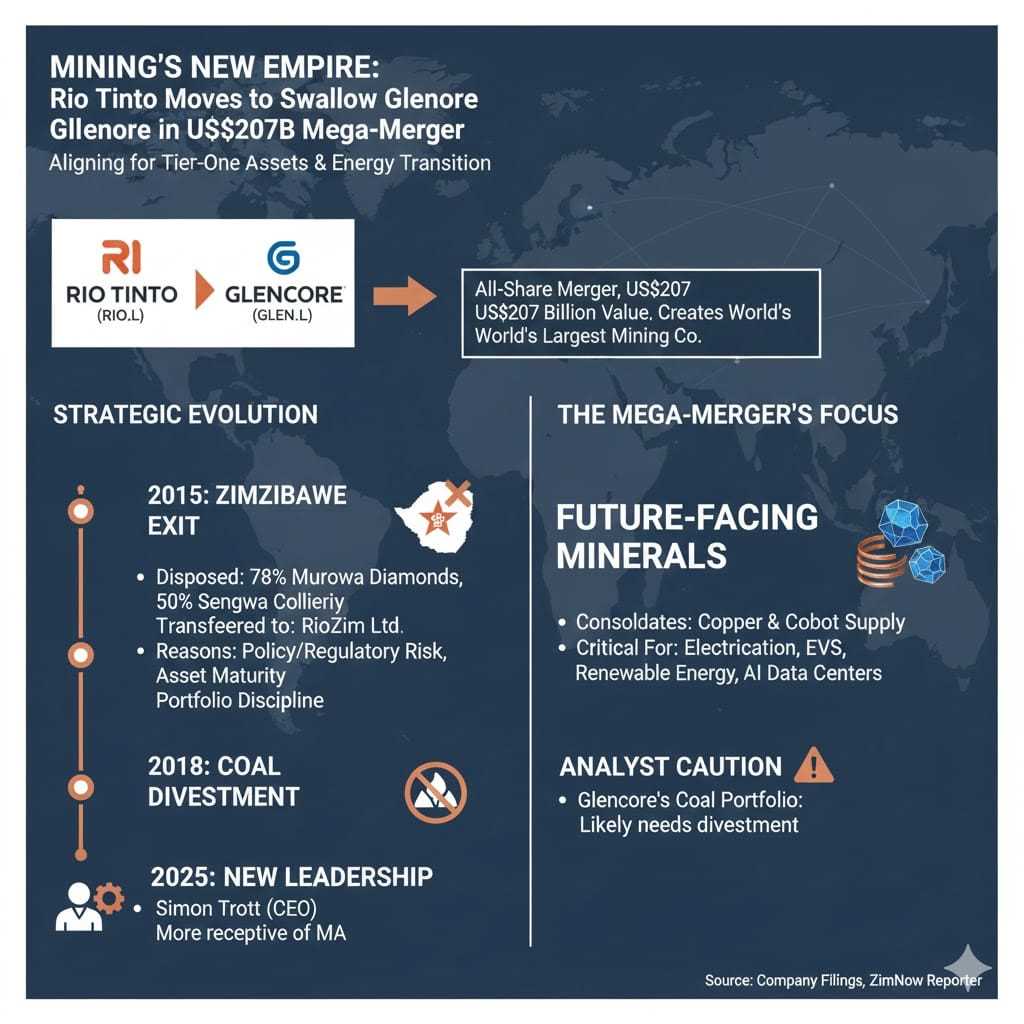
Rio Tinto (RIO.L) has confirmed it is in preliminary discussions to acquire Glencore (GLEN.L).
The potential all-share merger, valued at approximately US$207 billion, would create the world’s largest mining company, overtaking current industry leader BHP Group.
The talks come as Rio Tinto continues to refine a long-running strategy of concentrating capital on tier-one assets and low-risk jurisdictions, a process that has included its complete exit from Zimbabwe more than a decade ago.
Rio Tinto formally exited Zimbabwe in 2015, when it disposed of its remaining interests in the country, including:
Its 78% stake in Murowa Diamonds
Its 50% holding in Sengwa Colliery
Both assets were transferred to its former local subsidiary, RioZim Limited, marking the end of Rio Tinto’s direct operational presence in Zimbabwe.
At the time, the decision reflected a combination of strategic and structural factors:
Related Stories
Zimbabwe’s evolving indigenisation framework and increasing state participation requirements in the mining sector raised long-term uncertainty for multinational operators.
Although Zimbabwe holds significant diamond resources, much of the easily accessible alluvial material had been depleted, requiring a transition to deeper, more capital-intensive underground mining, a shift better suited to locally focused operators.
Rio Tinto emphasised that the exit was not a retreat from diamonds as a commodity, but rather a refocus on “world-class” assets, particularly in India and established underground operations elsewhere.
While Zimbabwe has long been off Rio Tinto’s balance sheet, the company is now pursuing scale in minerals critical to the global energy transition.
A combination with Glencore would consolidate a substantial share of the world’s copper and cobalt supply, metals seen as essential for electrification, renewable energy infrastructure, electric vehicles and AI-driven data centres.
However, analysts caution that Glencore’s coal portfolio, a sector Rio Tinto exited in 2018, would likely need to be spun off or divested to align with Rio Tinto’s environmental commitments and investor expectations.
The renewed push for large-scale mergers follows the appointment of Simon Trott as Rio Tinto’s chief executive in August 2025.
Trott, unlike his predecessor Jakob Stausholm, has been viewed by investors as more receptive to transformational M&A, particularly as competition intensifies for future-facing minerals.









Leave Comments