









Simbarashe Namusi
In modern governance, few portfolios are as unforgiving as Information Communication Technology. It is a ministry where misstatements travel faster than clarifications, where policy ambiguity unsettles markets, and where competence is measured less by intention than by precision.
It is within this context that questions have emerged about whether Zimbabwe’s current Minister of ICT possesses sufficient command of the brief to effectively superintend the portfolio.
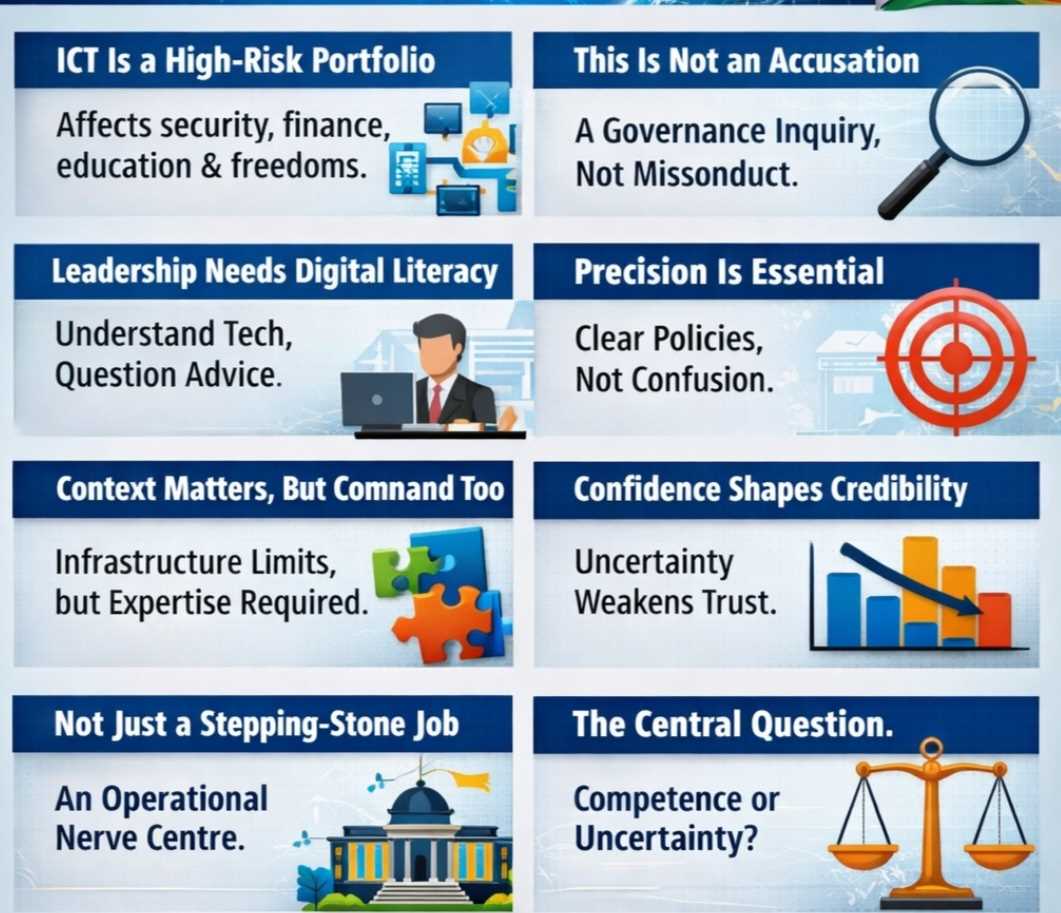
This is not an indictment, nor an allegation of misconduct. It is a governance inquiry. At its core lies a simple but consequential question: what level of expertise should reasonably be expected of a political head presiding over a highly technical ministry?
ICT is no longer a peripheral brief. It intersects with national security, data protection, financial systems, education delivery, innovation ecosystems, and civil liberties. Decisions taken in this ministry shape how citizens communicate, how businesses transact, and how the state engages technology companies operating across borders.
Superintendence, therefore, demands not just leadership, but literacy.
Supporters of the minister argue—correctly—that no political head is expected to be a software engineer or systems architect. Political leadership is about vision, coordination, and accountability, while technical execution rests with civil servants and specialists. This reflects how most governments function, and the argument has merit.
Yet the counterpoint is equally important. Effective oversight requires sufficient understanding to interrogate advice, distinguish substance from jargon, and anticipate second-order consequences. A minister without baseline familiarity with digital policy risks excessive dependence on advisers in ways that weaken accountability.
In such circumstances, a ministry may function, but not necessarily under the clear direction of its political head.
Public communication has become one of the pressure points in this debate. Statements on issues such as social media regulation have, at times, generated confusion and public anxiety before being clarified or reframed. Clarification is responsible. Repetition, however, raises questions about preparedness and policy grounding.
In the ICT sector—where trust is fragile and misinformation spreads rapidly—precision is not optional.
It is also fair to acknowledge the operating environment. Zimbabwe’s digital ecosystem is constrained by infrastructure deficits, limited fiscal space, inherited regulatory frameworks, and global technology dynamics beyond national control. Any minister would face significant headwinds under such conditions. Measured against this reality, initiatives aimed at expanding connectivity and promoting digital inclusion deserve recognition.
Related Stories
Recognition, however, does not resolve the underlying concern.
The issue is not effort or intent, but command of the brief. Can the minister confidently articulate the difference between regulation and control, between platform governance and censorship, between innovation policy and surveillance? Can ICT policy be defended in Cabinet, Parliament, and international forums without reliance on scripted assurances?
Complicating matters further is the politicisation of competence itself. In Zimbabwe, policy critique rarely remains insulated from factional politics or social media exaggeration. Legitimate governance questions can quickly morph into personal attacks, making it harder to separate substance from theatre.
This reality demands caution. Criticism should be anchored in observable performance, not conjecture or character judgement.
Still, the absence of malice does not negate the presence of doubt. Where public confidence in a minister’s technical grasp is uncertain, the credibility of the ministry is affected. Investors hesitate. Innovators disengage. Citizens grow sceptical of digital reforms that appear reactive rather than strategic.
The broader implication is systemic. Zimbabwe has long treated certain portfolios as political stepping stones rather than specialised command centres. ICT challenges that tradition. It is a ministry where learning on the job is highly visible, and visibility invites scrutiny.
Unlike other sectors, missteps in ICT governance are amplified by the very platforms the ministry oversees.
This brings the discussion back to alignment. The concern is not incompetence in absolute terms, but fit. Does the skill set, experience, and demonstrated grasp of digital policy sufficiently match the demands of the portfolio?
Is political authority reinforced by technical confidence, or undermined by uncertainty?
The answer is neither conclusively negative nor reassuringly affirmative. What persists instead is an unresolved tension between ambition and mastery, between leadership and fluency.
In a country seeking to position itself within a rapidly digitising global economy, that tension matters. ICT is not a ceremonial ministry. It is an operational nerve centre. Its leadership must inspire trust not only through office, but through clarity, fluency, and restraint.
Until those qualities are consistently evident, the question will remain—not as an attack, but as a legitimate governance concern. And in ICT governance, unanswered questions are rarely harmless.
Simbarashe Namusi is a peace, leadership, and governance scholar as well as a media expert. He writes in his personal capacity.









Leave Comments