









Police in Nkayi are investigating a tragic incident in which Zenzo Ncube, 47, a known mental health patient, allegedly killed his two young sons before later taking his own life at Mahlikihliki Village on December 14.
While the country still reels from the Guruve case, where one suspect is linked to as many as eight murders, following the killing of several members of one family in a single homestead. In an unusually direct public warning, police urged communities not to ignore warning signs of severe mental illness, stressing that untreated patients can pose a danger to themselves and others.
The cases have once again forced mental health into the national spotlight. But viewed in isolation, Guruve and Nkayi risk being treated as shocking outliers. When examined against publicly reported police and court records over the past five years, however, they form part of a far more disturbing pattern.
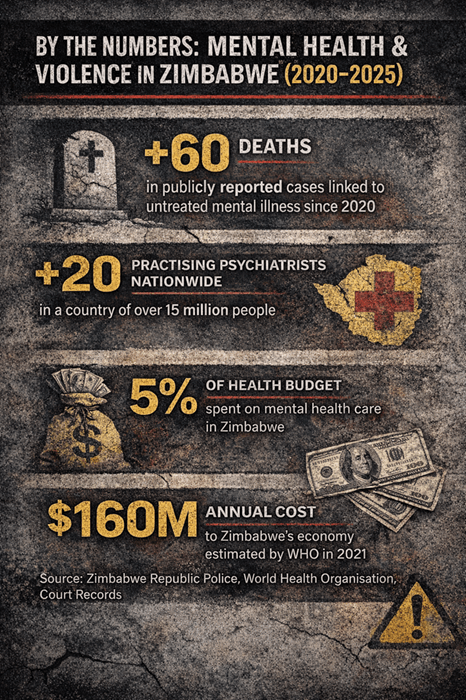
Based on incidents explicitly linked to mental illness by police, courts, or credible medical evidence, more than 60 people have been killed in Zimbabwe since 2020 in cases where severe mental health conditions, psychosis, hallucinations, or findings of mental incapacity featured prominently.
The true figure is almost certainly higher, as many cases are never publicly framed through a mental-health lens. A medical doctor said it is possible that many cases of infanticide by women suffering from post-natal depression are not discovered and accounted for. The doctor said if the manner of killing does not leave obvious trauma signs, most medical centers do not carry out postmortem examinations.
A pattern of brutality and multiple victims
One of the most striking features across these cases is not only their frequency but also their severity and scale. Several incidents involved multiple victims, often family members or people known to the perpetrator.
Earlier in August 2025, a man described by police as a mental patient killed five people in Madlambuzi, Matabeleland South, ranging in age from a small child to a centenarian. In Nkayi, two young children died in a murder-suicide involving a parent already known to have mental health challenges.
These are not isolated to one year. In January 2023, former police detective Jaison Muvevi went on a shooting spree across multiple towns, killing several people, including a police officer. His trial stalled for nearly two years after doctors ruled him mentally unfit to stand trial, with proceedings only resuming in late 2025.
In 2022, alleged serial killer Bright Zhantali, accused of murdering more than 20 women across several provinces, was committed to a psychiatric institution after the court raised concerns about his mental state.
Family-based killings have been a recurring and particularly distressing feature. In Buhera in 2023, a mother killed one of her infants at a prayer shrine after reportedly claiming she had heard voices instructing her to do so. In Chiredzi, a medical doctor accused of killing two of his children was judged unfit to stand trial after expert evidence pointed to psychosis and severe mental illness.
Police and court send consistent message
What distinguishes many of these cases is the consistency of official language. Police have increasingly referenced mental illness not as an afterthought, but as a central factor. In both the Guruve and Madlambuzi cases, police explicitly urged families to seek early medical intervention and monitor relatives exhibiting violent or erratic behavior.
Courts, too, have repeatedly relied on psychiatric assessments, ruling suspects unfit to stand trial and ordering treatment rather than prosecution. While this reflects adherence to the Mental Health Act, it also exposes a deeper systemic problem: by the time individuals enter the justice system, the damage has often already been done.
Related Stories
A system overwhelmed by need
According to the World Health Organization, Zimbabwe has only three psychiatric hospitals, a handful of psychiatric units in general hospitals, and fewer than 20 practicing psychiatrists in the public sector for a population exceeding 15 million. Most are based in Harare, leaving rural communities effectively unserved.
WHO estimates show mental health conditions cost Zimbabwe more than US$160 million annually, largely through lost productivity, while mental health receives well under one percent of the national health budget. The result is a system geared toward crisis response rather than prevention.
In many communities, families are left to manage severe mental illness alone, often without medication, counselling, or follow-up care. In this vacuum, cultural and religious explanations frequently dominate.
Across multiple cases, families reported turning first to spiritual or traditional interventions, sometimes cycling through prophets, prayer shrines, or healers before seeking medical help. While faith remains central to Zimbabwean life, mental health professionals warn that psychosis, severe depression, and schizophrenia cannot be resolved through spiritual intervention alone.
Delayed treatment allows conditions to worsen, increasing the risk of violent episodes, particularly when compounded by substance abuse.
Drugs, homelessness and visibility of crisis
Police and health practitioners have also linked several violent incidents to drug abuse, which can intensify paranoia and aggression in individuals with underlying mental illness.
Meanwhile, Zimbabwe’s towns and cities are seeing growing numbers of homeless mentally ill people wandering untreated, exposed to drugs, violence, and exploitation. They are both victims of systemic neglect and, in some devastating cases, perpetrators of violence.
A rising public safety issue
The cumulative picture from 2020 to 2025 is stark. Mental illness in Zimbabwe is no longer a marginal health issue but has become a public safety concern, intersecting with crime, homelessness, substance abuse, and family breakdown.
Police warnings, court rulings, and health data are converging on the same conclusion: early intervention saves lives. Ignoring warning signs, hiding illness at home, or relying exclusively on non-medical solutions carries consequences that can be fatal.
As the country reflects on yet another year marked by preventable tragedies, the question is whether Zimbabwe is willing to treat the mental health crisis with the urgency it demands.








Leave Comments