








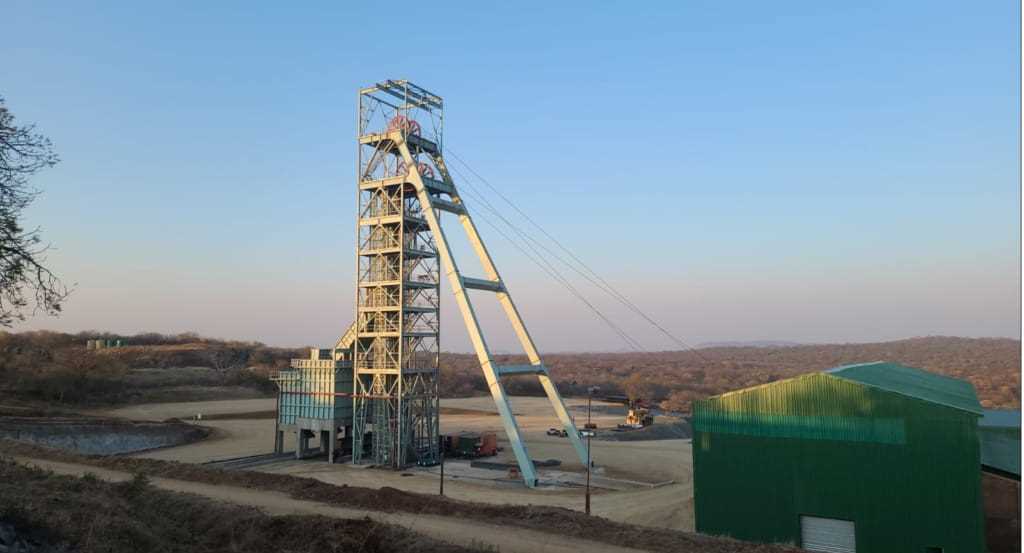
Caledonia Mining Corporation’s first-half results reveal a widening gap between Zimbabwe’s strong gold-price environment and the underlying production performance at its Blanket Mine, with higher bullion prices lifting earnings even as gold output fell 19% and all-in sustaining costs surged by more than half.
The company reported US$48.9 million in profit after tax for the six months to June 30, 2026, up 41% from US$34.8 million in the same period last year, while revenue increased 17% to US$142.3 million.
But the stronger financial performance was not matched by production growth.
Blanket produced 32,127 ounces during the first half, down from 39,741 ounces in the comparable period, while gold sold declined 21% to 31,594 ounces from 39,875 ounces.
The difference was largely made up by the higher price of gold.
Caledonia’s average realised gold price rose 48% to US$4,502 an ounce during the first six months, from US$3,045 an ounce a year earlier. In the second quarter alone, the realised price was US$4,259 an ounce, 34% above the US$3,186 recorded in the second quarter of 2025.
The figures therefore point to a central challenge for the mine: profitability is currently being supported substantially by exceptionally strong gold prices while the operation works to reverse weaker grades and lower production volumes.
Chief Executive Officer Mark Learmonth acknowledged the operational recovery during the second quarter but said the company still had work to do.
“The second quarter represented a significant improvement in operating performance across the business,” Learmonth said.
Gold production at Blanket increased 18% from the first quarter to 17,360 ounces, supported by improved access to higher-grade mining areas.
However, second-quarter production remained 18% below the 21,070 ounces produced during the same period last year.
The underlying production numbers are even more revealing. Ore broken during the quarter fell 15% to 210,200 tonnes, while ore hoisted declined 8% to 205,900 tonnes. Although ore processed increased slightly by 2% to 208,100 tonnes, the average feed grade fell from 3.4 grammes per tonne to 2.9g/t.
For the first six months, the average grade fell 18%, from 3.2g/t to 2.6g/t.
Gold recovery also slipped from 93.8% to 92.4% during the six-month period.
That combination explains why the mine has had to spend more to produce each ounce. On-mine costs increased 47% to US$1,704 an ounce in the first half, while all-in sustaining costs jumped 51% to US$2,715 an ounce.
The company has consequently raised its 2026 AISC guidance to between US$2,500 and US$2,700 an ounce, from the previous US$2,100-US$2,300 range.
Caledonia attributes part of the increase to costs that it says do not reflect core operating activity, including US$3.2 million in employee dividends linked to the 10% ownership of Blanket by an employee trust, US$4 million in advisory fees associated with fundraising, and US$3.2 million in higher royalties resulting from the higher gold price and increased royalty rates on shipments realising more than US$5,000 an ounce.
But even after adjusting for those items, management acknowledged that lower grades remain a major factor behind the increase in cost per ounce.
Learmonth said: “On-mine and all-in sustaining costs per ounce remained high in the six months to 30 June but include substantial costs which do not reflect core operating activities.”
He added that, after adjusting for those costs, “the residual increase in cost per ounce was due entirely to the lower grade.”
The financial results nevertheless remain strong.
Gross profit increased 17% to US$71.3 million, EBITDA rose 29% to US$79.7 million, and basic earnings per share increased 44% to US$2.16.
Net cash generated from operating activities rose from US$41.3 million to US$47.8 million.
However, free cash flow moved in the opposite direction, falling 29% from US$42.4 million to US$30.2 million, illustrating the increasing capital requirements of maintaining and expanding the operation.
Related Stories
Caledonia ended June with US$167.8 million in net cash and cash equivalents, compared with just US$8.2 million a year earlier. The improvement was significantly influenced by financing proceeds, including the US$145.1 million net proceeds from convertible senior notes issued during the first half.
The balance sheet therefore provides the company with considerable room to finance its expansion plans, but the next test will be whether that capital can translate into sustained increases in physical production rather than merely stronger financial results during a high-price gold cycle.
Blanket is targeting 72,000 to 76,500 ounces for the full year, meaning the mine produced only about 44% of the lower end of its annual target in the first six months.
Management expects the second half to be stronger.
The introduction of a seven-day working week in June is expected to increase production from September, when the company plans to process an additional 200 tonnes of ore a day.
Learmonth said the change, together with better access to higher-grade ore and an upgrade to the elution plant, should strengthen output.
“The successful introduction of our seven-day working week in June marks another important milestone and is expected to increase production from September 2026, when we intend to start to process an additional 200 tonnes per day,” he said.
The company is also increasing sustaining capital spending at Blanket, with management expecting the investment to support production above current guidance from 2027.
The revised 2026 group capital expenditure programme stands at US$103.3 million, down from an earlier US$178.9 million estimate. Of the revised figure, US$48 million is earmarked for sustaining capital at Blanket, US$3.5 million for Blanket growth capital, US$48 million for Bilboes, and US$3.8 million for Motapa exploration.
The reduction in the Bilboes allocation does not represent a reduction in the project’s scope or timetable, according to the company, but reflects the timing of payments for long-lead equipment.
Bilboes is potentially the more consequential part of Caledonia’s longer-term growth strategy.
The company has raised US$130 million through convertible senior notes and is pursuing a US$150 million interim facility from Zimbabwean commercial banks, alongside a US$300 million limited-recourse project finance facility.
More than 50% of the targeted US$150 million commercial-bank facility has already received credit approvals from the two lead arrangers, while prospective lenders for the US$300 million facility are conducting due diligence.
The first physical work at Bilboes is expected to begin in October with contractor accommodation and associated infrastructure.
Meanwhile, exploration is adding another layer to the company’s growth prospects.
At Motapa, drilling has confirmed mineralisation across approximately six kilometres of strike, with a maiden mineral resource estimate expected in the third quarter.
At Blanket, exploration at the K-Pits area identified significant oxide and sulphide mineralisation approximately 200 metres from existing mining infrastructure. Caledonia plans a resource estimate and potentially a trial mining and heap-leach programme in the fourth quarter.
But these projects remain future opportunities rather than current production.
Blanket’s immediate challenge is converting improved access to higher-grade areas into sustained production growth while containing costs.
The contrast between the first-half production figures and financial results illustrates the importance of that task. Gold sold fell by more than 8,000 ounces year-on-year, yet revenue rose by US$20.9 million because the realised gold price increased by US$1,457 an ounce.
That provides a powerful earnings cushion, but it also leaves the operation exposed to the other side of the commodity cycle if gold prices weaken before production and grades recover.
Caledonia’s own guidance reflects this tension: it expects a stronger second half, while acknowledging that the higher sustaining capital being deployed now is intended to improve production from 2027.
Learmonth said: “With improving operating momentum, a strong gold price environment and several growth opportunities advancing across the portfolio, we remain confident in Caledonia’s outlook.”
For Zimbabwe, where gold remains one of the country’s most important sources of foreign currency, the distinction matters beyond Caledonia’s shareholders. Higher international gold prices can boost mining revenues, but sustainable growth in export earnings ultimately depends on increasing production, maintaining recoveries and controlling the cost base as ore grades change.






Leave Comments