






Zimbabwe's civil society organisations are confronting what their umbrella body describes as an increasingly hostile operating environment, as shrinking international funding, tighter regulation and economic instability force hundreds of organisations to rethink how they survive.
The National Association of Non-Governmental Organisations says the suspension of several United States Agency for International Development-funded programmes, alongside the implementation of the Private Voluntary Organisations Amendment Act and new data protection requirements, has fundamentally altered the operating environment for organisations providing humanitarian, governance and development services across the country.
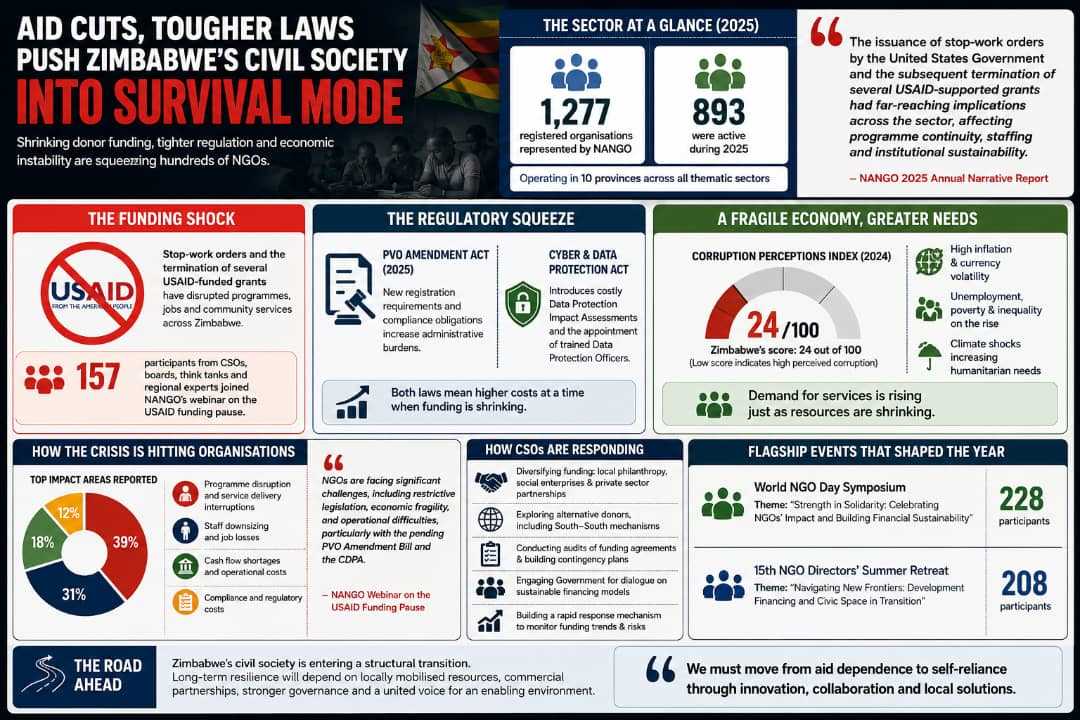
The association, which represents 1,277 registered organisations, of which 893 were active during 2025, says the sector is being squeezed from multiple directions at once: declining donor support, rising compliance costs, macroeconomic instability and increasing demand for community services.
Its 2025 Annual Narrative Report notes that Zimbabwe's broader economic environment remains fragile, characterised by inflation, exchange rate volatility and limited fiscal space, while governance concerns continue to weigh on development efforts. The report notes Zimbabwe scored 24 out of 100 on the Corruption Perceptions Index, arguing that corruption and illicit financial flows continue to undermine development financing.
Against that backdrop, the withdrawal of United States Agency for International Development support has created an additional shock.
"The issuance of stop-work orders by the United States Government and the subsequent termination of several USAID-supported grants had far-reaching implications across the sector, affecting programme continuity, staffing and institutional sustainability," the report states.
Rather than presenting the funding crisis as temporary, the association argues it exposes structural weaknesses within Zimbabwe's civil society financing model, where many organisations remain heavily dependent on external donors.
To assess the impact, the association convened a specialised webinar on the United States Agency for International Development funding pause attended by 157 participants, including civil society leaders, board members and regional experts.
Related Stories
According to the report, the meeting sought to examine "the far-reaching consequences of the funding freeze" while exploring practical ways organisations could continue operating under growing financial uncertainty.
The discussion concluded that the funding freeze was arriving just as organisations were already grappling with expensive compliance obligations introduced through the Private Voluntary Organisations Amendment Act and the Cyber and Data Protection Act.
The report warns these legal changes have introduced "new regulatory burdens, such as costly Data Protection Impact Assessments and the appointment of trained Data Protection Officers", increasing operational costs for organisations whose funding base is already shrinking.
Instead of calling simply for more donor funding, participants argued the sector must fundamentally change its financing model.
The report says organisations recommended "diversifying funding sources by establishing local philanthropy models, investing in social enterprises, and fostering private sector partnerships," while also strengthening links with alternative donors, including South-South financing mechanisms.
Participants further recommended comprehensive audits of funding agreements, contingency measures to reduce job losses, structured dialogue with Government on sustainable financing and the establishment of "a rapid response mechanism" to monitor funding trends and prepare organisations for future financial shocks.
The association argues the pressures extend beyond donor funding.
It says high unemployment, widening poverty, deteriorating mental health, climate shocks and growing inequality are increasing demand for civil society interventions precisely when organisations have fewer resources to respond.
The funding crisis also dominated the association's flagship events during the year. At the World Non-Governmental Organisation Day Symposium, discussions centred on shrinking civic space, declining donor funding and the need for innovative financing models capable of sustaining local organisations beyond traditional aid.
Later, the 15th Non-Governmental Organisation Directors' Summer Retreat, concluded that organisations must urgently diversify revenue sources, strengthen internal resource mobilisation and deepen collaboration with Government and the private sector as conventional development financing continues to contract.




Leave Comments