




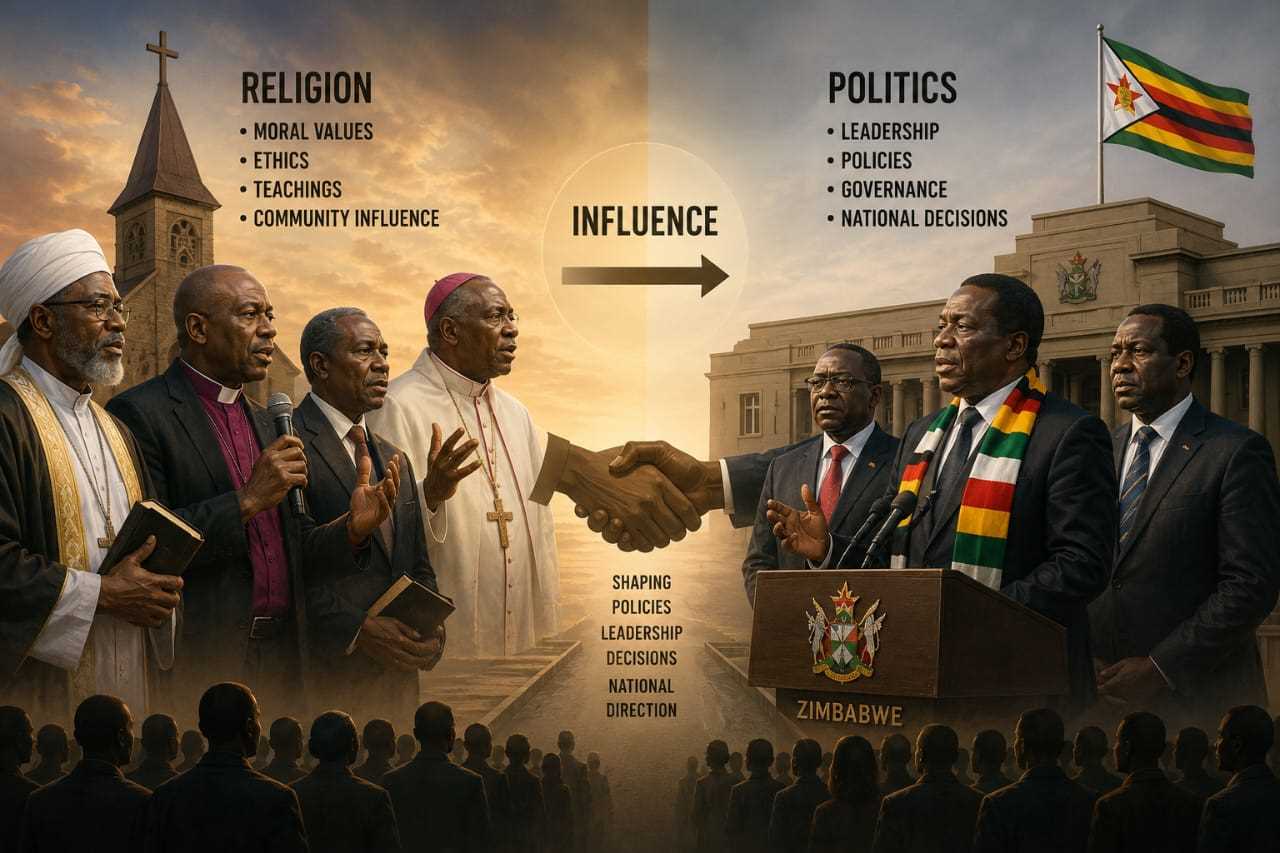
Zimbabwe, politics is often debated not only in Parliament, party headquarters and social media spaces, but also from church pulpits, prayer mountains and prophetic platforms where religious leaders routinely make predictions about constitutional changes, leadership transitions, economic crises and national upheavals.
Religious leaders command audiences that often exceed those of political parties. Their messages shape conversations within families, communities and online spaces.
During periods of major political debate such as the ongoing contestation around CAB3, prophetic interventions can influence how supporters and opponents alike interpret unfolding events.
As debate intensifies around the proposed extension of President Emmerson Mnangagwa's tenure through Constitutional Amendment Bill No. 3, prophecies predicting political turbulence, leadership changes and national transformation are once again dominating public discourse.
From mainstream Pentecostal figures to independent prophets and apostolic leaders, Zimbabwe's religious landscape has become an influential arena where political futures are forecast, contested and interpreted.
The phenomenon is not new. What has changed is the frequency, reach and political significance of prophetic declarations in an era shaped by social media, economic uncertainty and heightened political polarisation.
In recent months, a growing number of prophets have issued warnings about political instability and major national shifts. Among them is Obey Tichafa Mukanhairi, who recently claimed to have foreseen "a season of political commotion" in Zimbabwe, warning of discord, factionalism and social tensions.
"Let's all pray, I see upon Zimbabwe a season of political commotion coming ahead, I saw discord," Mukanhairi said.
His warning was accompanied by predictions concerning political developments across Africa, social unrest in South Africa, political changes within an unnamed African nation and increased global uncertainty.
Similarly, Solomon Gwashavanhu recently issued a message he described as a warning to Zimbabwe, linking future national events to issues of governance, social justice and leadership accountability.
"After 17 days, a wind shall blow. The Lord says: Change your ways, Zimbabwe, or what will happen next cannot be reversed by prayer but only by true change."
Gwashavanhu further claimed to have seen events stretching into 2027, suggesting that significant political developments lie ahead.
Such messages have found fertile ground in a country where religion and politics have long been intertwined.
Zimbabwe's fascination with political prophecy predates independence. One of the most cited examples remains the prophecy attributed to indigenous church leader Mudzidzi Wimbo in 1957. According to church tradition, Wimbo foretold that independent Zimbabwe would be led by a man bearing the name of an angel.
When Robert Gabriel Mugabe became the country's first post-independence leader in 1980, many believers interpreted the prophecy as fulfilled.
Political scientist Eldred Masunungure has previously argued that prophetic narratives often gain legitimacy retrospectively, with believers connecting historical events to earlier religious pronouncements after the fact.
Throughout Mugabe's rule, numerous prophets attempted to predict political succession, often with mixed results. However, the role of prophecy became particularly visible during the dramatic events of November 2017 when military intervention ended Mugabe's 37-year rule.
Several religious leaders subsequently claimed they had foreseen the transition.
Followers of Malawian preacher Shepherd Bushiri frequently cite a 2016 prophecy in which he allegedly predicted that then Vice President Kembo Mohadi would receive a "crown", interpreted years later as a sign of political elevation.
Meanwhile, reports at the time suggested that followers of prophet Mudzidzi Wimbo viewed Operation Restore Legacy as fulfilling earlier warnings that the military would become involved in politics.
The political transition reinforced public perceptions that prophetic declarations could provide insight into national events before they occur.
Over the years, Makandiwa has made several widely discussed predictions touching on Zimbabwe's economy, politics and future development trajectory.
Among his most notable pronouncements was a 2015 prophecy concerning the discovery of oil deposits in Zimbabwe. His followers also point to warnings he allegedly made regarding currency instability, leadership crises and demonstrations.
One of his most debated predictions involved a poisoning attempt against a senior political figure. Months later, then Vice President Mnangagwa became seriously ill at a ZANU PF rally in Gwanda, an incident supporters cited as validation of the prophecy.
Makandiwa has also repeatedly claimed to know the identities of Zimbabwe's future presidents, although he has never publicly disclosed their names.
Related Stories
Another influential voice is Dr Ian Ndlovu, whose recent messages have attracted attention for linking Zimbabwe's current trajectory to major historical turning points.
Ndlovu has reportedly described the period around 2026 as a significant national milestone comparable to 1980, a statement that has fuelled speculation among followers about possible political and economic transformations.
His calls for prayer and intercession against negative political outcomes have resonated strongly among religious communities concerned about the country's future.
The resurgence of political prophecy is occurring at a particularly sensitive moment in Zimbabwe's political landscape. The debate surrounding CAB3, which critics argue could fundamentally alter constitutional provisions governing presidential terms and electoral processes, has generated intense political contestation. Opposition figures, civil society organisations and constitutional experts have warned that the proposal could reshape Zimbabwe's democratic trajectory, while supporters argue it is necessary for policy continuity and governance stability.
It is against this backdrop that prophecies concerning political turbulence, transitions and national shaking have gained renewed prominence. For many believers, such predictions are interpreted through the lens of ongoing constitutional and political debates, particularly as questions surrounding succession, governance and political legitimacy increasingly dominate public discourse.
Political analysts argue that many contemporary prophecies function less as supernatural forecasts and more as coded forms of political commentary.
Political analyst Rejoice Ngwenya has previously observed that Zimbabwean prophets often reflect prevailing public anxieties rather than introducing entirely new political narratives.
"When people are facing economic hardships, political uncertainty and governance challenges, prophets naturally become vessels through which those fears and hopes are expressed," he said in previous public discussions on religion and politics.
Similarly, University of Zimbabwe political scientist Professor Charity Manyeruke has argued that churches remain among the few institutions capable of articulating social concerns to large audiences across political divides.
This dynamic gives prophetic messages unusual influence.
Unlike conventional political analysis, prophecies derive authority not from evidence or polling data but from perceived divine revelation. This often makes them more emotionally compelling and resistant to scrutiny.
As a result, prophetic declarations can rapidly shape public expectations, particularly during periods of uncertainty.
The influence of prophecy has expanded significantly through digital platforms. Where prophetic messages were once confined to congregations, they now circulate instantly through Facebook, WhatsApp, YouTube, TikTok and X.
A single sermon predicting political change can reach hundreds of thousands of viewers within hours.
Mukanhairi himself acknowledged this dynamic when warning that social media could contribute to political upheaval if citizens share inflammatory information without verification.
"Social media, if not utilized judiciously, can lead to political upheaval, as citizens share inflammatory information without scrutiny."
Political communication researchers note that social media has transformed prophets into influential opinion leaders whose messages increasingly compete with traditional news sources.
This has blurred the boundaries between religious discourse, political commentary and information dissemination.
The enduring appeal of political prophecy cannot be understood solely through religion. Zimbabwe has experienced decades of economic instability, contested elections, hyperinflation, currency reforms and abrupt political transitions. In such environments, uncertainty creates demand for explanations and forecasts.
For many citizens, prophetic messages offer a framework for interpreting events that appear unpredictable or beyond their control.
Religious scholar Ezra Chitando has argued that African prophetic movements often thrive during periods of social and economic distress because they provide both meaning and hope.
In Zimbabwe, where trust in political institutions remains fragile, prophets frequently occupy a unique space between spiritual leaders, social commentators and informal political analysts.
The challenge, however, lies in measuring prophetic accuracy.
While followers often celebrate fulfilled predictions, critics point out that many prophecies are broad, symbolic or open to multiple interpretations.
Political analyst Rashweat Mukundu argues that confirmation bias frequently influences public perceptions.
"People tend to remember predictions that appear accurate and forget those that never materialise," he noted during previous discussions on religion and governance.
This creates an environment in which prophetic reputations can survive even when many forecasts prove incorrect.




Leave Comments