







ZB Financial Holdings weathered Zimbabwe’s restrictive monetary environment in the first quarter of 2026 with growth in transaction fees, insurance revenue and property income helping cushion pressure from weakening lending activity, highlighting how banks are increasingly relying on non-funded income streams to survive high interest rates and liquidity constraints.
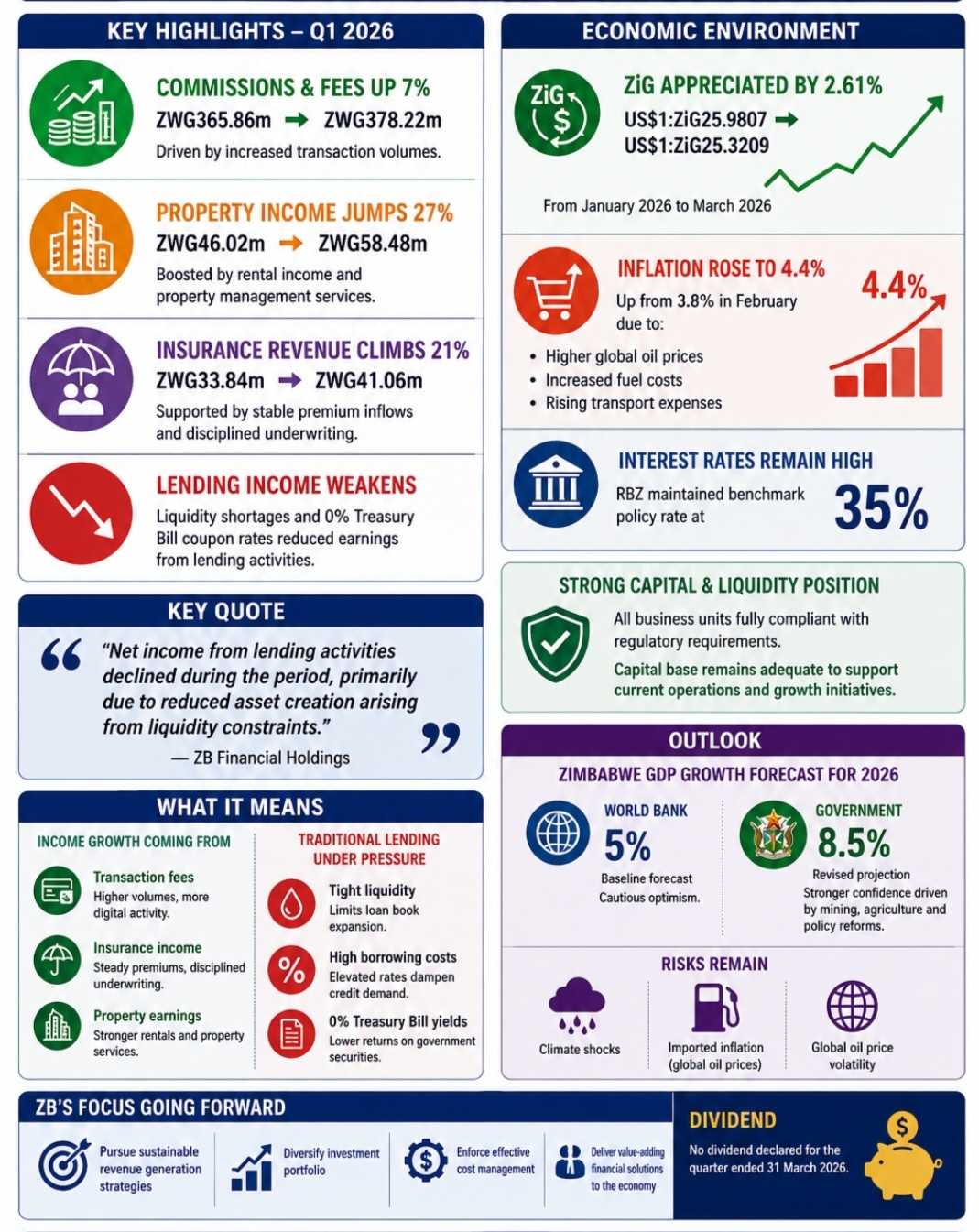
The Zimbabwe Stock Exchange-listed financial services group reported a 7% increase in commissions and fees to ZWG378.22 million for the quarter ended 31 March 2026, driven by increased transaction volumes as customers continued shifting towards digital and transactional banking services.
Insurance revenue also rose 21% to ZWG41.06 million, while property income climbed 27% to ZWG58.48 million on the back of higher rental income and expanded property management services.
However, beneath the positive topline growth, the group’s trading update revealed mounting pressure on traditional banking operations, particularly lending activity, as tight liquidity conditions and restrictive monetary policies squeezed credit creation across the sector.
“Net income from lending activities declined during the period, primarily due to reduced asset creation arising from liquidity constraints within the Group’s banking operations,” ZB Financial said in its trading update.
The group also attributed the decline to the maturity and reissuance of Treasury Bills at a zero percent coupon rate, a development that has significantly reduced earnings opportunities for banks that traditionally rely on government securities as low-risk income-generating assets.
The performance update offers a snapshot of the broader challenges confronting Zimbabwe’s banking sector as authorities maintain tight monetary controls aimed at preserving the stability of the ZiG currency introduced in April 2024.
During the quarter under review, the ZiG appreciated by 2.61% against the United States dollar, strengthening from US$1:ZiG25.9807 in January to US$1:ZiG25.3209 by the end of March.
Related Stories
Despite the currency gains, annual inflation accelerated to 4.4% in March from 3.8% in February, driven largely by imported inflation linked to rising global oil prices and increased domestic transport costs.
In response, monetary authorities maintained elevated interest rates and strict liquidity controls under the 2026 Monetary Policy Statement.
“These are not easy decisions. They are tough, but they are necessary,” Finance Minister Mthuli Ncube said recently while defending the Reserve Bank of Zimbabwe’s tight policy stance.
Against that backdrop, ZB Financial said it remained fully compliant with all regulatory requirements and maintained strong capital and liquidity positions throughout the quarter.
“The capital base remains adequate to support current operations and planned growth initiatives,” the group said.
Despite sustained calls from industry for lower lending rates to stimulate productive sector activity, the Reserve Bank has maintained the benchmark policy rate at 35% to contain inflationary risks and protect currency stability.
“Notwithstanding ongoing risks related to climate shocks and imported inflation pressures, particularly from elevated global oil prices, the Group remains resilient and committed to delivering value-adding financial solutions to the Zimbabwean economy,” the company said.
The group added that it would continue pursuing sustainable revenue generation strategies, portfolio diversification and tighter cost management measures as it adapts to Zimbabwe’s evolving macroeconomic and regulatory environment.
Zimbabwe’s economic growth projections for 2026 currently range between 5% and 8.5%, with government pinning hopes on stronger mining and agricultural output to support broader economic recovery.





Leave Comments